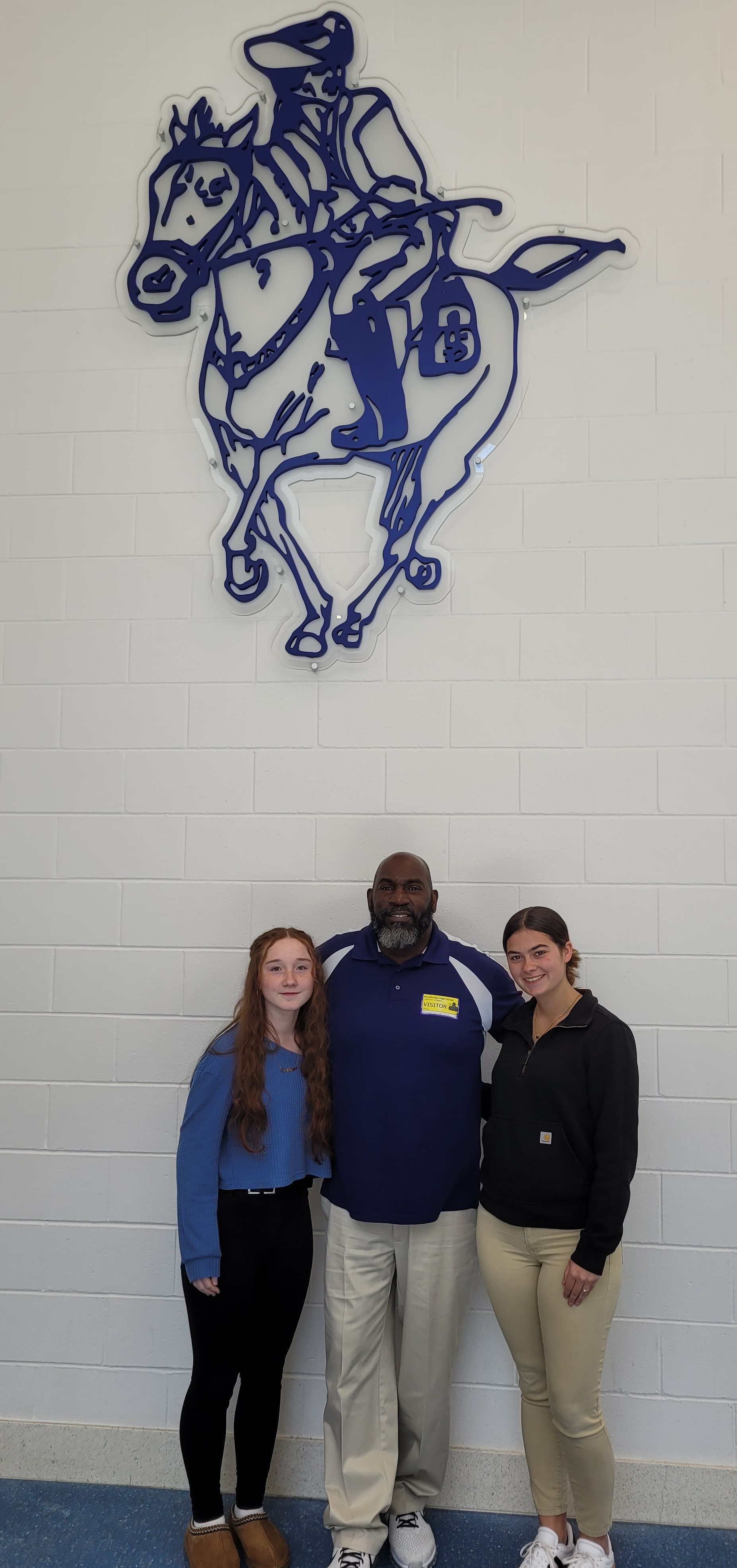
The rush of the final weeks is upon us. No matter what high school you find yourself, the rush of the end of the year does not get any easier. And yet, there should be moments where reflection on where we have come and where we are headed add to these moments.
Without a doubt the pockets of success and capability are a blessing at Woodbridge High School. Irene and Kayleigh as DIAA scholar athlete s well as the Woodbridge School Board student representative are one such example – the moving and deep seeded speech at Baccalaureate from Madison, the amazing strides so many students have made in representing student voices at legislative halls and leadership conferences with our Senators, Congresswomen, State Representatives, our school library circulation of resources this year nearing 3800 total from a mere 1100 ish last year, 7 total published young authors in 2024-2025, receiving over 350 new books this year from grants and applied-to programs, holding a state library Professional Development from the library as well as a state Festival of Words with over 13 amazing authors ( in our community and as far away as Washington D.C, New Jersey, etc.), WHS students combining with two other schools for legislative day at legislative Hall, fulfilling a tough schedule of over 20 podcasts with school board candidates authors, sponsors and more to come, students presenting their workshops at the Festival of Words, students from the Girls Who Code presenting at Festival of words, the only students presenting at the DLA/MLA Conference and that is just a FEW things that occurred after December 2024- there are SO many possibilities our students can have based on their talents.
One thing I continue to learn on a daily basis, is the power, motivation, and drive that may or might not be evident in the Class of 2025 graduates. This is the case in any school up and down our state. The very student you might think would be a challenge to accept or manipulate a leadership position in school, in the community, in sports, in academics, in areas you would not think, often those individuals ARE capable but definitely need to be reminded that they are quite capable of more than they know!
Celebrate these amazing pieces directed by Ms. Jones and Ms. Workman:
I absolutely, even though not done, HAD to get the amazing information and experience we had from this pre session tour. You will see why this is so connected and amazing to all disciplies!
Wednesday, May 7, 2025. BCMLA (Black Caucus of the Maryland Library Association (BCMLA)) on a Cultural tour of nearby Berlin, MD.
Some say hindsight is 20/20, but what about foresight? The Upward Bound program at Del Tech in Georgetown did just that with exploring the film on the Six Triple Eight on February 8th.
In February, students and myself, as well as others, delved into some amazing questions about this amazing piece of history that I never learned about, EVER, and was the first time I had been exposed to this piece of history.
THAT folks is why programs that delve into pieces of history that have missed so many are necessary to be exposed. How lucky is the program of Upward Bound (UBMS, Classic, and Talent Search) and able to bring such a topic to so many students, and then being now aware, see the connection occur a few months later and able to latch onto this connection? Organizations and groups that are able to inform, enlighten, and educate students where traditional curriculums miss whole sections of history, that impact and influence all races, all aspects of individuals that make up the United States are more important, now more than ever.
Names such as Charity Adams should have surfaced right along the names of Betsy Ross when I was growing up, but it is never too late to dig, not settle for a history that is traditional and go beyond traditional and inquire about the stories that often get buried, but need to resurface. It is exciting to revisit this topic that we encountered and were exposed to in February of this year, It is even more exciting to be historical archaeologists in discovering, publicizing, and representing histories that become new to us, even today. Sometimes the most overlooked moments in history are some of the most important, just waiting for us to discover, examine, and contemplate. To not have the opportunity to discover these actual moments in history that often get overlooked by the more traditional elements of history we have grown up with, is to miss whole histories that define us as Americans.
It is inspiring to know the Trio Program elevates students in higher thinking not just of themselves, and others, but about histories that define us as Americans. In an age where voices of youth are the voices that need to be heard to protect literacy, our histories, our differences, and our heritage, giving youth a place at the table of discovery is essential in defining who we are as Americans.
Just as in the classic tale of Cinderella had until midnight out of fear to have her true self revealed- could I possibly wrap up how the amazing first show of Cinderella impacted so many, before midnight?
I’m up for a challenge – it’s 10:46 PM – let’s get down to the plain truth and do this.
First, if you miss the next two days of this Cinderella production, you will never know how much value you missed.
Seriously. Hands down one of the best first night productions I have ever seen and I might have to say, my favorite production I have seen at Woodbridge High School. I heard this sentiment repeated many times in thew audience as I made my way out – do yourself a favor, bring your small friends, older friends, and newly made friends- all of you will walk away with a little bit of amazement in your step- 10000% worth it – and not overstating that fact.
I CANNOT tell you how many lines hit into the center of the heart in times today where so many are afraid to stand up for what they believe, live in fear of what others might think, are afraid of what their peers and family will think in disagreement, afraid of being true to themselves and true to being kind, and resisting being different over what is right. All that from this production of Cinderella? I never walked away with so much from this tale before, which makes this production ever more powerful.
Also, I have to admit, being School Library Week, and seeing so many of these cast members in the library space, sometimes at their very best and laughing, sometimes are some of their low points and crying and upset – it made me so proud to see them on stage but also to know they chose a space I was in as well to work out what they had going on at that time.
I have been to several schools the last few weeks where you walk into the library space and it is as plain and sterile as a operating room, and that says alot abut how much that space was intended for who- students? No. For adults who wanted a presentable space but not really to cater to the population intended for? – but I digress. It is amazing what the youth I saw on stage brought out in this production that can be applied to our lives. Another GREAT reason you should not miss this – personal and really powerful on a variety of levels. It means even more when I have been seeing the hours put in by so many – on this production, and assuming I knew what was coming with knowing it was Cinderella production and then REALIZING how different a message I received in watching it.
Phenomenal.
10:56 – Let’s break out some personalities.
Madison- All you need to see and hear is the emotion Madison is able to put forth and you think you are watching the second week run of this production. Whether you have seen Madison before, or the first time you have seen her in a production, her voice carries the very feeling she is assigned to portray on stage- and can carry you to the fairy tale at hand or to the reality of her presence on stage – but you will understand in seconds why she is Cinderella. I have had the advantage of hearing her laugh, (some true deep stomach aching laughs) and had the advantage of simply seeing her kindness and openness. It is refreshing to see someone as if you are seeing them for the first time on stage – but that is what makes Madison so talented- I could never see/hear enough of her on stage 🙂
Johnny- I would have to say years back I would not have expected Johnny to carry the roles he has carried, but carry them and lead them he does. His strength and boldness comes out full force on stage, and in the halls, you wouldn’t expect it just in seeing him in school. Yet, when you see him off stage and then on stage – it strengthens the image of what he is capable of even more. There certainly is strength in acting as well as conducting oneself in real life, and Johnny does both quite well. Very very refreshing to see such a talent in so many ways and see him shine in the way that he can do best.
Te’Neal – What can I say? Her boldness, outgoingness, and talent poured into this character make madame be exactly who you would want her to be as in a tale such as Cinderella. Coming off of JUST having her art piece as the cover if this year’s imazine presented the night before, and having her as a part of the student lobbying delegation to legislative hall this year with Madison and Carly, one realizes to take advantage of opportunity one must be willing to put yourself out there and not thing of consequences. Te’Neal does that in all she does, and hence, Madame is brought out past the stage due to the personality she brings to this production.
Cameron- Having seen Cameron before, he certainly can be the character you love to hate, dislike, and admire at the same time. Being able to bring emotions out from the audience to the person he is on stage is not as easy, not easy at all, as it sounds. Cameron normally, on a first night, would be just hedging that character role and yet, no. No “getting there but it is the first night” feeling, he brings the reality of Sebastian’s overbearing to light immediately and it pays off in the overall feeling he adds to this production.
Emerson – I have been lucky enough to have come to know Emerson and her family and having the pleasure of knowing her better and better gradually. The one thing I realized immediately on stage is that the power of her voice and talent when she is given the characters she has been given- matches the selflessness and quiet demeanor. But she will surprise you every time. Hands down she is one of those students that you pay yourself on the back and congratulate yourself for knowing and having had the chance to cross paths. Emerson is just overall a good hearted, talented individual and you can’t help but smile when you see her in costume (be it trick or treat, a production, or some other random reason). All you need to do is see her on stage once and you’ll understand – and her lines toward the end alongside her proclamation singing? – Amazing aspect of Cinderella.
Jaleya – Ever hear her sing at the sporting events? If not, well, YOU NEED to catch that! but it is hard to miss the enthusiasm she brings to this if you watch her from ball to crowd, to overall bustling among the community of cast- you get a sense of her being an active part of the production.
Rylee- Always ready to fool you into thinking she is a linger back kind of actor, she is not. When you hear the parts she contributes to and watch how she actively becomes a part of this production, it might seem subtle at first. Yet, watch her and listen to hr and you will pick up right away she brings much talent to any role she is placed in, and enhances the production quite easily when you see the parts she accents.
Robert- Part of realizing what a great contribution Robert plays is in knowing him. In talking with him and sensing his love of all things cooking, D & D and fantasy, writing, his creativity, all this just gained from the conversations we have had in the library- but in not having the luck of knowing that aspect of him, you still glean what part he plays. Watch his intensity and earnestness in every role you see him take on, dancing, part of the crowd, a merchant, and so many more – but he owns every role and brings them to life. It is exciting to see him being a part of this production, he adds ALOT of personality at every turn.
11:32 – I’ve got this because the cast is able to give me so much to say from their performance.
Onwards!
Abby and Carly- SUPERB! Not knowing these young ladies, they define the hilarity, obnoxiousness, and character that the sisters of Cinderella shadow. Knowing them, wow. Both are such strong young ladies in ways such as theatre, singing, art and more, and I could not be more proud of them – as they brought these and so many more talents to this production. It is funny knowing these students and then seeing them on stage with their know personalities and only adding to them, which they did to such a high degree. Abigail, absolutely hysterical and great to see the humorous parts I do not get to see every day and the tenderness and kindness Carly brings to her role matches what I see and she is capable of every day.
Tanner – WOW. Just WOW. He broke out of the quiet shell you always see in the library and really became a center of personality and breaking out boldly here. Kudos to him on the highest level, it was so exciting to see him take this role and then push it to the boundaries of endearment, laughter, contemplation, and representing the move towards standing up for things many choose to ignore. He did a MAGNIFICENT job and seemed to get only stronger and bolder as the production advanced.
Olivia- Holy wow! There are so many opportunities that exist that you get to see the full potential of aa great voice and the personality she can have. Sometimes it is easy to overlook her potential as she is reserved and insular, but there are SO MANY opportunities that you get to see what Olivia is capable of. She has come SUCH A LONG WAY on stage as well as academically, personally, and seeing her find her way through all these challenges, on and off the stage- is bittersweet but is something you can celebrate with her as she helps others find their way too in this production.
I have to tell you, Serenity from the ensemble told me ahead of time I was going to love this, and I thought, Cinderella, I mean, I am sure I am going to love it for knowing the students in it more than anything. Wellllll, that is part of it but also, the themes and messages dealt out the way the cast was able to personalize so much of this production, I loved it for even more reasons. Serenity always takes on that which she might have doubts about, and she did not disappoint at all. Love her boldness and determination.
I have to tell you, I am super proud of Allison in this production. I have seen this young lady roll through the various trials and obstacles that would put most people out of a daily ability to cope and she has done this and ten times more. Her energy, optimism, and ability in this production are impossible to overlook and miss and I am SO INCREDIBLY PROUD of what she brought to Cinderella and epitomizes what is possible you know what is right and are determined to see it through.
Isabel as part of the ensemble as well as just full of character, personality, and expression. This is her on a regular basis anyway and yet, she easily supports the power of this production with her amazing voice and ability no matter what her character would be. She has and does bring the energy and enthusiasm to the stage and you see it every time you watch her in the roles she takes on, on stage.
Speaking from experience, Adria is one of the strongest, most talented, and capable young ladies that Woodbridge has ever met. She is determined, and always exciting to see her involved in WHS productions. She pretty much defines the power a Raider has and it is awesome to know she is the very heart of many messages Cinderella sends out.
Brooke, from experience, is a talented and quite capable addition to Cinderella. Having been a part of the podcast interview crew from Steve Inskeep when he visited, she is quite capable of anything and is never been known to back away from a challenge. One sees her putting herself right in the middle of any task at hand and yep, she will come through with all colors as a result.
Shayla, Zaleigh, Keaton, Maya, Leonel, Gabby, Arianna, and Ethan, if you watch each one of them, are similar to lead roles in the way the conduct themselves. That is why they are part of this production. Watch them closely and you will see how the define the roles, themes, and messages Cinderella sends out- and each one of them is able to do this through their actions. This does not happen by accident!
As if these were not enough, the young cast of Cinderella is the icing on the cake. Harper, Cambree, Jeri, Myles, Brooklyn, Gabriela, Maddy, Janessa, Will, Ryan, Ashton, Teagan, Rhyann, Stevie, and Emmy, you help define the very purpose of Cinderella. Kudos to the amazing talent you brought.
So much more to say, BUT, midnight tolls. Now your turn to see what makes this stick with you beyond midnight and into 2025.
In attending the Lower Shore Land Trust Stewardship Training at the Snow Hill Library, 307 N. Washington St., Snow Hill, MD – it was easy to walk away with some of the most important things most people that live on the planet need to know, but don’t.
Staff Jared Parks and Franke Deuter have been seen at many a RALLY Conference, and their educational reminder that
-easements are not movements to be anti-development
-easements help assess land’s best suitability
-easements protect that land based on the characteristics that the land itself already contains within it’s habitat (think land whisperers)
-showing how losing over 102 acres over 25 years redefines how people look at sea rise and the term climate change
-Defining and breaking down land monitoring (OBSERVING AND NOT ASSESSING!)
All paint the picture of the difference between people claiming supposed facts about the land, versus the people willing to be out there on and among aspects of the land, to be the actual painters of what is happening with lands we call home. Politics does not play a role in the reality of the lands we live, work, play, and recreate in at the end of the day.
There is MUCH to learn in how we, as residents of the Eastern and Lower eastern shore respect the very land we hold so dear to our hearts, but what really counts is the action we are willing to put forth, as well as the willingness to reserve the time to make room for putting ourselves in the middle of such actions, to best protect and preserve that very land. Organizations like the Lower Shore Landtrust, The Nanticoke Watershed Alliance, The Nanticoke River Watershed Conservancy, The Sussex County Land Trust,The Nature Conservancy,The Sussex County Preservation Coalition, all might sound the same to you. But it is worth your time to spend time to go to each group’s site meetings, and events, and differentiate and define how each play a unique role in the environment and our state, as our state grows.
That is what separates myths and hypotheticals to the boots on the ground you can have for priceless aspects of what makes Delaware unique to visitors and those that call Delaware home.
Thanks to a generous gift giving to me at Christmas from a Woodbridge family, I found myself dining at Texas Roadhouse in Seaford. Keith Schaffer, the owner, was not a stranger, nor is he ever when he works. He makes a circuit around the restaurant and checks to see how your experience is and that speaks volumes and does not happen in all restaurants. Secondly, years ago when I worked and coached at Seaford High, he always always supported school initiatives for fundraising and being a long time community supporter- we have some amazing eating establishments in Seaford the reinforce the support needed from schools, he is one of them. Also – he continues to support so many of the students fromWoodbridge – seeing a multitude of them this evening, was actually pretty awesome! I know some people do not want to see students outside of school and yet, the conversations we had – pretty amazing.
From talking with Cody about his exciting discoveries in being a lineman and headed to Georgia after high school to Sianna who played a crucial role in building up our high school library collection in helping choose titles that would capture the interest of a wide ranging number of students- and she asked about them coming in while there this night) and hands down, one of the best servers there, Juli (yes an amazing Woodbridge High graduate as well) – she handled no less than 30 tasks at a time within 5 minutes and for years has been one of the most impressive servers, waitresses, bar managers and you name it) – the best word has been rewarding. The conversations and seeing how efficient these students are outside of school – in diverse ways in the way they communicate with everyone around them – is almost (ALMOST) as awesome as the food that is served with their conversations in your mind.
Did you know National Book Festival selections and titles are available on SORA?!
Doris Kearns Goodman, author of An Unfinished Love Story – interviewed in that link by David Rubenstein- was marvelous. Her opening story about her husband and his legacy through what she wrote (I will not spoil it for you) – is a story about how magical literacy is or can be.
A name dropped on stage also is a very important name – Clay Smith – and his role at the Library of Congress is pretty beyond a value for his contributions that therefore come out of the Library of Congress.
A Confident Cook by Tamaron Hall – I was unfamiliar with her and her show. In hearing her talk so passionately, how much literacy, librarians, books, had such an impact on her, as well as the value of the Library of Congress was easy to relate to if you have attended the Library of Congress National Book Festival.
With his platform of Books Build Us Up his three things he asked of readers- 1)Choose a book of someone that does not look like you, 2) Choose a topic you do not know about, 3)Choose a book that is published in a format that you would not usually never read. I love this challenge, and Gene Luen Yang is quite humorous.
In closing out the Opening Ceremony, Max Greenfield was THE PERFECT closer to this opening ceremony. Make sure you pay attention to the impersonations of his children when it came to reading and loved his humor of the fact that his books seemed to be about NOT reading, lol. His book Good Night Thoughts – I loved the portion he chose to read. Even more, love his word, implausible.
It is easy to see the formidable future could be viewed as implausible to be successful but what is often not figured in is the energy we can counter that implausibility. That is the power of literacy, represented in various formats, and I must ask – Who is more capable than we are? These speakers all challenged us to that ability.
An amazing mentor and inspirer of all things self and around us, Louis Cotto, photographer, writer, and entrepreneur that started so many amazing inspiring projects in Mexico City when I was blessed to be there, sent me this and I decided to comment on aspects of this following sections of this as I reacted to it. So many aspects of this struck home to me then, and now being away from the country where I was allowed to have time to think about the world around me amid so many rich influences.
Sent to me from Louis Cotto –
“Bro, I wanted to share with you this piece, keynote-speech, written by Dr. Hogan a frequent visitor on my program. It reminded me of those dedicated teachers I met in Mexico City like yourself and Hamilton.”
Dr. Michael Hogan for the Tri-Association Conference at Guadalajara, Oct 18, 2002.
Lost Lives and Impoverished Souls
Isn’t it strange that we call people from the European continent Europeans, people from the Asian continent Asians, and people from the African continent Africans, but the only people on the American continents who get to be called Americans are those from the United States? Also, people from Europe who immigrated to the U.S. such as my grandparents get to hyphenate their Americanism. There are Irish-Americans, or Polish-Americans and Italian-Americans. They have their own clubs and parades, their own feast days and holidays. Yet, those who come from the Americas whether Mexicans, Nicaraguans, Hondurans, Costa Ricans, El Salvadorans, are all referred to as Hispanics or Latinos. And it’s expected that El Salvadorians and Guatemalans, Cubans and Costa Ricans will all enjoy eating burritos and celebrating Cinco de Mayo.
WOW- this is SUCH a point so well stated. I realized how self-centered I was when I traveled and lived in Mexico starting 2017- and that is not an easy realization. I realized the way I viewed other countries, from my intake of what I thought was accurate news stories, to the way I perceived Mexico (and I am choosing Mexico because that is where I landed in 2017) had caused me rto actually lose so much intelligence about how other countries view the U.S. based on the way the U.S. views other countries – not sure if that makes sense) And all this truly sounds like a farse unless you are willing to pick up and immerse yourself into a situation that you are unfamiliar with. Many will never do this, and truly, doing this changed my perception of others, SO MUCH. For the better. And the expectations of myself when it came to viewing anyone, anywhere, outside of what I was most familiar with. Also, I am indebted to Mexico in this case for putting a WHOLE new, deeper meaningful spin on holidays that truly mean something more than a reason to PARTY in the U.S., and what those holidays meant to individuals from outside the U.S..
The poet William Stafford once wrote, “Though we could fool each other, we should consider, lest the parade of our mutual lives get lost in the dark. The signals we give should be real, because the darkness around is deep.” The signals we give should be real.” I believe here the poet means the language we use. Our language should, it goes without saying, be truthful. But it should also be precise. That is the first of our problems when discussing multiculturalism. The language has been politicized, compromised, before we even begin.
Don’t even get me started on how much I have seen politics and language, translate into misconstruing a culture, a region, a country, a belief, a people.
It is impossible to discuss culture, race, or even geography without precise language. So, the first step in a truly multicultural education is to examine the language and its implications.
I like this point as even from a colleague who has been discussing how valuable it is to teach writing and comprehension, to our students by making sure the vocabulary is there. It is an excellent point in research, you are going to teach someone to break down a paragraph, page and an essay assuming, ASSUMING they know the vocabulary contained within? Good luck on that one.
Let’s examine two terms, “Hispanic” and “Latino,” and see if they make any sense etymologically. “Hispania” is the Latin word for Spain and might be used to refer to anyone who resided in what was formally a Spanish colony. But Florida was once a Spanish colony and so was Texas and we don’t call the people from those states” Hispanics” based upon historical geography. Yet, we DO call people from Honduras, Hispanic, and they live in a former British colony. What’s going on here? Well, you say, perhaps it refers to the dominant language of the region. If that’s the case why people from Brazil are called Hispanics? They speak Portuguese. People from Haiti speak French and people from Belize speak English. Hmm. Well, perhaps Hispanic refers to blood line. People who have some Spanish blood. Again, what about Brazilians who have none? What about Argentines? More than half the population are either of German or Italian descent. There is no consistently rational basis in either geography, history, race or language for calling people from Mexico, Central America, the Caribbean and South America Hispanic. The reasons are simply political and the practice is unique to the United States. So, let’s use another common term instead with which we should have fewer problems. How about Latino? The etymology of that word seems obvious, but in fact the word does not appear in any dictionary prior to the1980s. The assumption is that it is based upon the language spoken. Thus, anyone who spoke a Romance language, that is, a language derived from Latin might be called a Latino. But we don’t refer to Jean Paul Sartre as a Latino philosopher, although French is a Romance language. We don’t refer to Nadia Cominiche as a Latina gymnast although Romanian is a Romance language.
The terms are political and reductive, that is to say they reduce unique cultures and the people from those cultures to easily quantifiable entities. In addition, the terms are largely of U.S. origin and usage reflecting a solypsistic–that is, a self-referential–definition of culture. We make a major mistake in education when we confuse political terms with social, ethnic and cultural ones. Recently New York Magazine put out a special Latino issue. The issue referred to the “Latin explosion” in culture in the U.S. It featured articles on Selena, the singer, the actress Jennifer Lopez, the actor Edward James Olmos, the singer Ricky Martin, the novelist Junot Diaz, there were features on Keith Hernandez,Chita Rivera, and Daisy Fuentes. But in the entire issue no mention was made of Mexico, Puerto Rico, Cuba, Colombia, or the Dominican Republic. Could you imagine an article on Brendan Behan, or Angela’s Ashes or even the rock group U-2which did not mention Ireland? Could you imagine an article on Michael Caine or the Beatles or Princess Dianawhich did not mention England? Latinos are a statistical formulation for consumer ethnicities, a broadly circumscribed group which are little more than a target for specialized consumption.
In reading the above, I found the following example.
What I realize also is this – it is interesting how I am realizing pieces on information and discussion seem to be conveniently left out when discussing topics, when it comes to the United States’ way of absorbing/dissecting news or information. Meaning, an individual is not taking in the full, complete topic of any news article until you look at it from all lenses, NOT just a lens that you are most familiar with. In doing so, you are missing truly a complete understanding or picture of any topic. Realizing this supports a new way of seeing and absorning information not only about yourself, but about others, and it I feel the fuel that drives some of the best creative writing and nonfiction as well.
I have not even touched upon the most interesting of all the politically correct terms. That is the term “Native American.” Logically that should refer to the indigenous people of the Americas. Thus, Mayans are Native Americans, Incas are Native Americas, along with Huicholes and Micmacs. Is that correct? Mayans are Americans but Guatemalans are not. Huicholes are Americans but Mexicans are not. Micmacs are Americans but Canadians are not. Clearly not entomology, not reason, not geography, not race, not language, and not even common sense support the nomenclature currently used in the United States. It is self-referential, solipsistic, absurd and as antiquated as the use of miles, quarts, and Fahrenheit instead of the universally accepted metric system of kilometers, liters and Celsius. But it is potentially more dangerous than being simply out of step with the rest of the world and its language for measuring reality. This language reduces interesting complexity to absurd simplicity, multiculturalism to racial categories, and geographical diversity to a narrow nationalism. Should anyone doubt that the categories are racial and political I refer them to Newsweek magazine which coined the term “the browning of America” to refer to recent immigration trends, a phrase the New York Times promptly repeated. Neither editorialist aware, obviously, that the Americas have been rather brown for the past four thousand years long before Christopher Columbus arrived.
I am so glad the terms Native American were touched on. Again, I was blessed to be part of an Indigenous Seminar study in Salisbury the past summer that analyzed the lack of history and recognition to terms when used – and applied – to individuals and societies that existed LONG before anyone we know inhabited the eastern shore. This parallels the excellent points made above. It has always been humbling and eye opening to see what I thought I knew, was affected by the way I was always instructed to think about something. That certainly does not make it correct until you example the whole topic and consider views of a topic. Common sense and politics? Since when have those two ever start being cordial?
There is a famous story by D.H. Lawrence which explores the relationship between two kinds of people. One is a lawyer from the city, named Bertie. He is educated, formal, reserved, rejecting out of hand those who attempt to get too close. The other character, Maurice, is a blind man, a farmer, slow, primal, but satisfied with the physical life. The lawyer visits the farmer to discuss some matters with him. The blind man, after talking with the lawyer for a while, says, “I don’t really know you, do I? Would you mind if I touched you?” And he begins to touch the lawyer’s cheeks, the nose, the lips, and the forehead with sensitive hands. The lawyer, D.H. Lawrence tells us, is “almost annihilated” by this intimacy. Then the blind man asks the lawyer to touch him. And, quivering with revulsion, the lawyer touches the scarred face; presses his fingers upon the disfigured eye sockets. When he is finished, the blind farmer is delighted. “Now we know each other!” he exclaims. He feels that the two have become friends. The lawyer, however, is devastated. He is, according to D.H. Lawrence, “like a mollusk whose shell is broken.”
The difference between the reserved, introspective, enervating isolation of modern life and the instinctual, physical, unrestrained passionate life was one of D.H. Lawrence’s major themes. He urged a return to the natural, the passionate, and the instinctual. Yet, he found himself unable to practice in real life what he preached in his novels. When visiting Mexico he was repulsed by the “savagery” of the Indians dancing at Lake Chapala, by the dusky beauty of the children, by the intimate proximity of the people. The Mexican people were too warm with their abrazos, their neighborliness, and their woven hammocks of language. He fled in horror back to the relative safety and isolation of his ranch in New Mexico where there was some insulation from the people, and where the Mexican and indigenous cultures had already been diluted by the process of assimilation.
What the story illustrates is important. There is a clear difference between north and south, between urban and rural, between the energy of exposure and the power of containment. A former student of mine, Maria Muller, who is now at Yale University, used to live in southern Italy. She told me that people in Naples were considered sloppier, slower witted, more sexually active, and lazier by their compatriots in Rome. They were also considered more passionate, more musical, better dancers, less uptight, more generous and more poetic. The same has been said with different arrangements of the adjectives about the people of the south of Ireland compared with the people of the North.
Now, let’s return to the United States where political correctness makes being forthright about such matters difficult. We hear the same types of things said in the U.S., too, informally, and never where there is a television camera or a reporter, and certainly never in the classroom. The citizen of Massachusetts considers his compatriot from Mississippi to be slower talking, slower thinking, more easy-going, less likely to have the same economic and social advantages. The citizen from Mississippi considers the Yankee from Boston or New York to be abrupt, impolite, fast-talking and fast-dealing, less honorable, prideful about his education but lacking in common sense. To announce any of these generalizations in public, however, would be considered poor taste, would reflect prejudice.
Just so, most people in the United States feel that people in Mexico and Central America are less ambitious, more easy-going (the mañana syndrome), colorful and childlike, inclined to passion, lacking in serious reflection or ambition, and plagued by a spirituality which is mired in Catholic superstition. While Mexicans in Mexico on the other hand, see los estadoundienses (the U.S.ers) as being materialistic, hypocritical, putting work ahead of family, always in a hurry, careless of their children, prone to violence, and lacking in any real faith except that of the dollar bill. In Mexico itself the people in the major cities feel that the “indio” to the south in Chiapas and Guatemala is ignorant, locked into a devolving antiquated system, under-educated, but also colorful, part of an ancient heritage yet, sadly, damned by the genetic pool.
The importance of analyzing this tendency of northerners and southerners to demean each other, is that failure to do so actually provides an external reality more powerful that we might imagine. We don’t mention these thoughts, we don’t examine them; we simply dismiss them from our consciousness as embarrassing prejudices, and they grow in secret power in the fertile and febrile soil of our subconscious.
As I said above, taking this all in, NOT having time in the course of a day at work, at home, or personal time and not having time that is reinforced in a culture of work in the U.S. prohibits the ability to fully take in the experiences and an individual’s thoughts and reactions to the full picture. I never felt this more than when I first moved to Mexico and when I was actually ENCOURAGED to build and instill time in my work and personal schedule to take in beliefs, friends, colleagues’ beliefs practices, points of view, I had time to see a larger picture and time to really look at myself and see who I was based on the beliefs I had been building in myself for years. Interestingly enough, the opportunities I had to meet individuals from all over the world at the American Legion in Mexico City, through the poetry and reading Open Mic’s were not simply about creativity and the arts an poetry, they were creating spaces to take in the huge differences I was experiencing in Mexico and applying it to a knowledge based I had up to that point failed to realize.
This is unfortunate and dangerous because only by being exposed to the light of day can they be effectively analyzed, modified, and incorporated in the complexity of our being.
All of which brings me back to the blind man and the lawyer of the story. It is my belief that we all have both the blind man and the lawyer inside of us. Both passion and control, materialism and spirituality, violence and passivity, polite charm and rudeness. Selfless honor and selfish ambition, procrastination and decisiveness are all parts of our character which is constantly at war with itself between these extremes. However, uncomfortable with these dichotomies, the psyche struggles for simplicity and clarity as it leans toward one or the other. Each of us has a twin soul with both northern and southern tendencies. But in each of us, one twin is stronger than the other and seeks to ill-legitimize his fellow by making him the “alien,” by externalizing him.
I agree with this 100%. It would be amazing to know someone is 100% pure and not self-serving. (Maybe God?). But even this realization helps open doors to a new understanding of others and the world around us.
Once when teaching in San Francisco back in the 80’s, one of my students noted that there were some Mexican kids who were in the 9th grade and didn’t even know algebra. I pointed out that they were actually students from Nicaragua who were displaced by the civil war then raging between the Sandinistas and the Contras, and that probably they missed a year of school. The student responded: “Mexicans, Nicaraguans, what the difference? They’re all Latinos.” This is the danger of reductionism; this is the danger using language which does not define but merely disjoins. For me, it was a teaching moment as the student and I went on to explore what was happening in Nicaragua at that time, and how the history, the culture, the economic and military situations affected those students’ access to algebra in their native country. Hopefully, as the student and I researched and talked together, he grew a bit–not only in compassion and empathy–but also in his global awareness.
This speaks to me so much as I recall so many students when I taught early in my career hearing students refer to students from very specific areas, being lumped into one country or one specific area, ignorant of knowing any difference. It was similar to when I was teaching AP Literature trying to differentiate between Japanese, Korea, and Chinese beliefs and literature, none of it the same due to specific characteristics of the specific countries’ history. In this point made the ver complex reductionism could be a great starting point for a classroom discussion on examining news articles.
We have to capitalize on such opportunities. We have to stay current in world affairs. We have to be lifelong learners along with our students. Multiculturalism cannot be laid down in a one-size-fits-all curriculum, it is too dynamic, too varied, and too complex for that.
I agree. I have seen every walk of life in a student and myself, from areas of farming and agriculture, to business professionals and Doctorate recipients, all benefit from a broader perspective and being able to experience a country outside of their own for all their specific areas of interest. It is very easy to simply say, No need to know anything outside of my own knowledge base, but I had noticed that attitude affects how individuals treat others as well.
But there are five specific things we as educators can do. We can make a beginning by
(1) Directing our students to appropriate resources when confronted by negative cultural perceptions based on ignorance,
(2) By using specific language to refer to the people and to the countries we discuss, Mexicans are from Mexico and their country is located in the North American continent along with the U.S. and Canada. You’d be surprised how few U.S. students actually know that.
(3) By making geography a required course in grammar school with accurate maps of the world rather than America-centric maps such as exist in most U.S. textbooks showing (to take one example) Texas to be twice the size of Brazil when in fact Brazil is 12 times as larger than Texas.
(4) By mandating cultural geography (which the AP program now includes) in high school so that students can connect the places they see with the economic, cultural and natural resources of the country as well as the limitations of its geopolitical status.
(5) By affirming commonalities of cultures even as we point out differences. A Korean student whom I complimented on her hard work once told me, “We Koreans are the Anglo Saxons of the Asian race.” What an interesting and revealing metaphor! Certainly worth exploring, and we did explore it collectively in the classroom. In the words of John F. Kennedy, “Let us affirm what unites us, instead of belaboring what divides us.” Before we can do this, however, we need to know what we’re talking about and that is the major task for the educators of this millennium. We must be lifelong learners, knowledgeable not only in didactics or our specific disciplines, but knowledgeable about the world. And we need to speak clearly and precisely about what we do know, and avoid the jargon of educationist and what George Orwell would call the doublespeak of modern political correctness.
The video below about doublespeak says almost anything I would reiterate here.
We are teachers, not politicians or marketing executives. We do not need so much to be “politically correct” in our language as we need to be precise. If we are precise, than that is correct, politics be dammed. We need to be aware when institutional patterns of thought are nonsensical and undermine the avowed purpose of the institutions we are called upon to serve. We do not need to be all-knowing in our teaching so much as we need to be open to all learning. If we are open to the truth, curious and disciplined in our search for it, our students will follow our lead. There used to be a saying. Those who can, do. Those who can’t, teach. I would amend that to say, those who can, do. Those who can do more, teach. Teaching in the 21st century is in my view the most challenging, most demanding, and most important job in the world. I’m not talking about covering the subject matter, using the text and the lesson plan, listing benchmarks and goals, collecting the check at the end of the month. I’m talking about the on-going challenge to expand our knowledge of our subject matter and the world in general, to reaffirm the importance of the precision of language, and most importantly, to teach from the heart with genuine care for our children.
AMEN. Now you know how I feel about what the difference is between simply being a teacher versus an educator.
This is no ordinary job. It is an extraordinary calling, a vocation that demands we be the very best we can be. It is a job for people of great energy, of genuine caring, in possession of strong spiritual and emotional resources, who renew themselves in their studies even as they exhaust themselves in their labors. Teachers need to be idealists but at the same time skeptics. We need to have an idealistic vision but be skeptical of solutions which tend to oversimplify the world of politics, or history, or economics or social interactions. But we need to be especially wary of simplistic solutions in education, an activity which partakes of all of these facets of human development and enterprise. Simple solutions usually turn out to be no solutions at all but rather self-referential and solipsistic attempts to impose our norms on others, or to market an educational product without regard for how well that product meets the demands of the international community. The darkness around us is deep.
Again, so many people are okay with educators and librarians as long as these professions fit into their categories of expectations. Ridiculous. I think of this interview with George Orwell. The idea that we are American if only loyal to a PARTY, ugh. No thanks. That is not a definition of an American – a true American.
There are no shortcuts to becoming citizens of the world, to becoming a cultured and truly literate people. But in this generation we must begin again in this hemisphere where we live, not looking to Europe who has taught us as much as she can of cultural superiority and arrogance. We must begin again very humbly to look at the America we inhabit: whether North, South or Central and affirm what unites us, in the words of the Nobel Laureate Octavio Paz, “Espero que un día los estados unidos de América se vuelvan a ser una parte del mundo, nada más, nada menos.” I hope that one day the United States becomes a part of America, nothing more, nothing less.
All of us teach our children the self-evident truths that Thomas Jefferson wrote about so eloquently two and a half centuries ago. Let’s keep it that way. But let’s also teach them that a part does not constitute the whole. And that, although we sometimes believe we’re the only ones on it, America is an enormous hemisphere and those living in the fifty states of the U.S. are not the exclusive owners of the name, the cultures, the histories or the territories. It fact, we’re late arrivals, somewhat loud, somewhat rude, but at heart, decent folks who have one more chance in the new millennium to prove it. As William Stafford reminded us earlier, the signals we give to each other and to our children need to be clear, because “the darkness around us is deep.”
We teachers in American Schools of Latin America are uniquely positioned, not only to provide the highest example of American ideals but also to learn and incorporate the mores and values of our host countries which are amenable or even superior to our own.
We teachers from the U.S. have a feeling that our values, our culture, our personal virtues are superior, but working abroad we sometimes are caught up short. I’m reminded of a story from my second year of teaching in Mexico in which this feeling of superiority was replaced by one of deep humility. A student by the name of Nicolas Morris had arrived at my first period English class just minutes before the bell was to ring. He asked me for permission to go to the bathroom.
” Go ahead,” I said. “Just hurry back.”
” Do I need a pass, Dr. Hogan”, he asked.
” No, no,” I said, “just go.”
But our assistant principal at that time was quite severe. He gave detentions to students who were in the corridors without a pass. Anyway, the boy returned, quiet and seemingly depressed. I noticed, but was in the middle of a lesson so I made no comment. Later, I approached him. “What’s going on, Nicolas? You look a bit down.” “Nothing,” he said, in the typical male fashion. So, I let it go, until after the class. When everyone had left the room, I asked him again.
“Come on, something’s up, Nick; you were in a good mood this morning and now you’re upset.”
+” Well,” he said, “I just got a detention.”
” For what,” I asked.
” For being outside without a pass.”
” But didn’t you tell the vice principal that it was my fault, that I didn’t give you one?”
” No.” he said.
” Well, why not, Nicolas?”
Because,” he said, “I didn’t want to get you into trouble, Dr. Hogan”
Needless to say, I spoke to the vice principal and got him off the hook. But when I had time to think about it, I realized how humbled I was by this student’s morals. As Pip said of Joe the Blacksmith in Great Expectations, “I looked up to him in my heart.” To him it was more important that I not be hurt, than that he suffer an unjust detention. What an unselfish act. Even though I came from a good family and was educated at excellent private schools in the U.S., I could not imagine myself capable of such an act as a teenager.
It brought me humility but it also revealed to me that some of my students held themselves to even a higher standard of virtue and integrity than I had been used to in the United States.
It is interesting, I find the above but moreso, I found students in the school maintaining at times a unwillingness in the opposite direction, having one of privilege than of humility and having to reinforce the fact that four star hotels have less to teach us than sometimes hostels. That was interesting as I also realized thats most views of the U.S. viewed students of Mexico poor and disadvantaged, and when in Mexico I found a majority exactly opposite but finding inner circles where I needed to teach what I was learning from others outside of the U.S.but within Mexico. (See if you can figure THAT one out!)
We need to affirm values such as these. We need also to affirm in our conversations with others the high quality of education in the American Schools abroad, and the high academic rigor which characterizes our schools. Recently I received a letter from Greg Nagy, the Head of the Comparative Literature Department at Harvard University. The letter was to congratulate our students on our literary magazine receiving the Highest Award from the NCTE. He said and I quote, “This magazine is as good as most college publications, and what is even more remarkable is that it’s from an American School south of the border.” This is from a worldly-wise and highly educated academic at Harvard. Needless to say, I hastened to tell him and his colleagues that many American Schools south of the border are not only on a par with U.S. schools but are notably superior in many instances.
OH YES! WOW DID THIS HIT HOME! When we started the magazine Repentino. – and traveled to a specific publication conference, at first, other students there thought we truly could not, were not from MEXICO, but New MEXICO. How many U.S. students remarked that my students could not be Mexican because their skin was not dark enough?! OH MY the conversations we had over that, being from the U.S., but visiting U.S and being a resident of MEXICO. And we turned around and Repentino. became the award-winning magazine it STILL is today because it paints a picture of expression that so many are not used to, not familiar with realizing. That was the power of being proud of defying the stereotype of Latin America, and it was affirmation in the recognition we received from doing it.
According to Bernadette Longboy, the Assistant Director of the College Board International Program, our students have some of the highest Advanced Placement grades in the world, significantly higher than the U.S. states or the U.S. AP population as a whole. Among international students 75% get grades of 3 or higher, while 61% of the U.S. score as well. The best U.S. exam scores are in Connecticut: 71% get grades of 3 or higher and that is still 4 percentage points lower that the international school average. At the American School of Guadalajara for the past six years more than 90% of students received grades of 3 or higher on the English Literature exam which is19 percentage points higher than the U.S. average.
I can testify to the amazing brilliance and knowledge I experienced of the students at the American School In Mexico City – and I did notice the rich intake all took in of the world and participating in MUN – and it seemed this impacted the students awareness of the world and their education ten fold.
While U.S. schools race to be more multicultural as they should, the American Schools abroad (which are already multi-cultural by their nature) are becoming counter-cultural. As Patrick Bassets recently noted in the Independent Schools newsletter, “What research shows about schools of all types and in all locations is that the best of them share two main characteristics. They have exceptional teachers and appropriate moral climates. What is equally certain is that the school’s internal moral climate runs counter to the prevailing popular culture whether it be that of the U.S. or that of the host country.“
For example, the prevailing culture rationalizes dishonesty for profit whether it be the Enron scandal in the U.S., or police taking bribes locally. In our schools there are honor codes, intellectual dishonesty constraints, monitoring of plagiarism, and a high moral expectation.
I would say in most cases upon returning to the U.S. from Mexico, this IS the case though not all cases. This is what has caused me to move and relocate from school to school – when the emphasis of abiding from following the school expectations sets deviates from the actually enforcement of such a code to all students.
In the prevailing culture whether it’s Beavis and Butthead or the Simpsons, vulgarity, coarse behavior and disrespect are the norm. Whereas at our schools we confront impoliteness and disrespect. We set standards for demeanor and appearance and we lead by example. In the prevailing culture violence is seen as a handy solution, the rights of gun owners influence Congress, proliferation of weapons and assaults occur daily on public school campuses, and both the cinema and public rhetoric embrace violence as a suitable solution to problems domestic and international. In our schools there is an emphasis on conflict resolution, active measures to inhibit bullying, and peer counseling to find peaceful solution to conflicts.
I LOVED the fact that in almost all experiences in the American School in Mexico City, courses and classes and TIME DURING CLASS, we taken to address the very things American Schools did NOT take the time to address. Just as mentioned, and also, the art that was reflected- reflected imagery that by any standard would be not allowed to be expressed in most U.S. schools.
In the prevailing culture there has a been a return to cultural tribalism, asserting one’s uniqueness, ones rights and privileges as a member of a minority race, a minority religion, or claiming special privileges because of gender or sexual identity. In our schools we work as a community to find our commonalities, to discover our shared values, and to reaffirm what unites us rather than belaboring what divides us.
AMEN.
In the prevailing culture spirituality has been confused with religion and efforts have been made to exclude any spiritual references from governmental, scholastic or national enterprises. At our schools spirituality is seen as integral to human development, regardless of whatever religion is practiced or not practiced by the student; spiritual development and a values-centered environment is considered integral to the educational process and to human life. In the words of the poet Jaime Sabines, “Otros saben las palabras del canto, pero nosotros cantamos.” Others know the words of the song, but we sing.
I noticed the intensity of spirituality in Mexican culture and education and it NEVER ONCE got in the way of education or classes. I found this profound.
We do not spend a great deal at our schools of time teaching our students to be “tolerant.” We see instead that they become more humble as they wrestle with the complexities of another vocabulary, with rigorous and exacting verbs forms, with new pronunciations, with an alternative history of the Americas to the one they had been taught, with cultures that are layered and complex and ancient. They become more than just tolerant. They become interested, fascinated, multi-cultural beings who are respectful of others, and learn from them. It is our finest exportable product. In the U.S. where less than 10% master a foreign languagemuch less understand another culture, we need to be heard and seen as examples of a truly successful multicultural programs.
I can definitely testify to this fact that students learned os much more but heading into controversial and often misunderstood common thought and working through it with discussion among so many. It was powerful to see in process.
Whether our children grow up to be businessmen, economists, industrialists, teachers, writers, artists or technocrats, they will be the leaders of the new millennium. They will be the ones who will insure that true diversity will continue in the hemisphere, and not be sacrificed on the altar of nationalism, or free trade or cultural imperialism. They will be the ones to guarantee that the beauty and complexity of life in the Americas will not disappear because a simpler vision was proposed and seemed easier, more comfortable, or that just being a “plain old-fashioned American” was good enough. As Kurt Langraf, CEO of the Educational Testing Service recently noted, international education is our best defense again terrorism. Quoting Secretary of State Colin Powell he noted, that through diplomatic educational assistance abroad we help promote moderation, tolerance and human rights throughout the world.
I never felt so complete as when all of these characteristics fit together in the American School in Mexico City. it guided me to be a better educator and seeker of information and instilled in me how to implement this in daily practice. As a result, it improved my student’s success rate when I came back to the U.S..
We as American School teachers have a responsibility to continue this process as well as increasing our awareness of the host country’s multiplicity, to learn the language and history, to develop a wider view of the world. But as we grow and as our schools rise in excellence, we must also step forward and assume leadership, we must share what we’ve learned with colleagues and fellow educators in the U.S. and elsewhere. Administrators and directors of American Schools in Latin America must help us to make this happen. Directors must utilize talented teachers to give in-services at their schools as well as encouraging them to share their skills with other schools both in Latin America and in the U.S.
The same exists of the need on the part of librarians in the U.S.. They are powerful educators that are overlooked 95% of the time. And non biased, contrary to what many people assume.
Organizations which profit from programs abroad must begin to utilize more and more effectively, the human resources of the countries from which their programs profit: whether it’s the College Board, the University of Alabama, Framingham, Lehigh, Walden, Northern Iowa, SUNY, or Arizona State. What we would like to see in the years to come are some of the graduates of these Masters programs giving guest lectures at the U.S. institutions on international education, multiculturalism, second language acquisition, as well as being recruited to teach in the masters programs abroad. Those teachers who have more than one language and experience in teaching in another culture, as well as developing successful model programs in their host countries, are a valuable resource for any university which claims to be in the forefront of international education. When less than 5% of U.S. teacher candidates study abroad, it is increasingly important that visiting international teachers come to U.S. campuses.
I WISH, that it was a requirement to be living abroad for a minimum of one year, to graduate from ANY program. That would be a game changer for everyone.
We also look for the College Board to continue to hire teachers from Latin America to become exam correctors and consultants, and to make it a priority. This contact with teachers who have worked in another culture, who speak another language, and who have read widely in another literature is invaluable for AP teachers in the U.S.
AMEN.
The AAIE, the Tri-Association, AASA and other organizations catering to the community of international education should hear voices and points of view from professionals working in Latin America, and should include them among their keynoters and presenters in addition to the fine U.S. educators and theorists currently contracted.As President Fox of Mexico said recently to President Bush of the United States, “If you truly want a partnership with Latin America, then it must be that. We cannot continue to be merely the consumers of your products, your services, your values. A partnership must go both ways. You must give us the opportunity to share with you what we know, to pass on a view of the world which is not accessible to you, and to truly develop a network in which there is a shared leadership, mutual dialogue, and a full utilization of the talents of people on both side of the border.”
That is a lifetime of reality above and affects so many areas. WOW.
There are three things any quality teacher who has taught abroad knows with certainty: First, you learn more of a foreign language and culture in six months in a host country than you learn in two years of academic courses. Second, mere tolerance for another culture is not the same as an abiding respect, and third, the United States’ best chance to true leadership in the world rests upon a clear vision of how the rest of the world truly is, not how it is through the narrow lens of CNN but through the wide angle lens of dedicated and dynamic educators working abroad. International School Services (ISS) knows that well and has developed a solid core of international teachers who exemplify the best of these values and who are open-minded enough to not only see what the U.S. does well, but what other countries, values and traditions sometimes do even better. Most of you, I’m sure, remember John F. Kennedy’s inaugural in which he declared “Ask not what your country can do for you, but rather ask what you can do for your country.” The next line, largely ignored, is even more important today. He went on to say, “My fellow citizens of the world, ask not what America can do for you, but rather what together we can do for the freedom of mankind.” That is the message of multiculturalism, a true partnership based not on military superiority or economic clout, but on human excellence, shared values, mutual respect and common goals.
Finally, as I look around me this morning at all our guests from the Unites States, from all over Mexico, from Puerto Rico, from Guatemala, El Salvador, Honduras, Belize and Haiti, from Nicaragua, Panama, the Dominican Republic, Costa Rica and Colombia, I want to reaffirm two things and neither in irony. In the words of Los Tigres del Norte, “Todos Somos Americanos”, we are all Americans–custodians of the Americas, North and South and Central. We are the teachers of those who will inherit the great wealth and the great promise of this, the freest, most beautiful, most hopeful part of the world.
I could not agree more. I resent and chide anyone that says me me me me – it makes me want to yack, to put it simply.
What we offer our students is not only an environment for excellence as Mary Virginia Sanchez so eloquently suggested in her theme for this year’s conference. We offer something even more than that. In a world shattered by war, by obfuscation, by lies, by manipulation, we offer a safe place where students’ not only feel protected but loved. Where the teacher is not only a mentor, but a lifelong learner accompanying the student on a mutual journey. Walk through the campus of any American School in Latin America and the first thing you notice is the sparkle in the eyes of the students, the gentle ways they deal with one another, the generous spirit and warmth of their personalities, their natural kindness to strangers. This is also what we have to share with the rest of the world, a kind of spiritual ambience which sustains us and which we help sustain, and which keeps us working here day after day, year after year.
I have to agree with this completely. You can FEEL the difference, without words being said and that is ALL the difference.
As Martin Luther King said in another time and another place, “Darkness cannot illuminate darkness, only light can do that. Hatred cannot eliminate hatred, only love can do that.” The great strength of the American Schools in Latin America is that our teachers and our students live this message every day. As one educator among you who has shared that life for more than a decade, I know that you American School teachers are the last best hope of a troubled world. Thank you all for being our guests this week in Guadalajara. Please come back and see us again. Muchas gracias y que Dios les bendiga. The American School Foundation of Guadalajara
The best takeaway of this inspirational speech is, We can be so much more if we are willing.