It has been awhile since TeenTober has been spotlighted into a small look into a month, where it is shown how teens come to the front of the community, represented out what school libraries encourage them to do. However, we are trying to bring that focus back. In the next few posts, a look at how and what youth did in October with the support of school libraries. Don’t have one? Then YOUR community and students are missing out.
When a new school board member election was afoot, it was important for our school library to again have youth be at the front to enlighten people of the individuals running, as well as the platforms of those candidates. We had begun this out of the school library, through the Student Government, in 2020 and it definitely was a hit. Last year, students interviewed candidates for the school board, and one of those elected candidates, Mr. Tim Banks, remembered the statement that students would like to have more communication between the board and themselves, so they felt more connected from school board to student body. Things did NOT need to end just because elections occurred, we needed to see and involve the new and current candidates all year long.
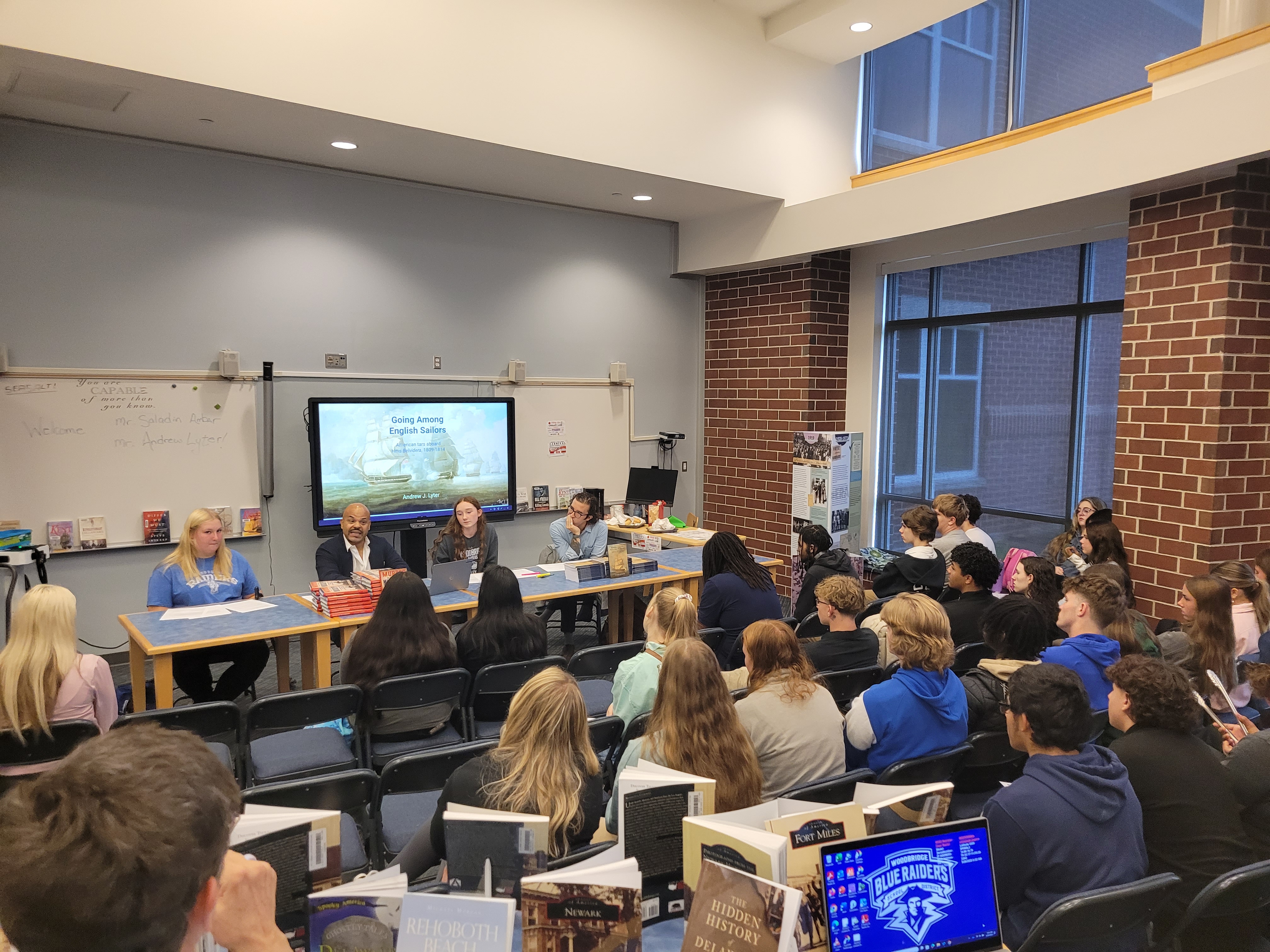
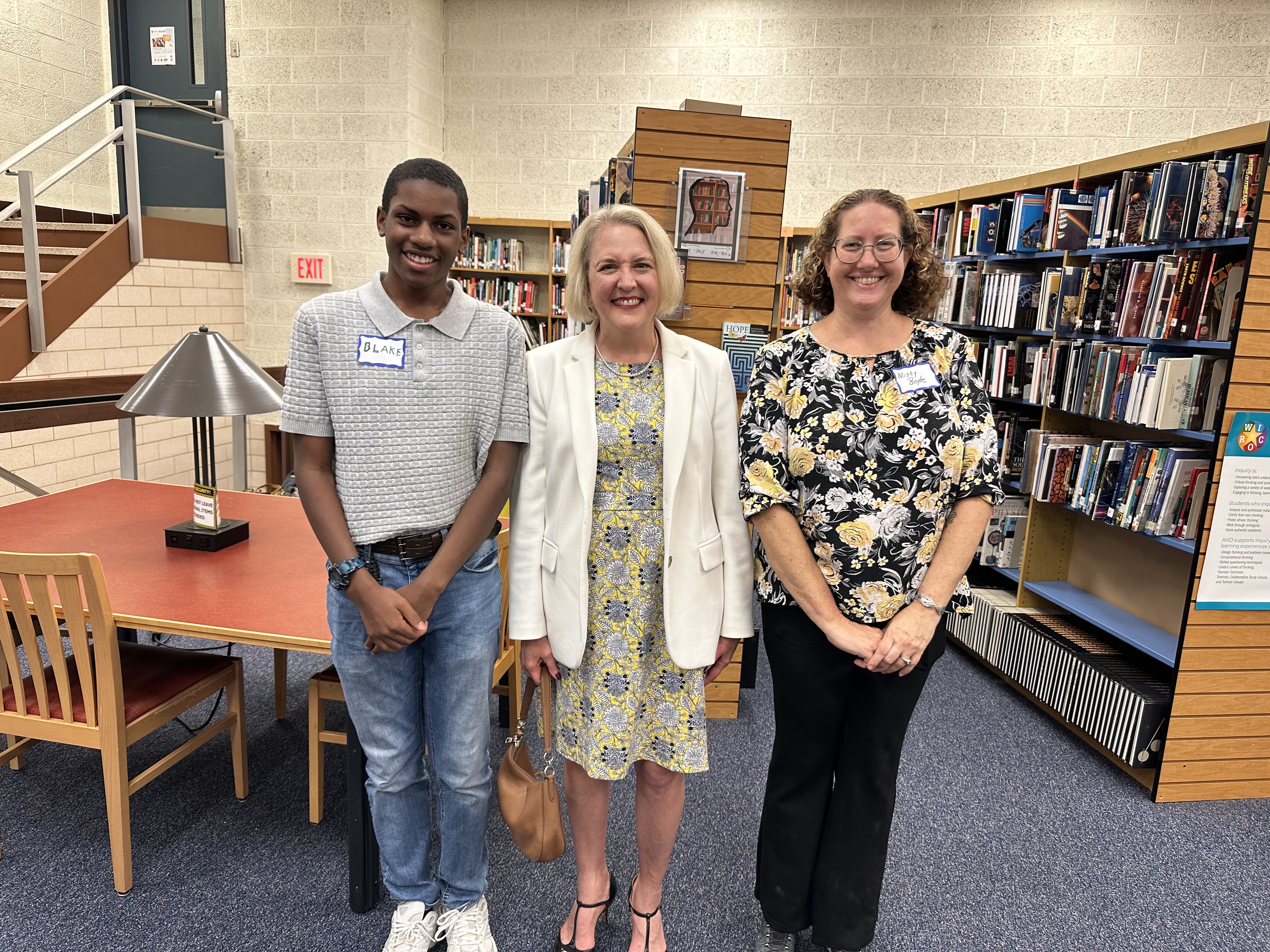
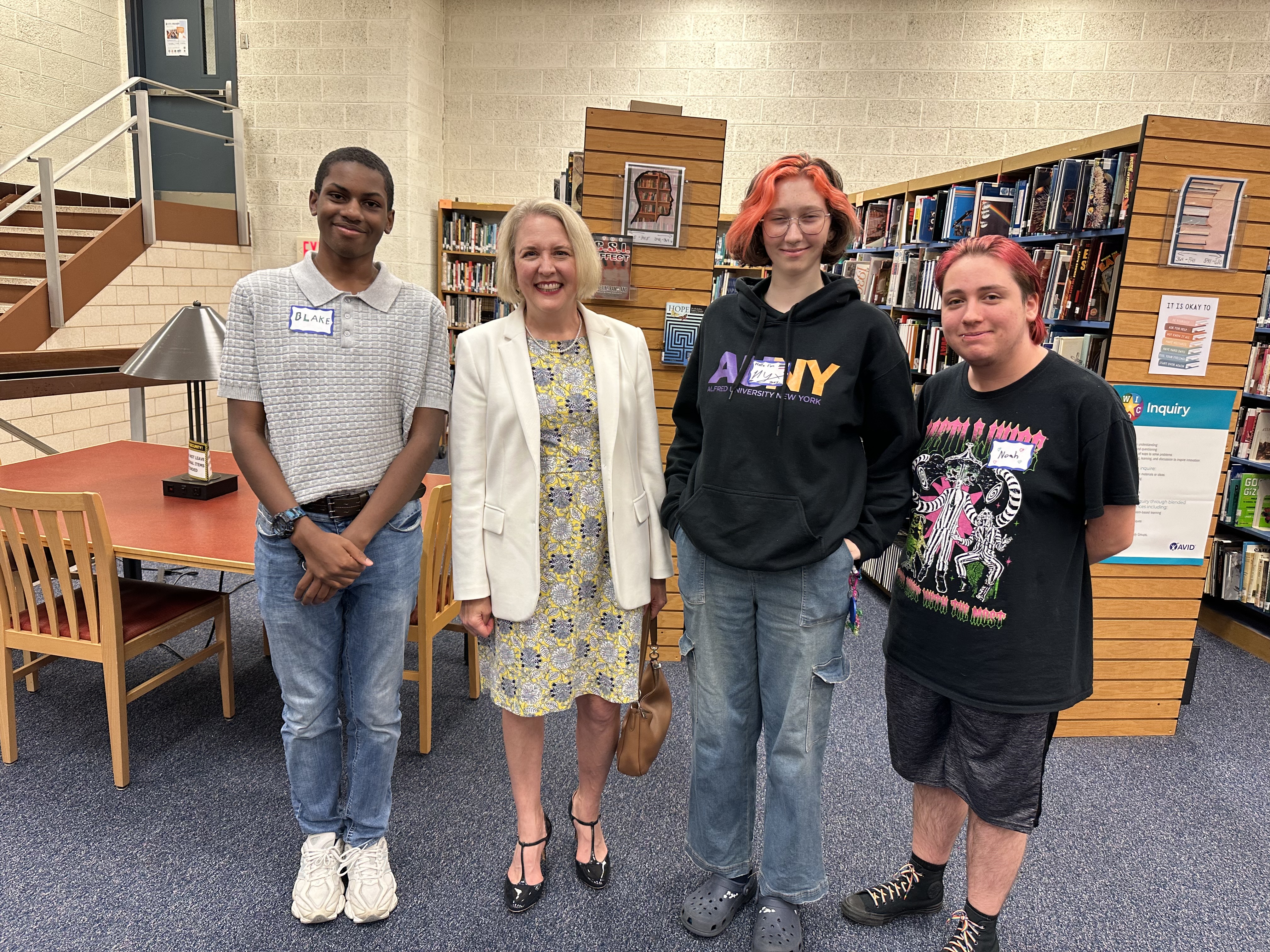
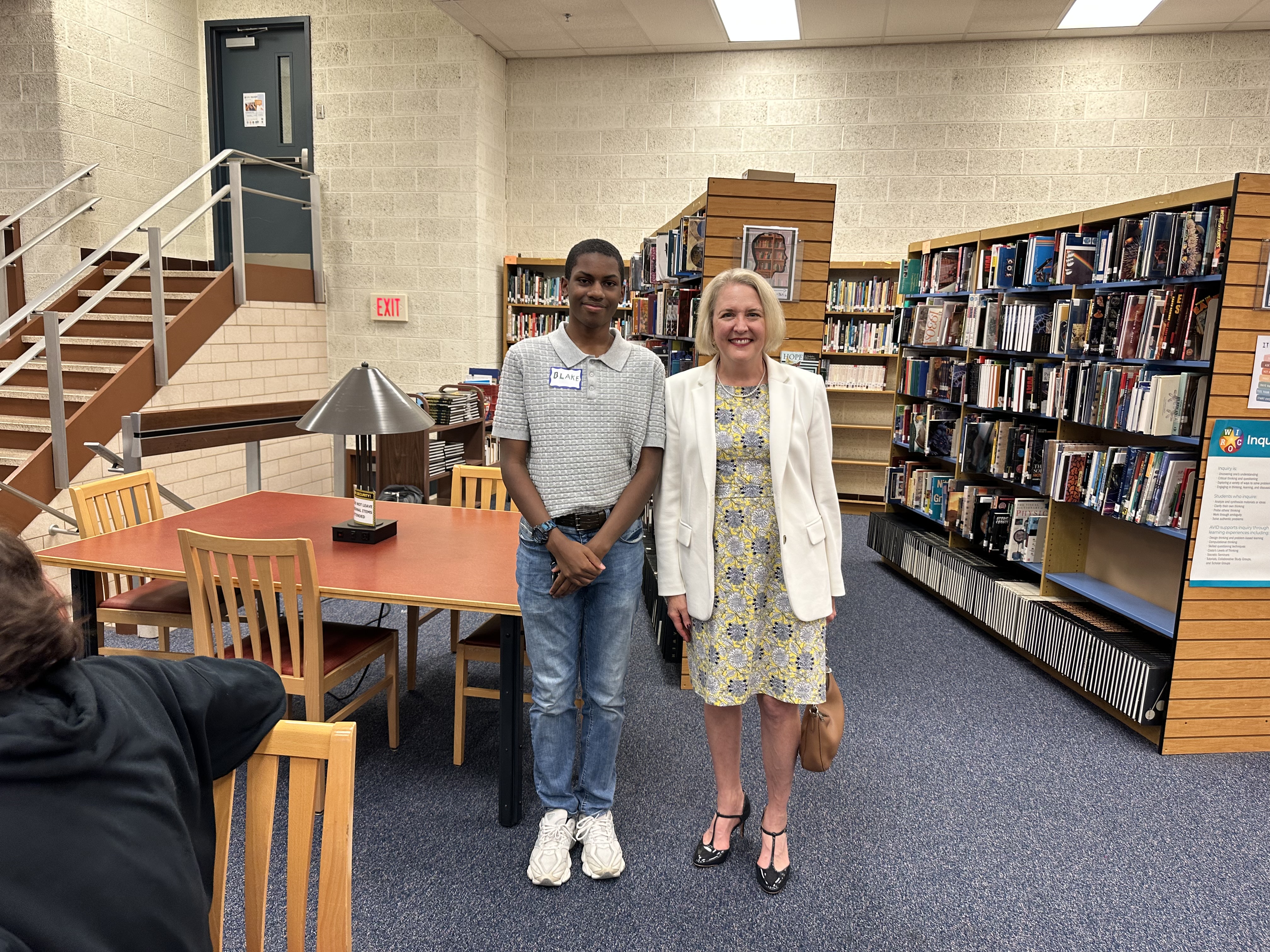
True to his word, Mr. Banks called two weeks ago and asked for a time to meet again with the newest SGA officers. We set it up from the library and let the students roll with their interview and opportunity to meet Mr. Tim Banks as a current board member. Usually we like to have such events occur IN the school library as an example of showing the school library is a host to all opportunities to the school. In this particular day. we had Upward Bound, college visits, and several English classes visiting the library for their next read, and thought ahead to reserve a conference room to enable students a chance to have a quiet-like atmosphere to have discussion, all around the SGA. In doing so, on November 11th, the Woodbridge SGA were able to meet with Mr, Tim Banks and keep the ties between school board and student body open. Next students plans to meet with the whole school board to keep the lines of communication open – but to continue to have a direct line of accomplishments, inquiries, ideas, and more.
This is ONE of several amazing events youth took on in October – stay tuned for many more!
November 14th, I received sudden and mysterious texts from Beth Kopicki and Lynne Betts stating there was going to be a shipment of produce to the Our Lady of Lourdes Church in Seaford and to let families know through social media, emails, etc..
I woke up on Saturday relishing the fact that I FINALLY has a Saturday where I did not have to dash out of bed and run to my next to be at location, lol. I looked and I remembered, I saw it was 7:50ish and I knew the produce delivery was supposed to be at 8:00 – 8:15ish, so I headed over to the church to grab a few cases of food to give to families. The two lines looked modest, but not out of control at all, and glad to see word was getting around.
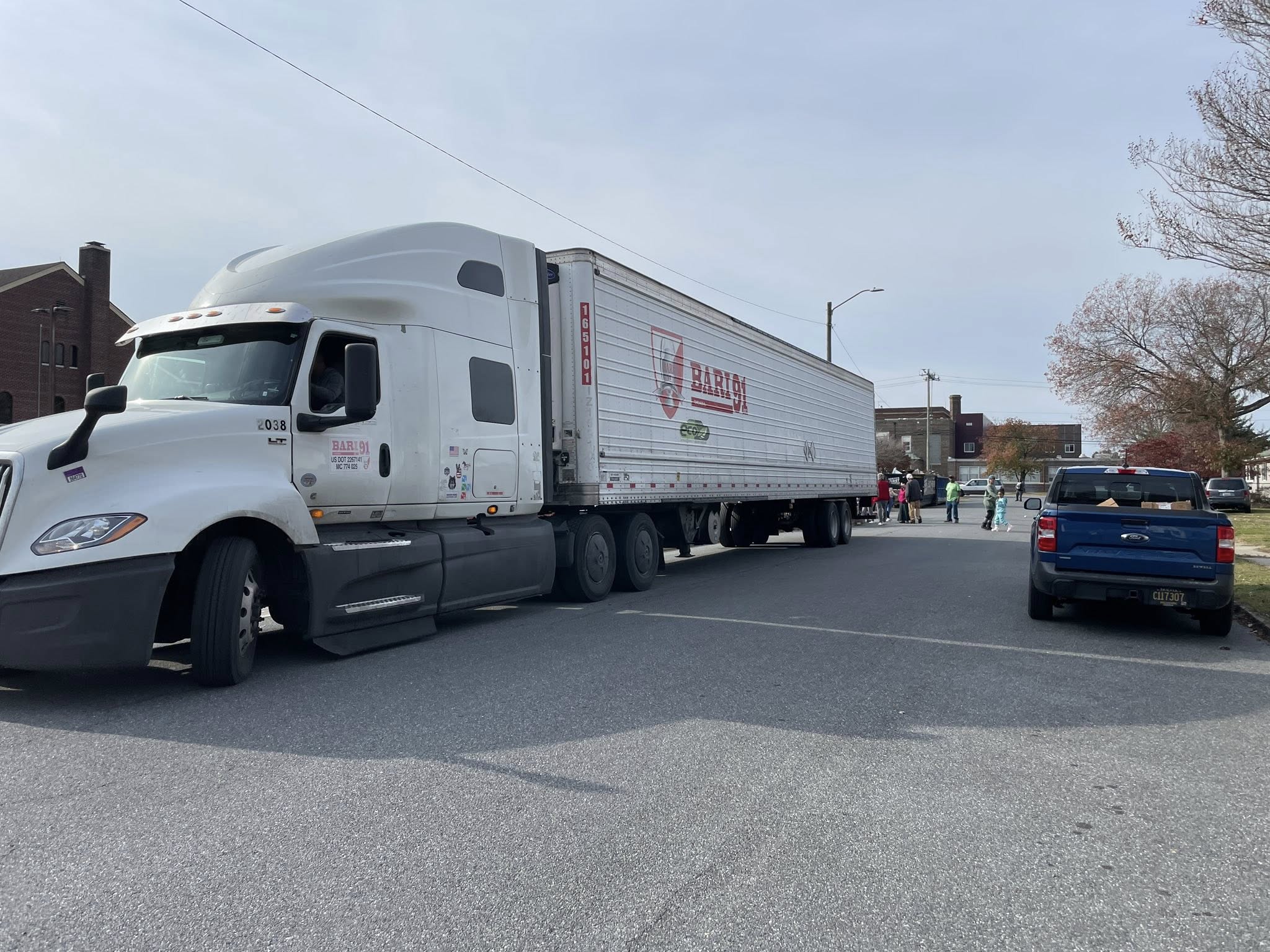
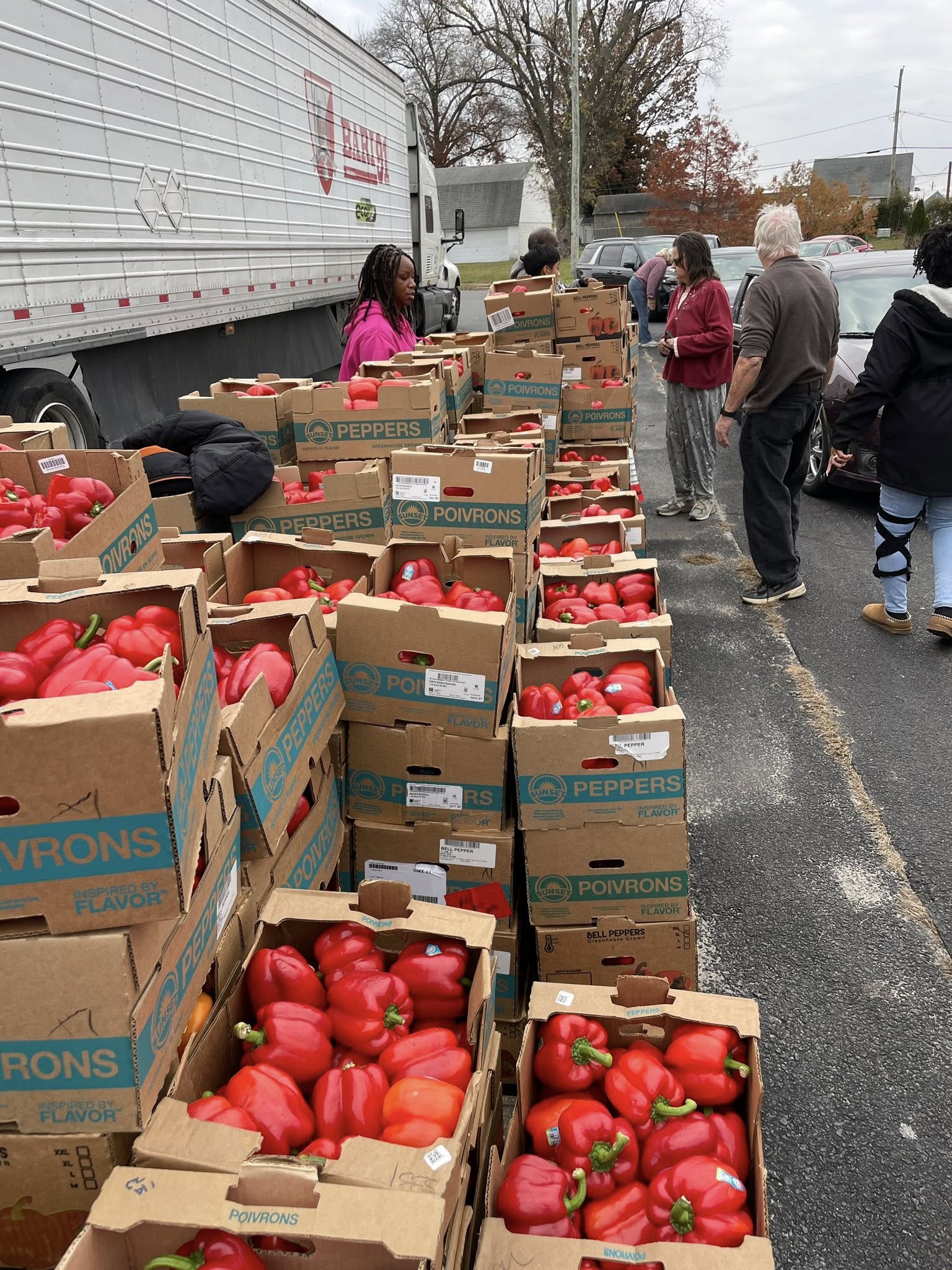
As I waited in line, I saw a tractor trailer pull up and also began to pull up alongside the tractor trailer from the front of where it was parked, so unknown to me, unclear to me, was the contents, etc.. I did see tomatoes, peppers, etc., start to come off. When I pulled up alongside the truck, I began to grasp the reality of how much produce we were talking- (See below photos). I was flabbergasted, and of course, my phone died at that moment, so communication between reaching more people was cut off. As I loaded up my vehicle (see images) I saw that a pantry was opening (separate from this event by at this same location) and half of the help were needed over there- so me being the former Friedman’s /Bilo Food (117 years of being in business) employee from Butler,
I said, hey, I can help….whew. I had no idea. The truck driver Joseph had not stopped since he arrive with this shipment (all purchased and sponsored by Trader Joe’s by the way) – and he was already sweating long by now, and we were not even halfway through the tractor trailer.
As we got through pallet by pallet and people taking tomatoes, peppers, and cucumbers, there still was so MUCH. The problem was at 10:00 AM, there had to be a point where the tractor trailer had to leave and the help with the tractor trailer had to shift over to the pantry, and there was easily a third of the tractor trailer produce still left. I had my truck full, so I headed over to a neighbor to the church who had a large family and was coach of the XC team, then to my Mom’s in Virginia Crest Apartments and ran into some neighbors there, passing out liberally the items I had in my truck, I saw two other cars also helping distribute their loads, the same people who we had been working together to unload, (great minds link alike!) I went back and saw they truly had so much left, they needed help.
Thinking of the cuff – (as I seem to always do with a crazy minute by minute sequence of events) I through, I am running on fumes in my car, I told the truck driver I know where we can go, if you follow me, where we can get the rest to families, I just need to get gas, and it was a deal. I went to Seaford Royal Farms, saw some kind of commotion there with four Seaford police cars, but tried to avoid that and went to the pumps- started filling up. At this point, I started looking around and saw two people parked in the parking lot that were obviously hunters, I asked if they wanted or knew families that could benefit from so much food (my truck was stuffed!) They said yes, ( I am sure they thought I was crazy approaching their truck asking if they wanted so much food or wondered if I had just ransacked a grocery store), lol. They ended up filling a good portion of their truck bed with the produce, as well as me not being afraid to hit up the guy on the other side of my pump, and he took some cases too! So much I emptied out my truck to those three vehicles just filling up my vehicle with gas- so I was on a roll.
I went back to Our Lady of Lourdes and connected with the driver Joseph, by now he had been unloading his truck with the help of some amazing people since 8:00 AM, and we lined up and he was following me to Georgetown. My initial plan was to head to El Mercado in Georgetown- but what worried me as I was headed there were the side streets with a tractor trailer. But then, as we hit Seashore Highway, I remembered the ML Country Store in Bridgeville and while I knew they had that flea market, I also knew I just bet we could fit into the parking lot. Sure enough, we stopped, I ran into a former Woodbridge student who helped me ask if we could pull the tractor trailer into the parking lot to distribute free produce, and sure enough we were off to the races. I then saw another student, Sophia, pull in and I was like, AMEN! YES! I asked her to call anyone she knew about the food, her aunt owned the store, and then cars started coming like crazy. 2 1/2 hours later, CAN YOU BELIEVE IT!, we made it to the back of the tractor trailer. All pallets empty, families taking food and sharing with other families, I will be honest, I could not believe it, and we did not even have to go all the way into Georgetown. I had a few small cases and I took them to Woodbridge where I distributed them further to other families, again, amazing timing.
My thoughts on this – FIRST – totally unexpected and amazing how many people you can think of last minute that can benefit from something, other than yourself, so last minute. A Miracle.
Second, how lucky were we to have the volunteers that responded to Our Lady of Lourdes call to distribute food, on such short notice? Amazing.
Third, it was HIGHLY UNBELIEVABLE how generous of his time the truck driver, Joseph, was unloading EVERYTHING. I would say most truck drivers are amazing to begin with, but I can 100% see a truck driver also stating that he was a driver, not an unloader and not jumping in 100% from the beginning, he was AWESOME.
Fourth, seeing the Woodbridge students come to the rescue and start dialing out and contacting families, who then came to had the network to distribute to other families, it was AWESOME. It made me again realize how much of an asset some of the best students we have ever seen exist in our community and ultimately, how they make an impact on our community when given a chance. They showed up, (Sophia and Aida) by chance and last minute, helped unload constantly, and contacted others, they WERE the pipeline today at the 2nd half of distribution.
Fifth, just how luck are we to be put in a situation to help others and then see the impacts of these, and realize how good life can be, amid such chaos happening around us? I am convinced we can make the changes we need to occur on a larger level by doing so on a smaller level.
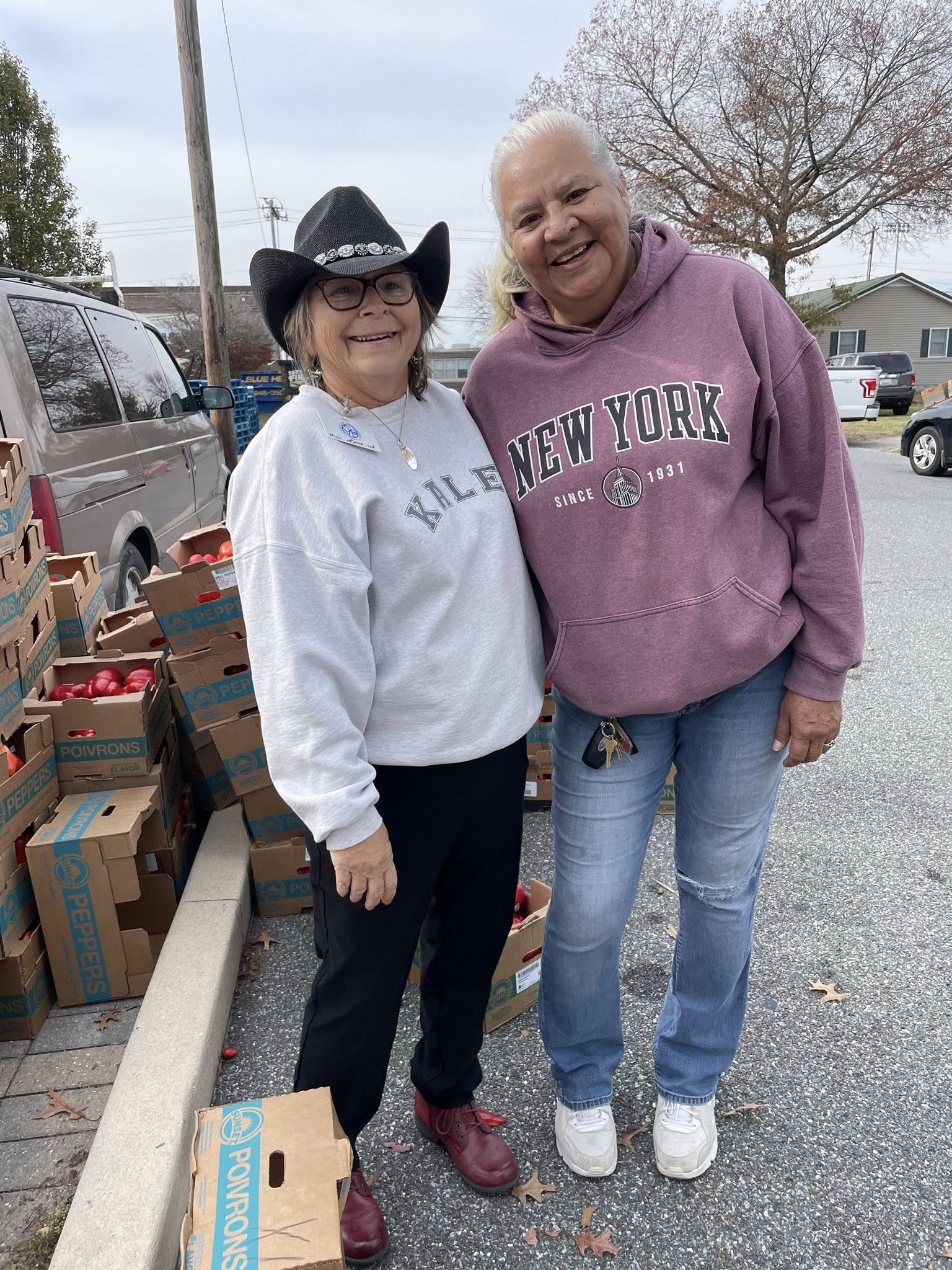
Sixth, Lynne Betts said it best, she said she was almost in tears when she looked around, and then she saw Beth Kopicki, then she saw Dave/Cindy Blackwell, and Juanita Mireles, then she saw young kids and others in a second helping and it shows what can be done when you just pray, trust God, and reach out to others. HUNDREDS of people are impacted positively.
Seventh, at age 53, I certainly never thought I would be recalled back to my grocery store days of unloading trucks like my hair was on fire and yet, here I was. I was grateful I was still able to do it, but my body was constantly saying, “Dude! – this was over 30 years ago and you expecting me to bounce back to that day? You are going to PAY.” LOL.
As we finished unloading the last pallets and yes, we even had a chance to get the pallets to someone that would be willing to take them- the truck driver insisted on buying me lunch, and I fought hard back against this but he refused to let me buy him lunch, and we went into M L Country Store and I changed his mind from a cheeseburger to a Burrito, and we laughed about the day and just amazed at what happened. (It might have been the best burrito I had in my memory since returning from Mexico). The truck driver, Joseph, mentioned that he was driving here (to Delaware) and felt the spirit of God come on him as he was listening to gospel music, and he knew something was going to happen that was special. Between Lynne and Joseph, I could not have explained it possibly any better. I also realized there is still magic to be found in our community among all faces, places, and spaces. it was a magical day. Thank you Trader Joe’s for starting off a connection of power that was not apparent from the start of the day.
Yes, I have tomorrow off – I might be waking up just a little later than today- just in case. 🙂
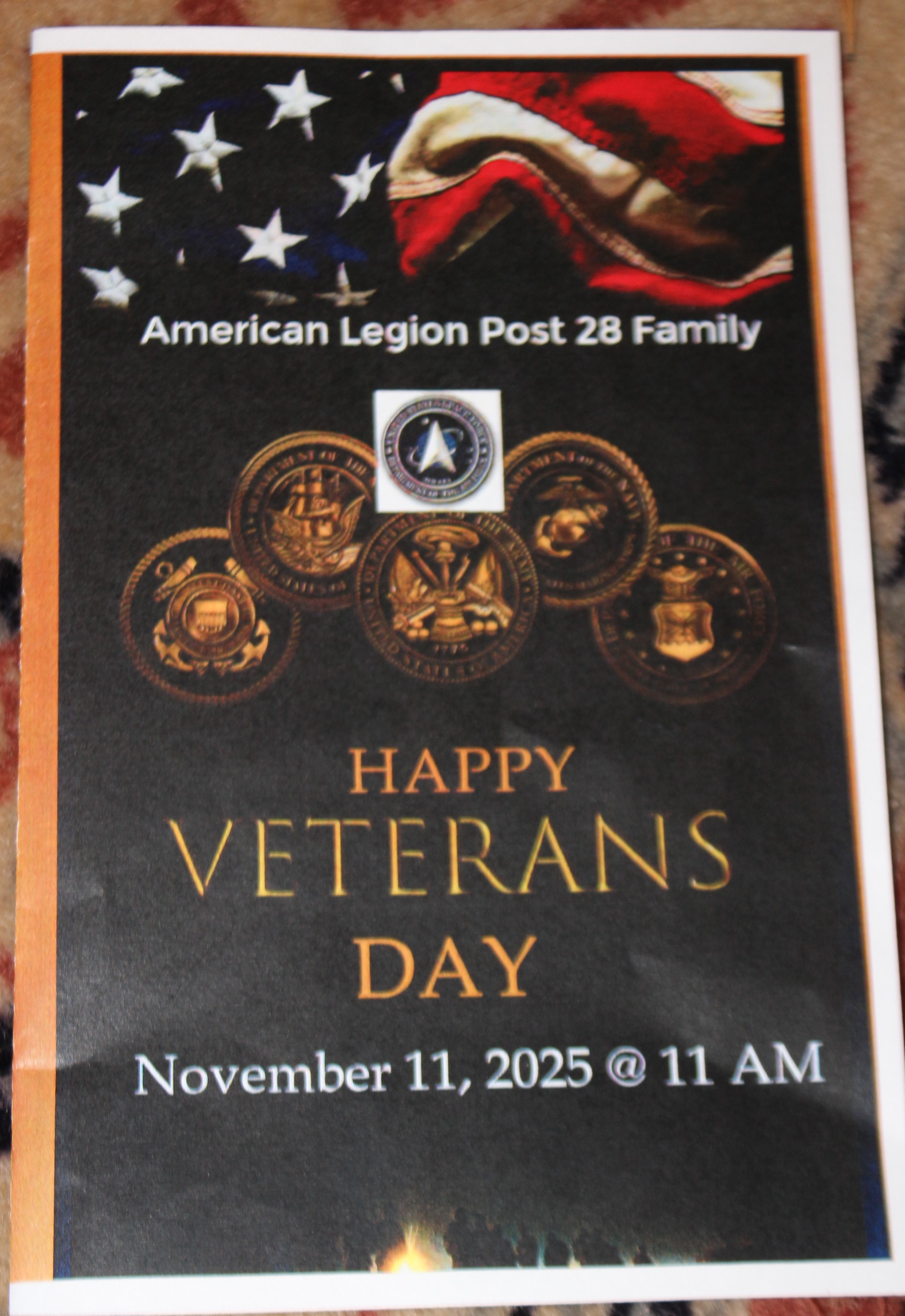
Veteran’s Day 2025. I wanted to so something different to make Veteran’s Day more personal, more meaningful than simply posting a “Thank You for Your Service”, actually a self-imposed Project Based Learning project. I did notice on the Delaware Humanities calendar the workshop – “Vietnam Mailbag” and since I had not had a chance to see this, and I was on the Delaware Humanities board, it made sense!
I was in a hurry to get to the American Legion Post 28 on time, and was seeing I was about 4 minutes late. I rushed in, and did in fact see a ceremony occurring with a room PACKED full of veterans, and spied a small map of Vietnam from the back from the room. Yet, nothing indicating this specific presentation. I asked the bartender at the time if this was the so and so presentation (forgetting the exact name from trying to slow down from getting here in the nick of time)- I was talking a little louder than I wanted to baed on the Ssssh’s she was giving back to me, but she did explain, “Well, this is the ceremony?!” but I wasn’t sure if it was THE ceremony I was looking for.
Thinking I might have made a mistake, I went back out to my car, checked my phone, gave a quick call to Executive Director Michele Anstine to make sure I was at the right place- kind of expected that she would be in maybe 2 other places, and with no answer, I was resolved, if I was in the right place, or was in the wrong place, it seemed right be in a place with veterans anyway to honor them.
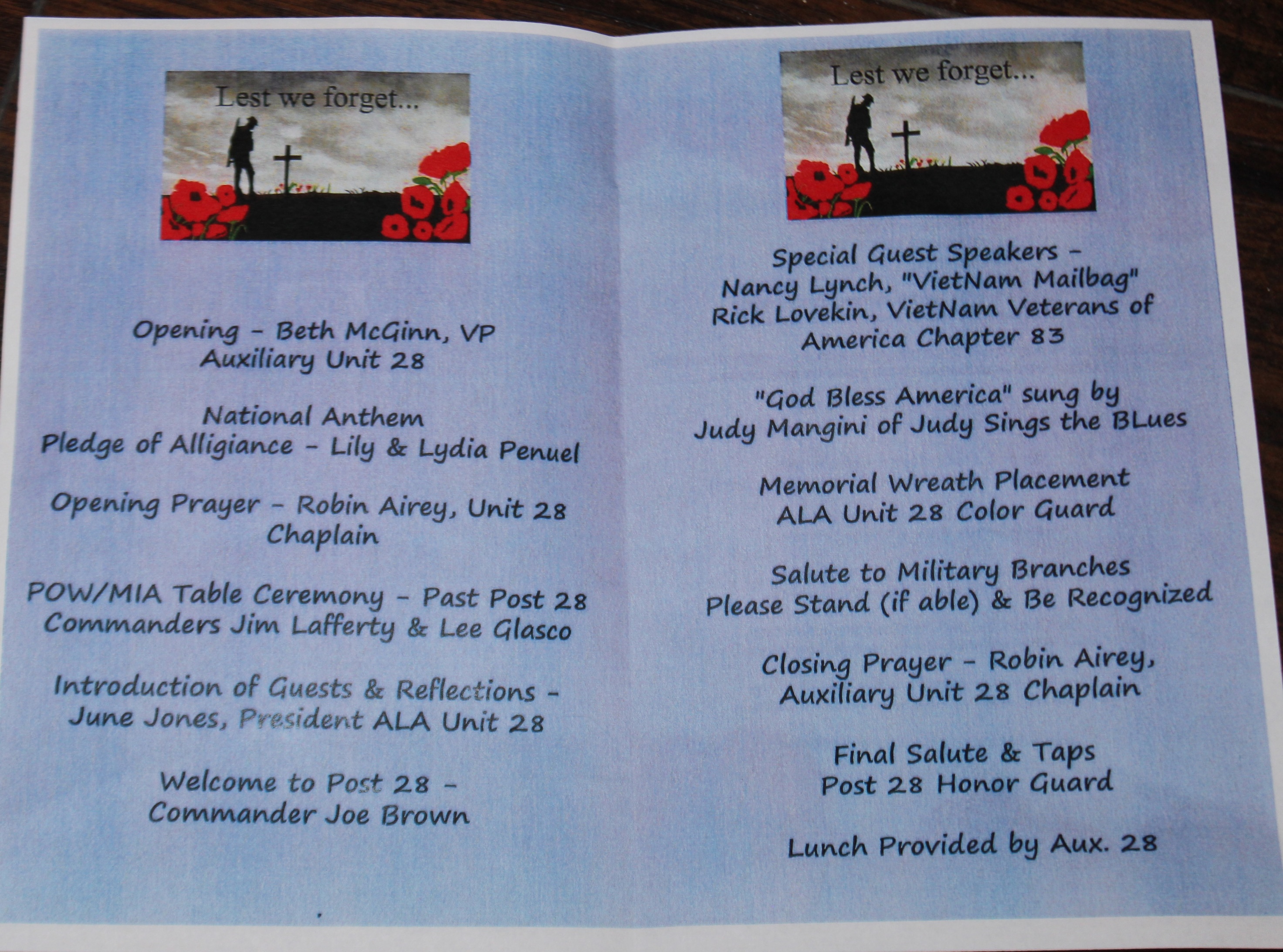
I went back inside, took a seat and waited and listened. This is what I learned:
The Commander of the American Legion Post 28 was John Brown, and the Captain was Jim Russell. There was a group tied to Post 28 named The Colorettes. Garth Miller was the Commander of the Sons of The Riders.
She introduced the fact that the Delaware Humanities, founded in 1973, funded this project (Thank you Ms. Lynch!)
From Delaware, 800 troops were in Vietnam, and she made it her mission to create Vietnam Mailbag, based on her ongoing column called “Nancy’s Vietnam Mailbag” newspaper column- collecting conversations and letters and mentioned in 1972, she had over 1000 letters in 5 years from troops.
She was motivated to follow up and ion December 18, 1972, put these letters in a book to honor the troops. In 2008, this book was released, and she mentioned countless names from Millsboro that were in the Vietnam conflict. Names such as : Robert Dowdy,William E Jones, and James E Holden, to name a FEW.
Next up to the podium was Rick Lovekin – and I have to say, he chose to NOT use the microphone, and unfortunately, I was at the VERY back of a packed room, so what I heard was minimal. But what I heard was astounding just the same.
He is fromThe Vietnam Veterans of America’s Delaware State Council, Chapter 83. He was a Huey helicopter pilot, and didn’t graduate high school at first and then went back in ’68 to graduate. He was only 20 years old in the slides he showed and he mentioned the song, “We are the Champions” was the way they felt THEN during the time those slides depicted. He mentioned the 9 foot statue in Delaware that commemorates 166 Delawareans – and empty spots exist there due to some unknown names still not known / found that served.
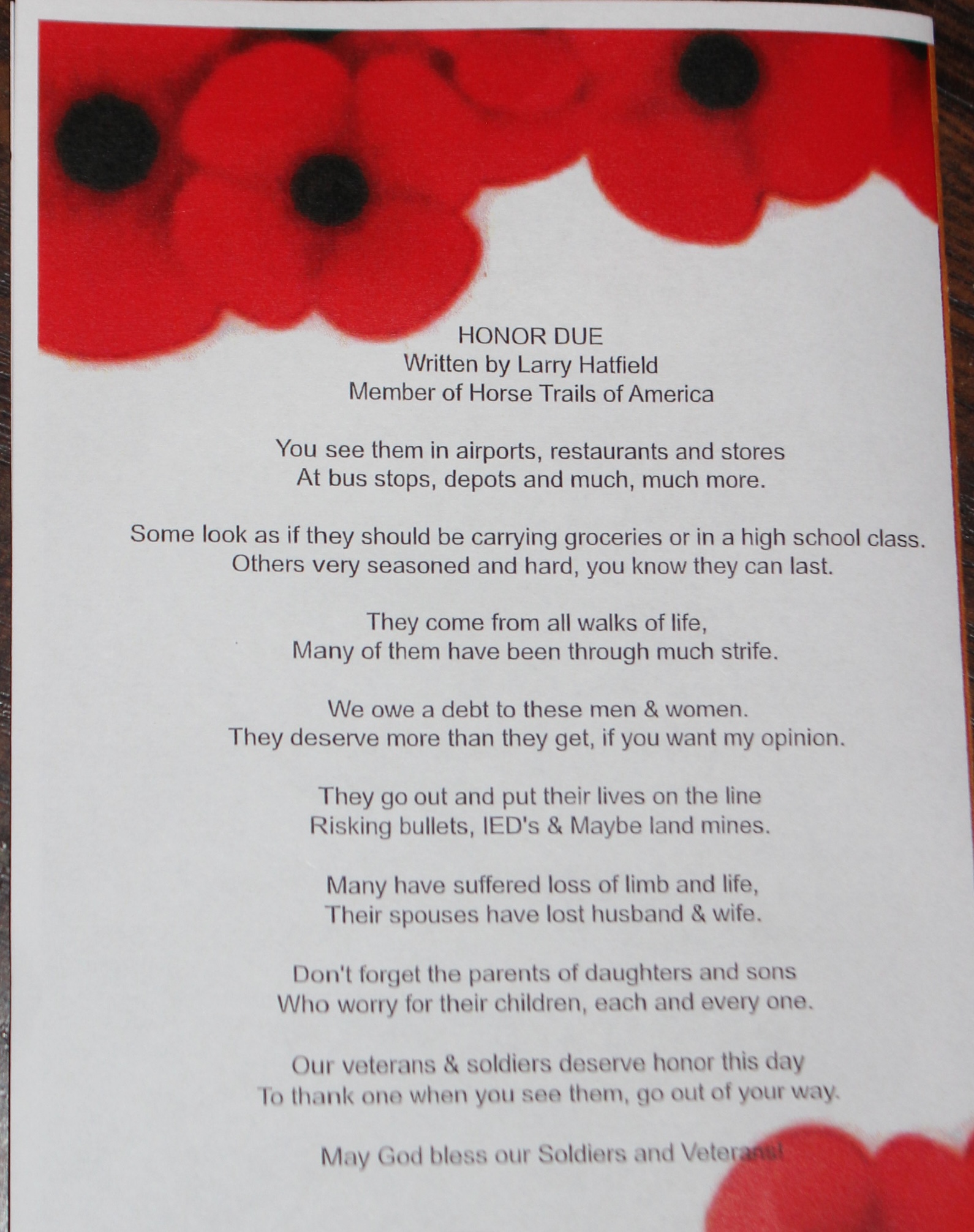
The ceremony ended with all singing “God Bless America”, a wreath was placed, and the anthems for all the military branches were played and asked to stand if they served in a particular branch. A closing prayer was said, and TAPS was played. It was stunning.
Overall, when anyone wants to ask what the Delaware Humanities are, it is easy to see the Delaware Humanities is an open book to origin stories. Stories and histories that define the human experience on the widest spectrum possible, and it was an honor to be part of the Veteran’s Day Celebration that occurred today.
I think by challenging ourselves to experience celebrations that we could too often easily take for granted, and doing things out of the ordinary, help fully appreciate the meanings of such special events. The American Legion Post 28 was amazingly accommodating, friendly, open, and simply a pleasurable experience. (The cheeseburger and fries were pretty darn good too!)
Before the start of #AASL2025, I received this email:
(Insert your name after Dear, because I realized,
this pretty much describes anyone I have met that truly dives in 100% as a librarian)
Dear ,
This has been one of my favorite summers, thanks to you. The extent of your impact not only in my life, but the lives of countless others, astounds me.
You have a hard time being recognized for your work. I wonder if that’s because you feel it’s your duty. You just do it because the future generations need us, passing it on just as the countless teachers, family members, and friends poured their hopes and dreams into you. That’s one thing I respect most about you. The question: should I do good or do bad? isn’t even a choice – you transcend the question entirely. The cornerstone of your self is unquestionably your service. And somehow, you find the energy to do it all despite the chaos. I seek to embody this attitude as well, and have taken inspiration from you as one of my mentors heralding that value. There is a word from African philosophy I love: Ubuntu. It roughly means “I am because we are,” or to put it plainly, my existence means nothing without the existence of a community. We are all connected, all beings on this earth. You embody this philosophy in its entirety.
In the same way you connect people from all sorts of different communities, I really appreciate how you connect different subjects. To others, substance abuse and environmental conservancy may seem like two entirely separate topics/problems. They’re not. Further than that, you try to adapt and utilize modern technologies like AI – heralding the libraries approach to learning and connecting resources where there are opportunities. I see the role of every one of these subjects:
Writing for critical thinking, storytelling, and advocacy Art for communication, expression, and what words can’t say The environment for it’s ecosystem services – physically, mentally, and spiritually History for contextualizing past injustices to indigenous peoples and other modern struggles Politics for establishing policies that incorporate philosophy to make our societies more free Fitness to develop discipline, health and overall well being Education and librarianship as the center stone for them all: learning itself
Your refusal to fit the box of a specific field gives me hope for my future. Even in something you don’t have tons of expertise in, you’re willing to try and grow. For me, cutting off one of my many interests would be akin to amputating a limb. They all play a role in a living healthy, full life.
More importantly, (Your name), the thousands of people you have impacted and the hundreds of close bonds you create almost become a family. To me, that is the richest sort of life, richer than any billions of dollars. We, your students, will be there for you should you need us.
Also, a little reminder, amidst all of this it’s OK to say no to some things to stay sane. And to ask for help. From one to another – every runner needs their rest. Even if it means walking on the trail as the birds fill the silence with their song and the trees sway in the breeze, remembering to breathe, remembering that your students will be right behind you supporting you, should you ever feel lost.
Keep in touch,
“The student each of you impact every day.”
Your turn. Send us in your most inspiring letters and memos- we are making a collage to show the power of Librarianship!
Our WHS English teachers Ms. Fagan and Ms. Martin jumped at the chance to show the intersection point of History and English, while we made conclusions about both of these disciplines shaping our everyday life. Having WHS staff Ms Webb, Adams, and Principal Sharpe who also added awesome connectons to the history and its impacts on our lives? – priceless. Chelsea and Emily rose the challenge of digging in and asking about History, English and more.
There are two parts that are AMAZING to this student led podcast, but we start with the first one.
It is the backbone of a school library when students are not in the BACK, but in the front- and guiding the very vessel (Sorry Mr. Lyter) that leads us to improved levels of literacy. From planning festivals, to creating book talks to exploring authors through podcasts, we are JUST scratching the surface of where students can take us to – in tackling litereacy issues, and we are hurtling at this issue 100%. Stay tuned for many more ways we are bringing the need for heightened levels of literacy to the surface!
Doing the math, this year was the 22nd conference (held every two year) and as I prepared my belongings to head out I wondered, what good stories do people have about the people that watch over things when they head out to AASL? If it were not for my cousin, I would not be able to even step out of my brood of dogs, cats, and fish – and his attention to details was priceless- and I KNOW there are many good people everyone relies on when they head out. Who are they?
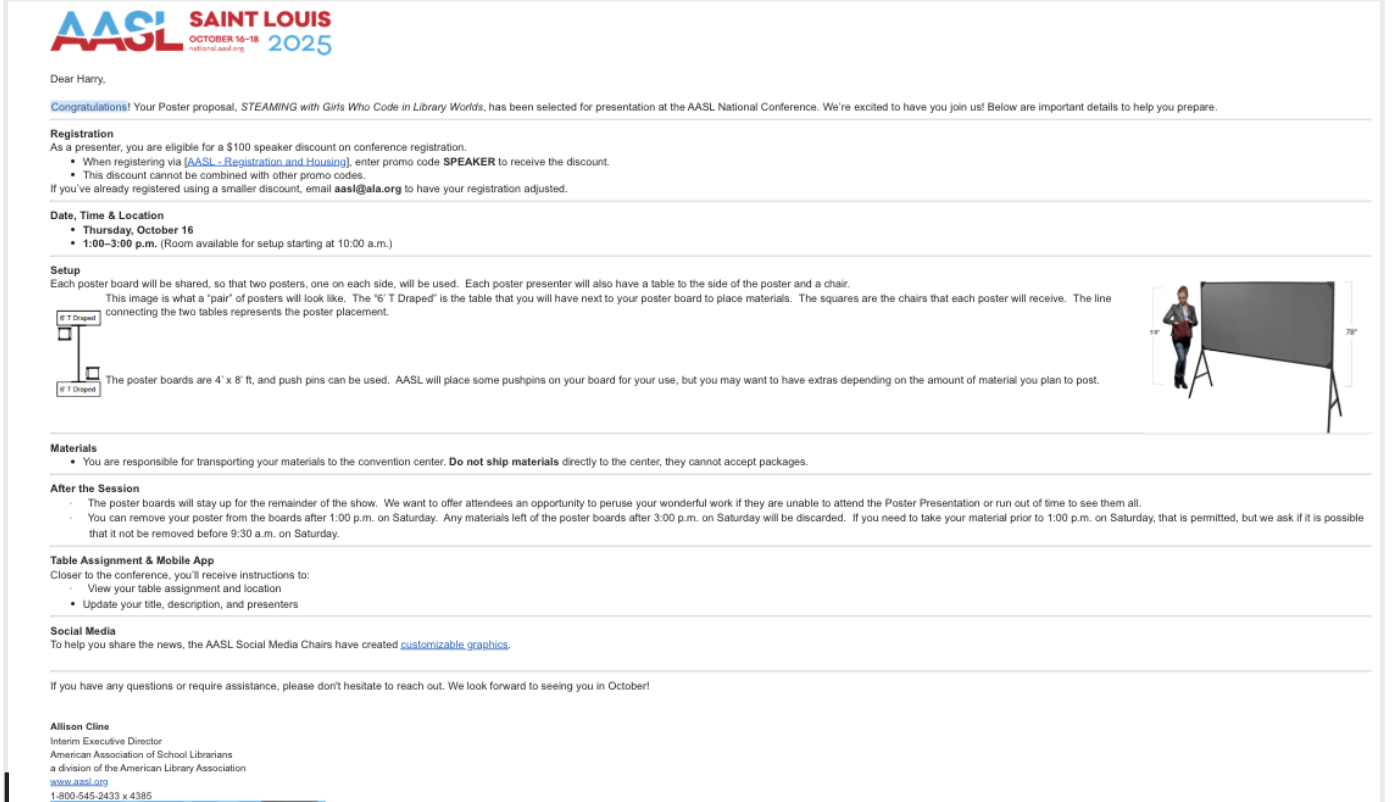
Why is it so important for you to attend AASL? My goals have changes in being tied with AASL, as originally, it was for the reason of SHARING AND CREATING ideas that would energize my own school library. That is has. Now I find this is an outlet and opportunity to GROW future librarians in students and finding ways to give them a platform beyond their own community. Today, I was realizing I had a day to graciously represent our GIRLS WHO CODE group, in also helping draw an eye to what goes on into our school library. They have served as guides to lead others to the school library and I was getting a chance to have them represent what they have been doing in the school library.
Off from Salisbury, Maryland airport, to Charlotte, (I had a bad experience last conference coming back from Tampa, over 17 hours in hat airport coming back until we had pilots) and I wondered, and cringed a little, but no out of the ordinary occurrences- YES! – with a long layover, I found myself waiting in Charlotte for my last leg to St. Louis. I had slept a whole 2-3 hours the day before so I had caught many ZZZ’s in Charlotte while waiting.
I checked my phone instant messages and saw a message from Airbnb, and learned the residence I was to check in would not be ready due to renovations- but the owner was checking on a hotel for me and getting me a Lyft from the airport to that hotel – despite this – I was glad I knew what was happening and was appreciative of her attention to the detail. Any adventurous stories out there about your flights in?
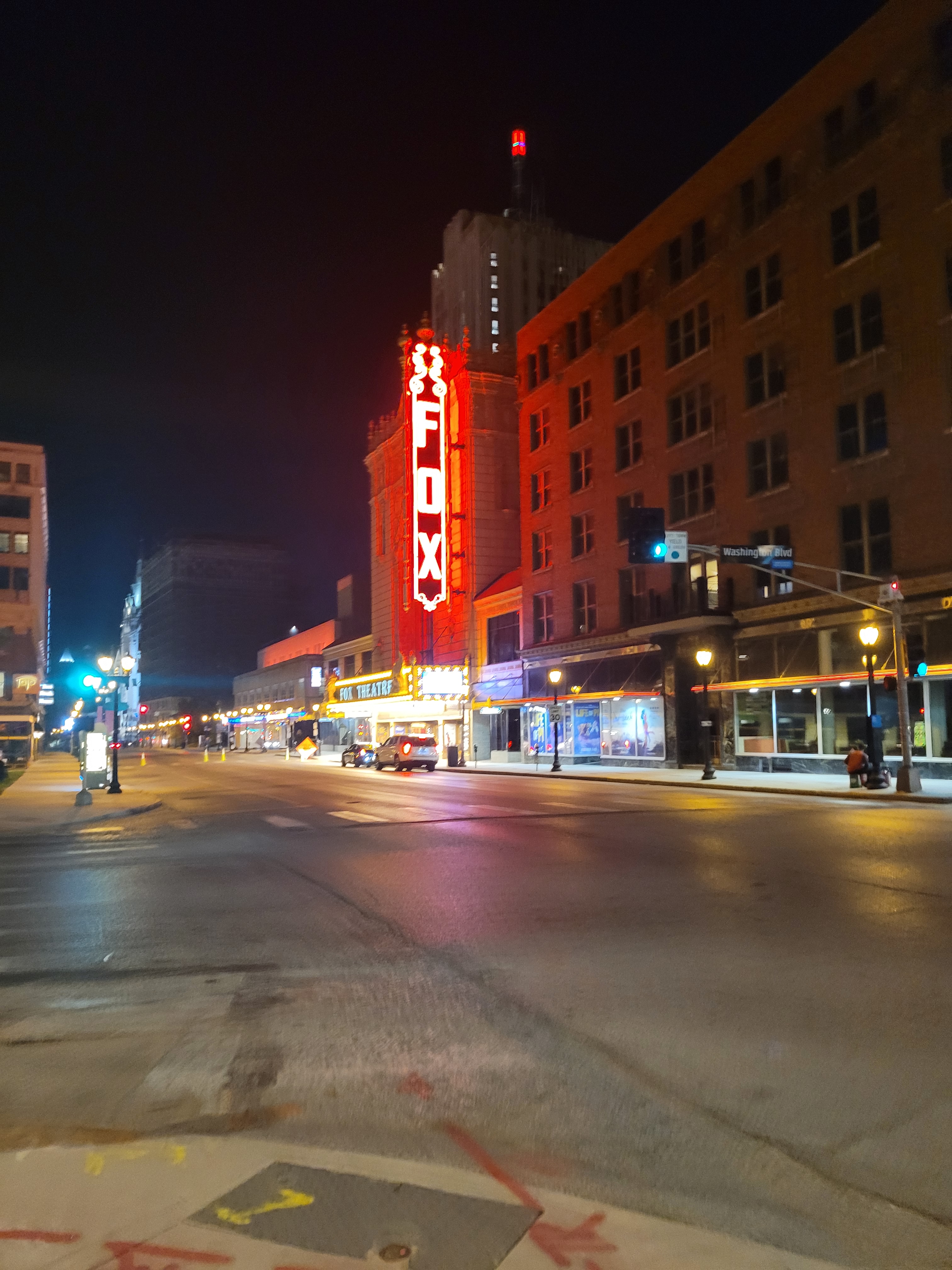
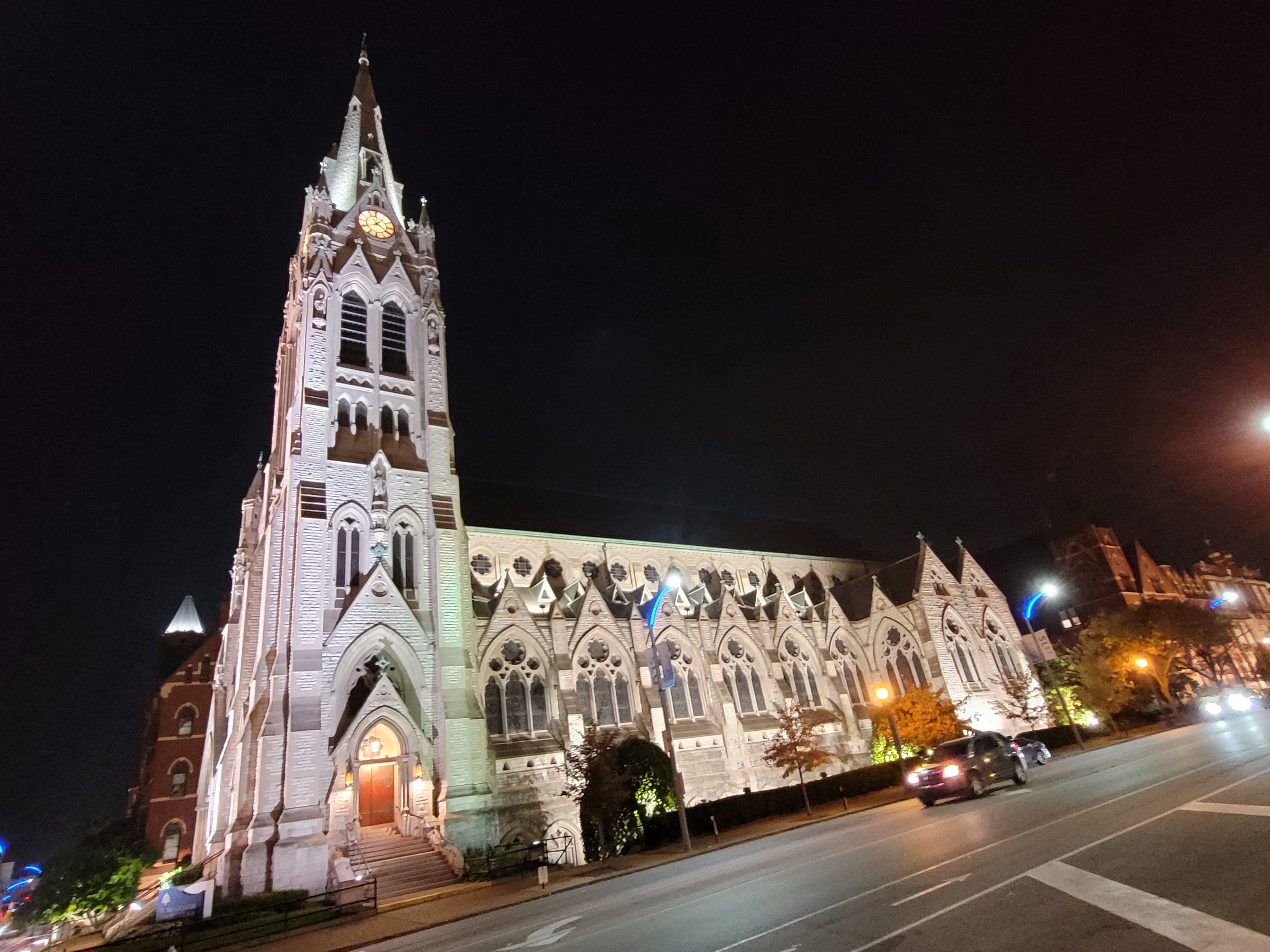
On landing in St. Louis, I realized how WARM it was in St. Louis – it felt like summer and I was sweating- but it was wonderful to feel how warm it was – wow. Major change from the cool nights and storms we had just experienced in Delaware. Without too much delay, my Lyft was here and the driver and I discussed how there had been little rain recently in St. Louis, a stark contrast to what we had been experiencing as mentioned. On our way I realized I would be staying at the Angad Arts Hotel –
the owner of the Airbnb-Stephanie, was awesome and kept in touch every step of the way with me- she made this a smooth transition. I had never seen anything like the Angad Arts Hotel –
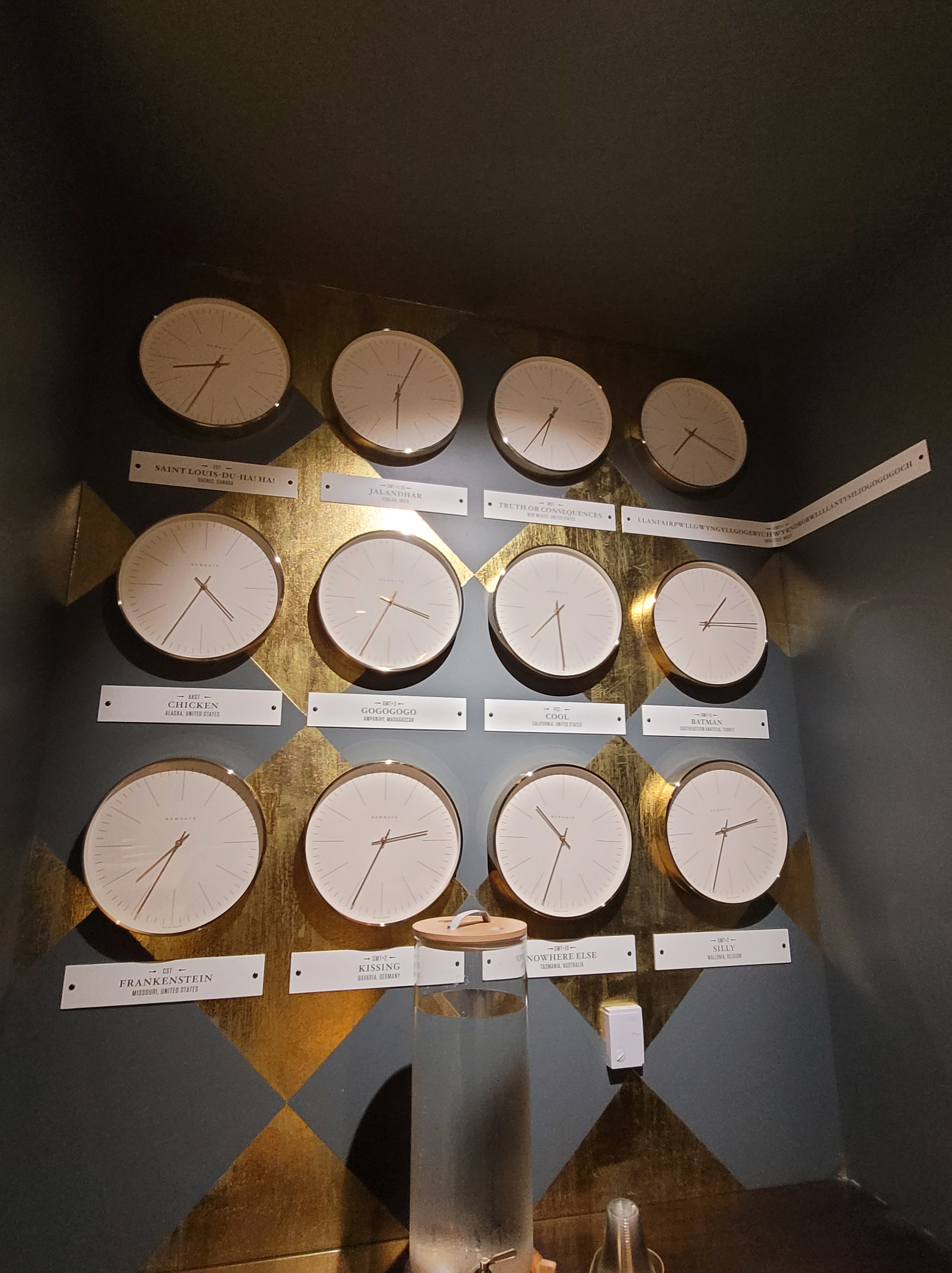
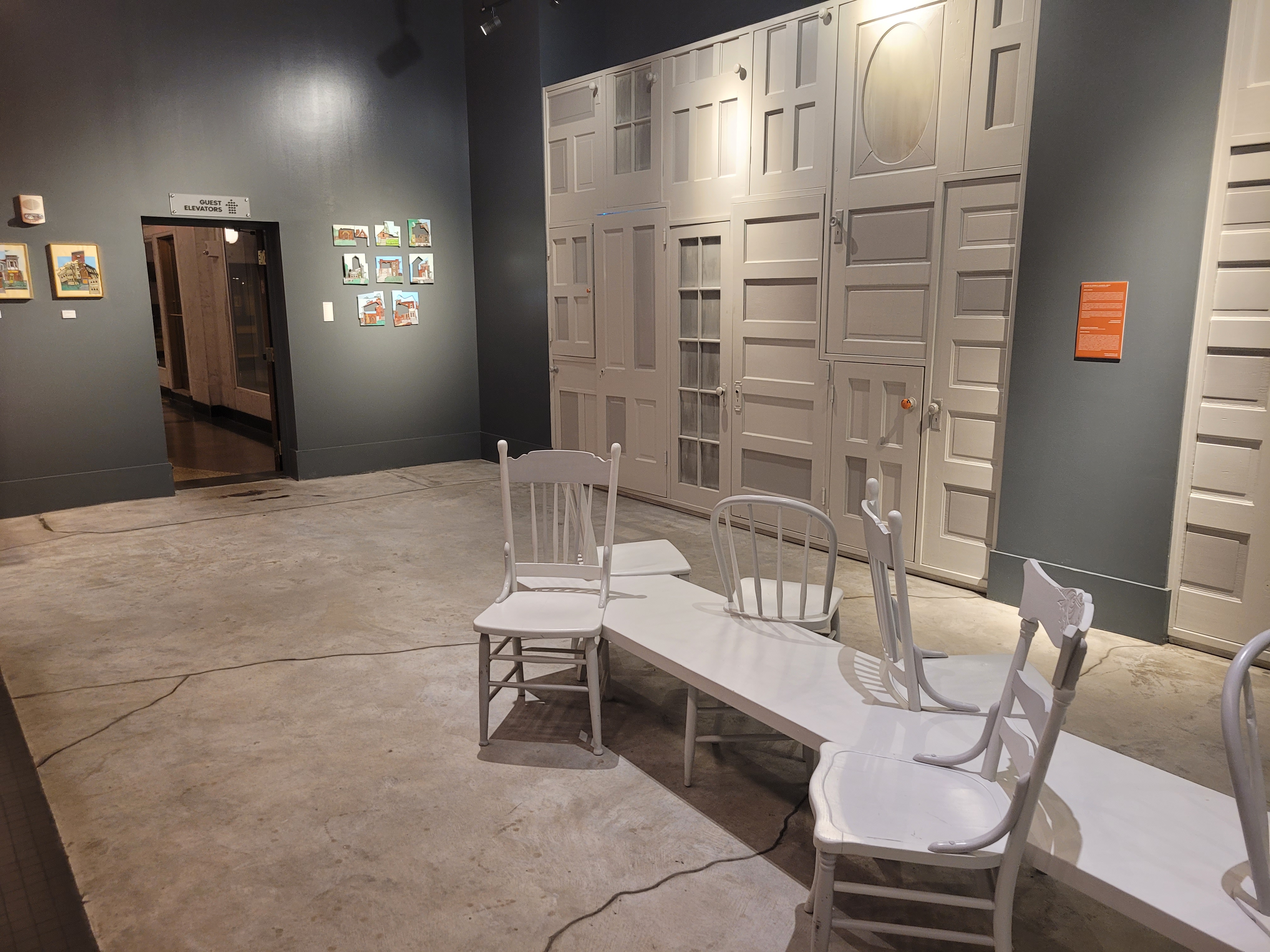
Sitting across the street from Powell Symphony Hall and as I entered the hotel, is was flanked by artists of all types. Music flowed out and you walked into the midst of a lobby art exhibit,
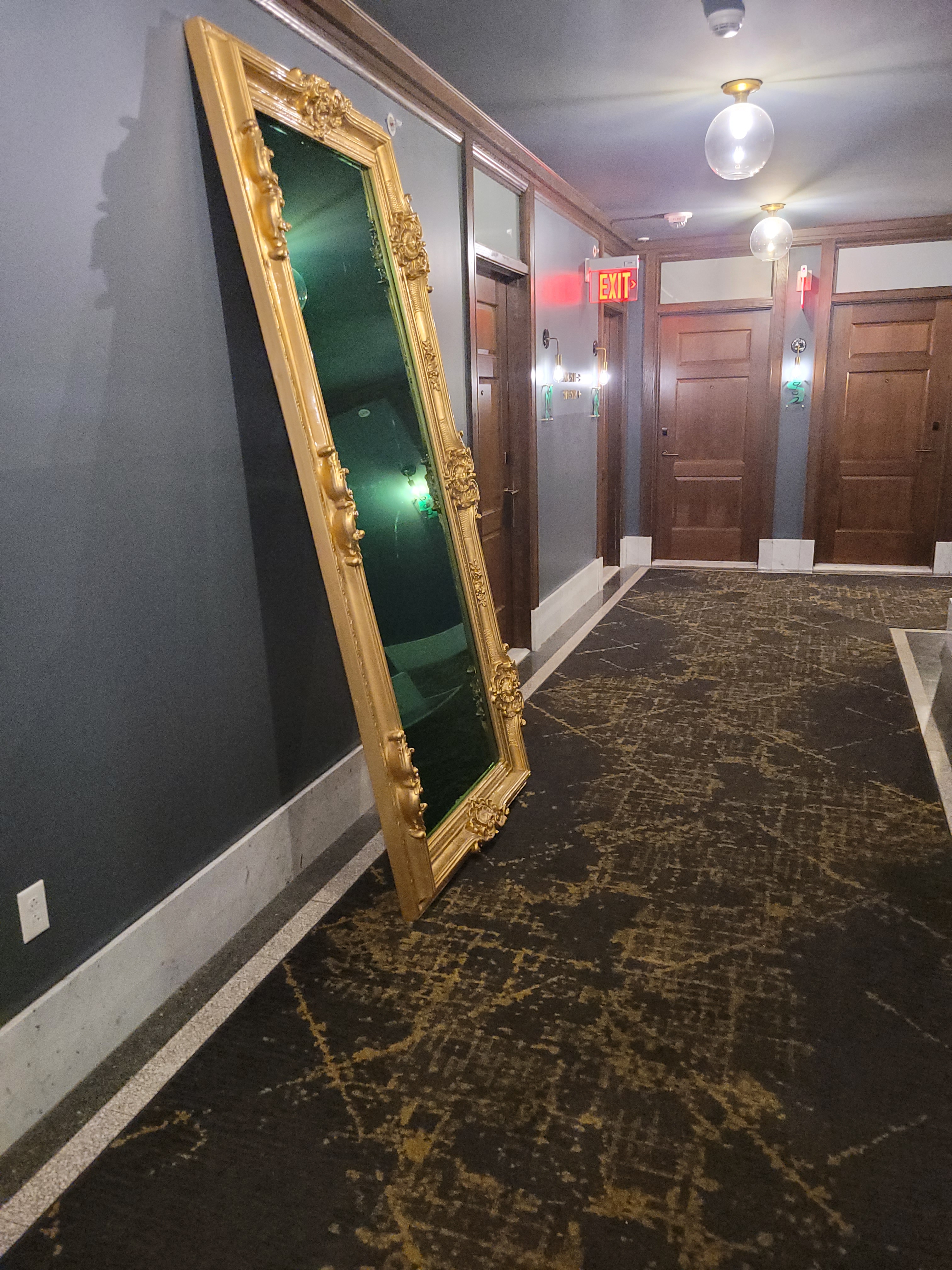
and as I went up to the 12th floor – watching the art viewing on the tv in the elevator, the door opened up onto the lobby but surrounded by art everywhere– and the halls, all types of art found EVERYWHERE- it was a variation of the idea of a Night At the Museum movie.
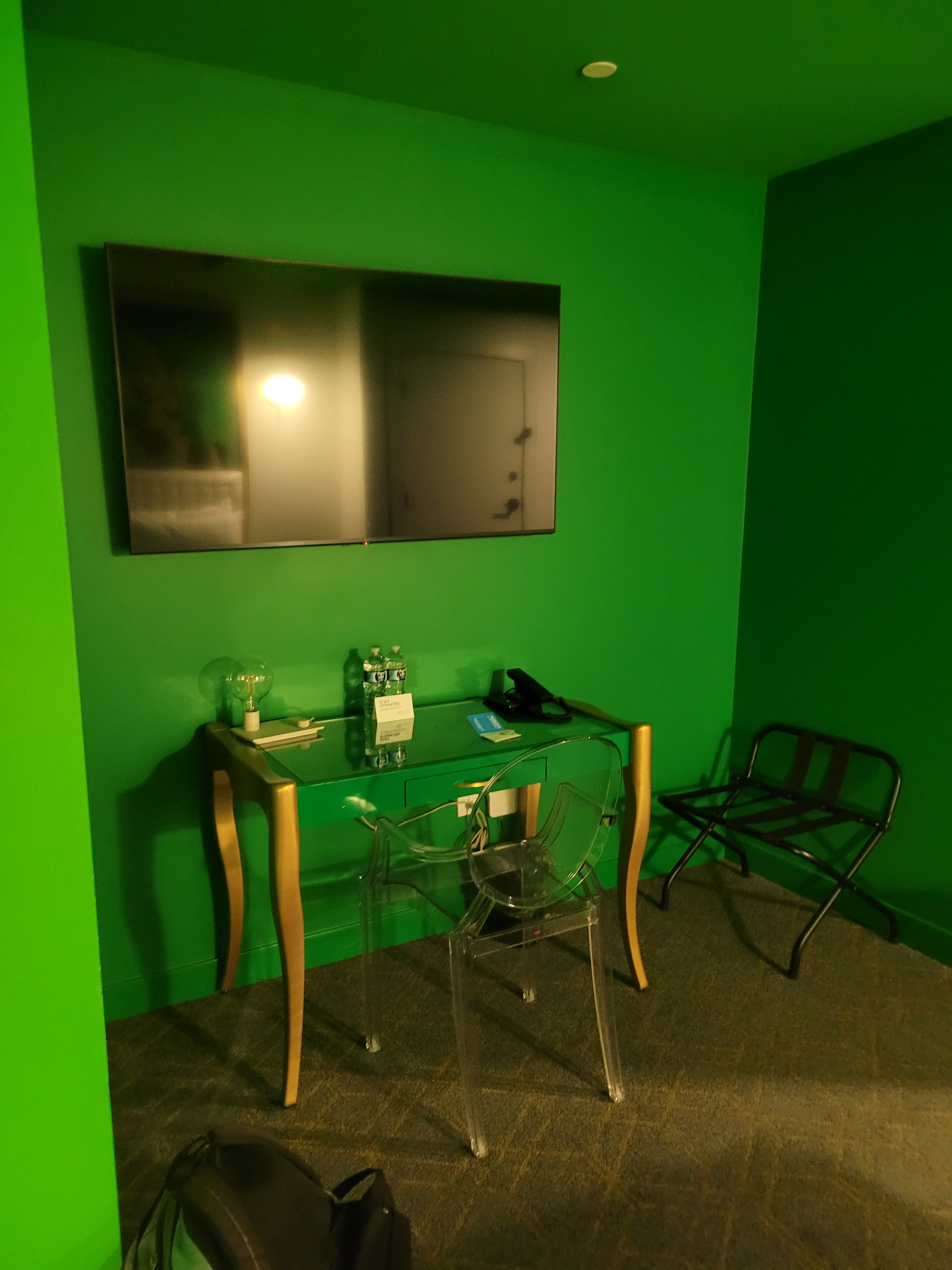
I went into my room and yep- it had been slashed and immersed into Green –
while not my favorite color-the color just hit you immediately and fixtures you might not “see” the first time- hit you as you paid close to the details. Amazing hotel and I was excited. The rooftop looks out all over St. Louis and it a breath taker. As I realized I was getting hungry, I wandered out past St. Louis University, and found Rally’s. Not figuring out the late night entry (doors locked) I found myself at the night window and ordered. The fries were crisp and very good, the pie was similar to McDonald’s but a deeper taste with cinnamon like a churro, only apple inside, and the burger, Big Buford, huge but very good. It hit the spot!
That night as I walked back, the lights illuminating the area around the neighborhood,
seeing the arch in the distance- a great welcoming to a location I had not remembered since 2006 – when the St. Louis Cardinals had won the World Series, I was there for an NCTE conference I believe, and remember the sea of red.
What were the first details you remembered upon arriving in St. Louis? Please tell! Sleep came before I realized it making up for a total count of probably 5 hours in the last two days…but I was excited to get ready for what would be presenting The Girls Who Code’s initiative and seeing what the first day would hold!
Day One Conference
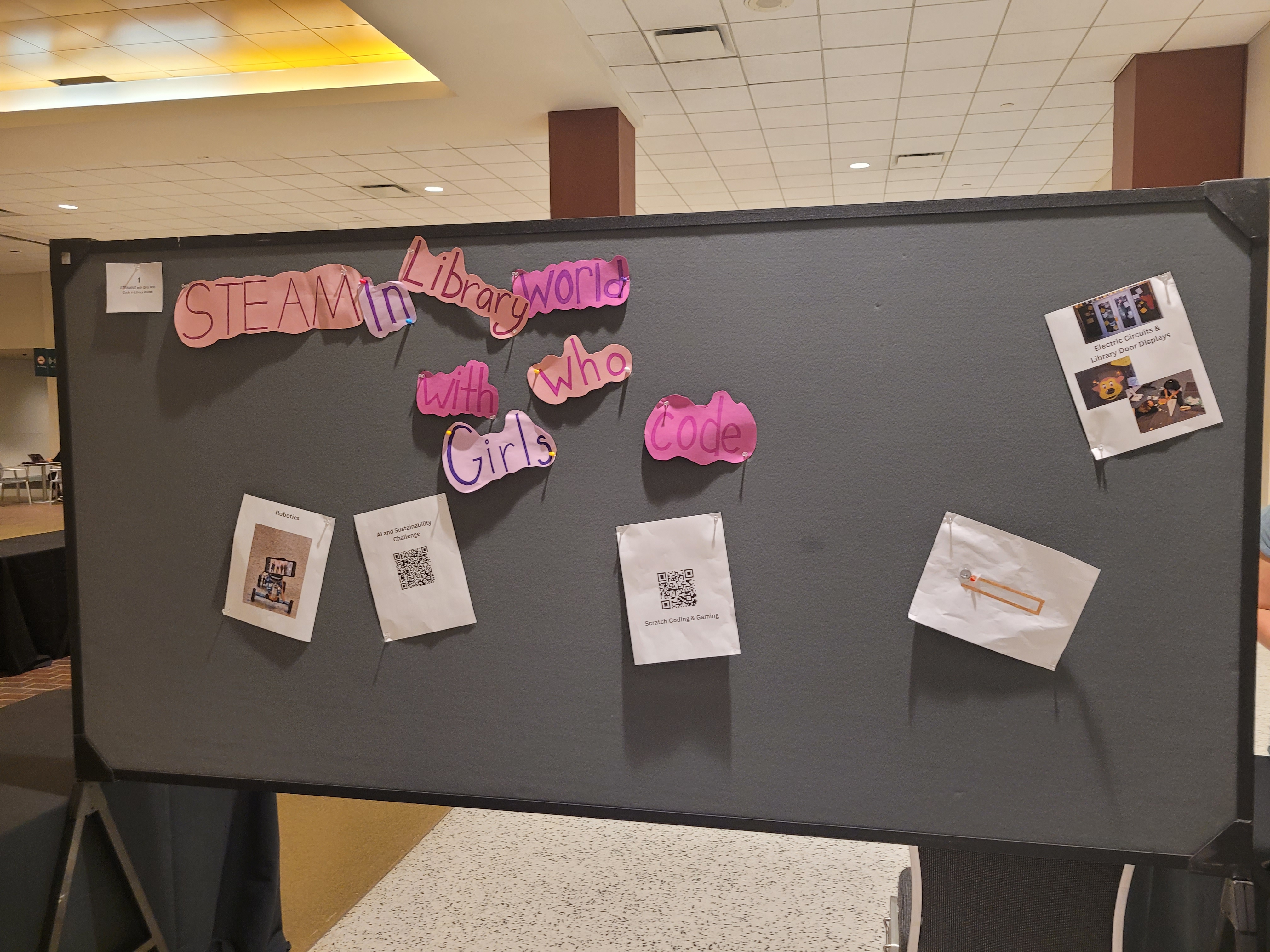
Up at 7:00 (maybe a tad earlier) but YES YES YES! Refreshed with sleep! I found the local Office Depot and I had a list of to do’s from the Girls Who Code- stapler, printouts, color prints oh my- every have one of those days where you go in and come out and voila, need to go back in- this occurred 4 times (I think?!) until finally I simply had to flee. I headed to the St. Louis Convention Center via Lyft, and found my way to the posters in the Exhibit Hall – and…the stapler did not open (this makes it hard to staple on a bulletin. board )- go ahead, try it… :). )
The “neighbor” displayer graciously let me use her extras – and she saved the day! Once we finally had the pieces up on the board – connecting to the students via Teams to get them live – BUT – not only did I get the time zone difference wrong, the Wifi was not connecting and barely doing so with my phone as a hot spot. Over the next 3 hours – we tried to connect to no avail, the poster session started and we had over 25 visitors to talk with but we were all disappointed the wifi and the Teams meeting would fall through. We decided we would get the GWC members to be able to do it again and share with the people that stopped by.
When things went all wrong, did not connect went the way of a tornado – library heroes Misty Boyle, Katelynn Scott, Susan Elizabeth Cordle School Librarian liaison – priceless. When I forgot everything about tech, phones, and connectivity, they made sure they had my back. They were AWESOME. The librarians that stopped? We talked spheroes, they reassured me to tel the ladies that worked overtime to prepare for the conference, they were full of ideas. Together, anything bad could have happened and good would have resulted. That is what librarians are able to do.
Do try some of the QR codes above too !
SO many people stopped by and were not necessarily unknowns to Girls Who Code, but interested in how we were using this as a school library advocacy piece to get the girls into OTHER libraries and also more library enthusiasts are coming into ours. Despite the disappointment we had with connectivity, thanks to the ladies, they created a followup video to send out to all. The conversations we had were numerous, and so excited to see so many interested in these initiatives!
While the day for me was posters and meeting and greeting, then checking out vendors until 4:00 ish, there were ALOT of great sessions happening –
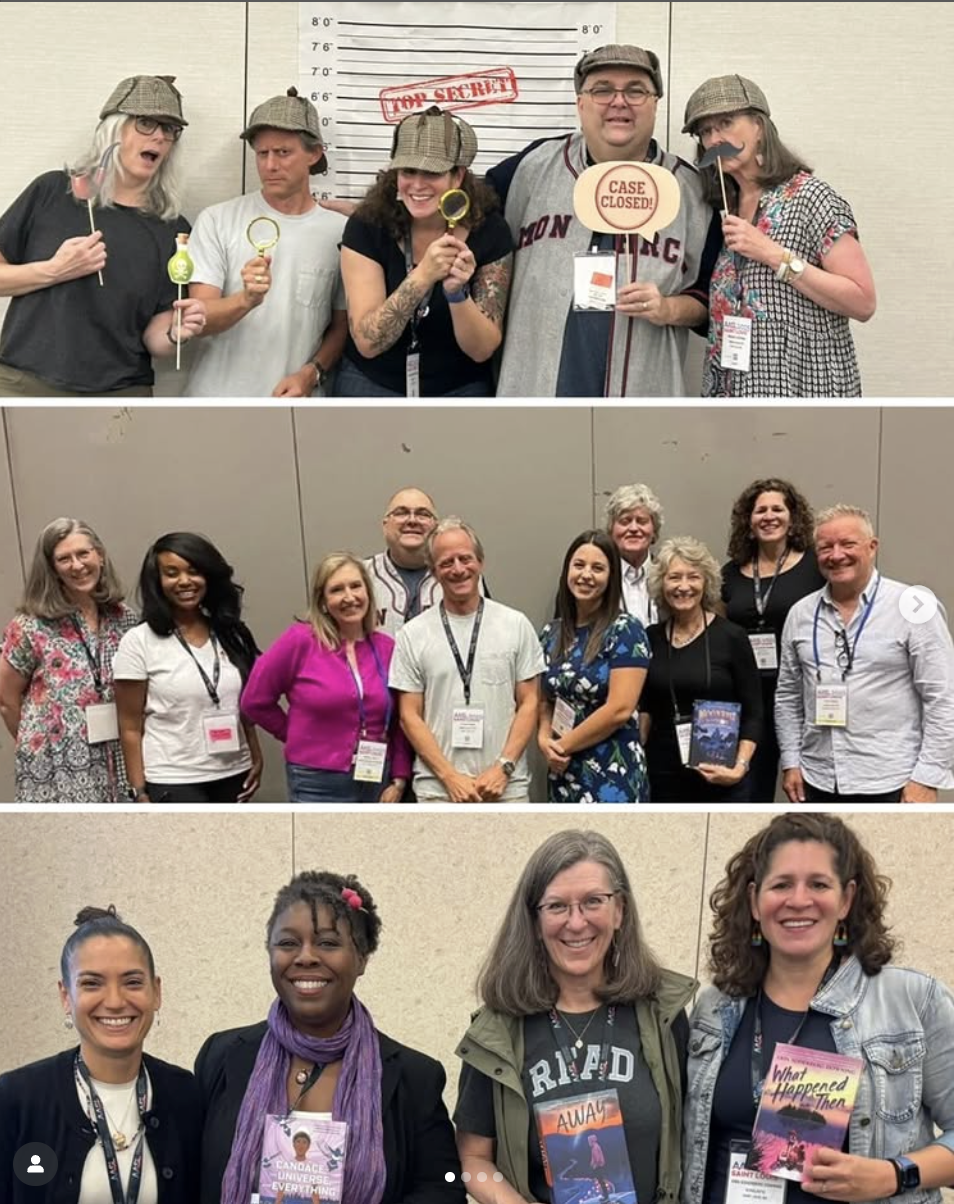
and if you have not come across her, you must check out Christina Personti – The World’s Loudest Librarian – she does a FABULOUS job of keeping you in the AASL loop from top to bottom – and one of the best librarians in the Red Clay District ( I know this from her constant energy to keep providing exciting aspects for her patrons, you will see- check out her instagram!) A guide below to go with her first day Instagram:
Spy party – (There was something similar to this we did in Tampa, and thanks to Christina, we were able to see James Ponti ) he is quite the show and makes everything you love about literacy come alive!
This day was exhausting, nerve wrecking and disappointing when I could not get the ladies from Girls Who Code in front of us, when we planned so much out to stand out for so many –
BUT – this is a great lesson in rebounding from that and coming back with a one-two punch and making up for opportunities that do not, might not, pan out.
Also a note, there are many schools that are mediocre or below when supporting their libraries. Others are not. But when you have amazingly high-caliber, energetic librarians like Christina Personti and Misty Boyle (see below)- that pour so much of their profession and energy into resources to make every day an amazing one, an amazing spy adventure! – for students? HOW COULD YOU NOT REALIZE HOW VALUABLE librarians are and be so grateful for the time they are putting in? If every profession took so much excitement in as these librarians, don’t you think we would be exploding at the seams and pressuring other schools that do not support their librarians even more – BUT – this is what you can do – show these instagrams, posts, and activities to PARENTS, OTHER SCHOOLS, LEGISLATORS,COMMUNITY MEMBERS and make sure they are asking, why do not we have this excitment in EVERY library? Our students deserve this.
Misty Boyle, it was amazing to know how Representative Gorman took the time to check in with Ms. Boyle’s class and meet the students from her library that met at legislative hall this past year over the issue of the necessity of school libraries.
Seeing Representative Gorman‘s October 7th visit to Newark High School’s School Library and willingness to take in the impact and power literacy has is a start- priceless. The reason librarians from all over sacrifice their own money, their own time, their own spaces and often time at home is they realize their students are still in need of so much that is there is not enough of – literacy, mentors, role models, and inspirers like Misty and Christina – but we need the support of families, community members, and other schools to keep that support in front of the people who might not see the day to day impacts – administrators and superintendents. Please help us keep litereacy growing with your voice, questions and inquiries. We need all of you!
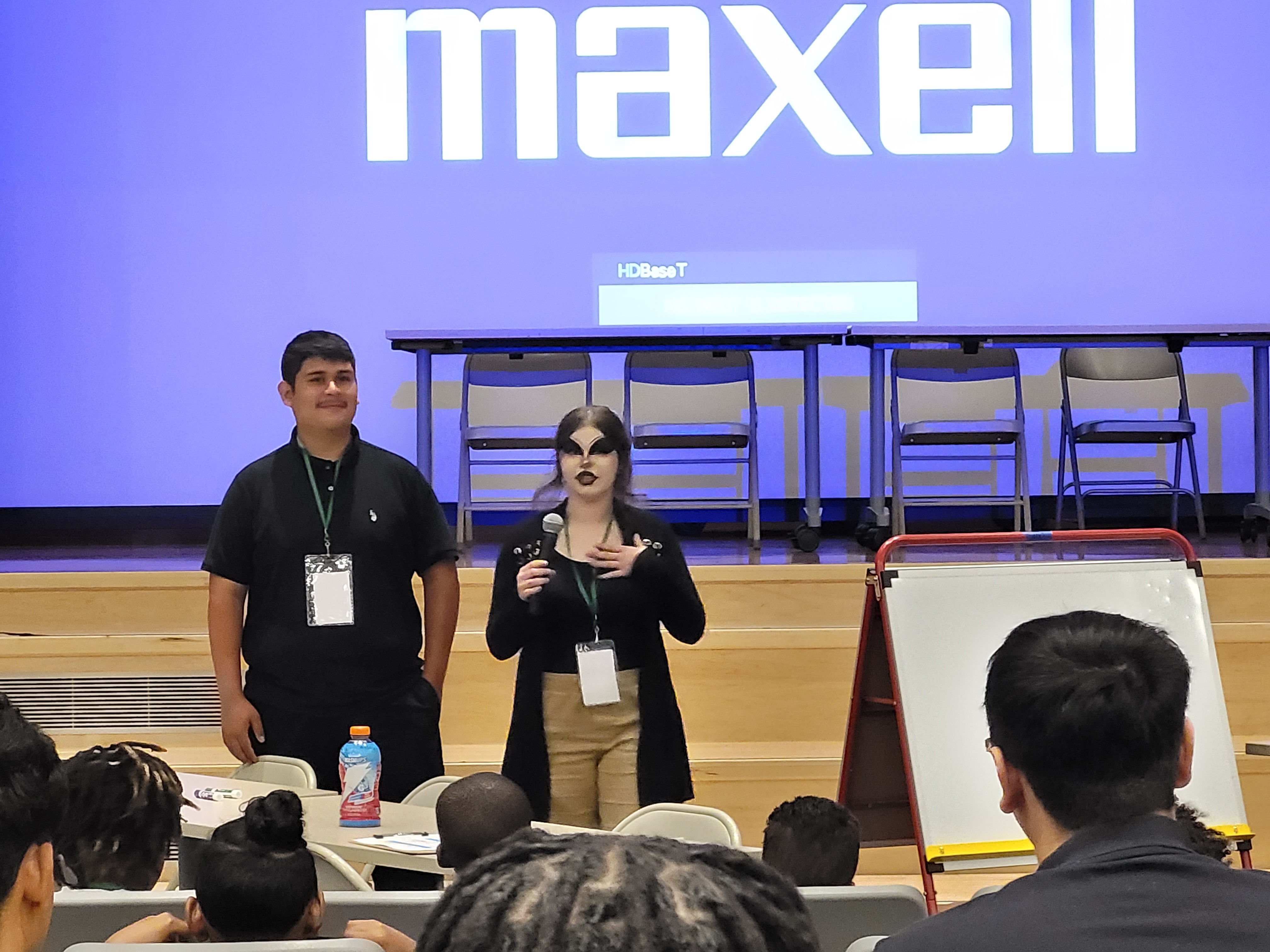
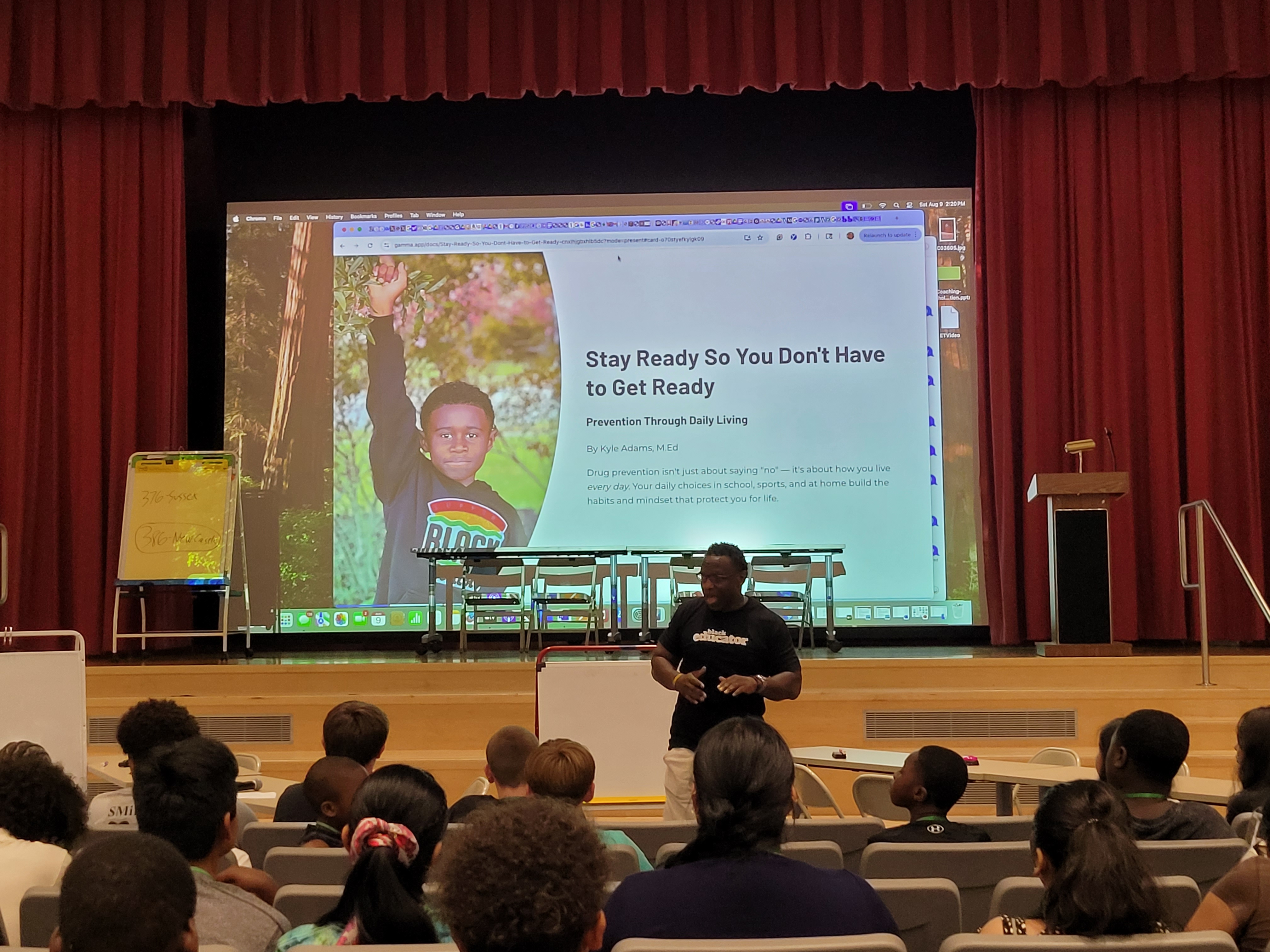
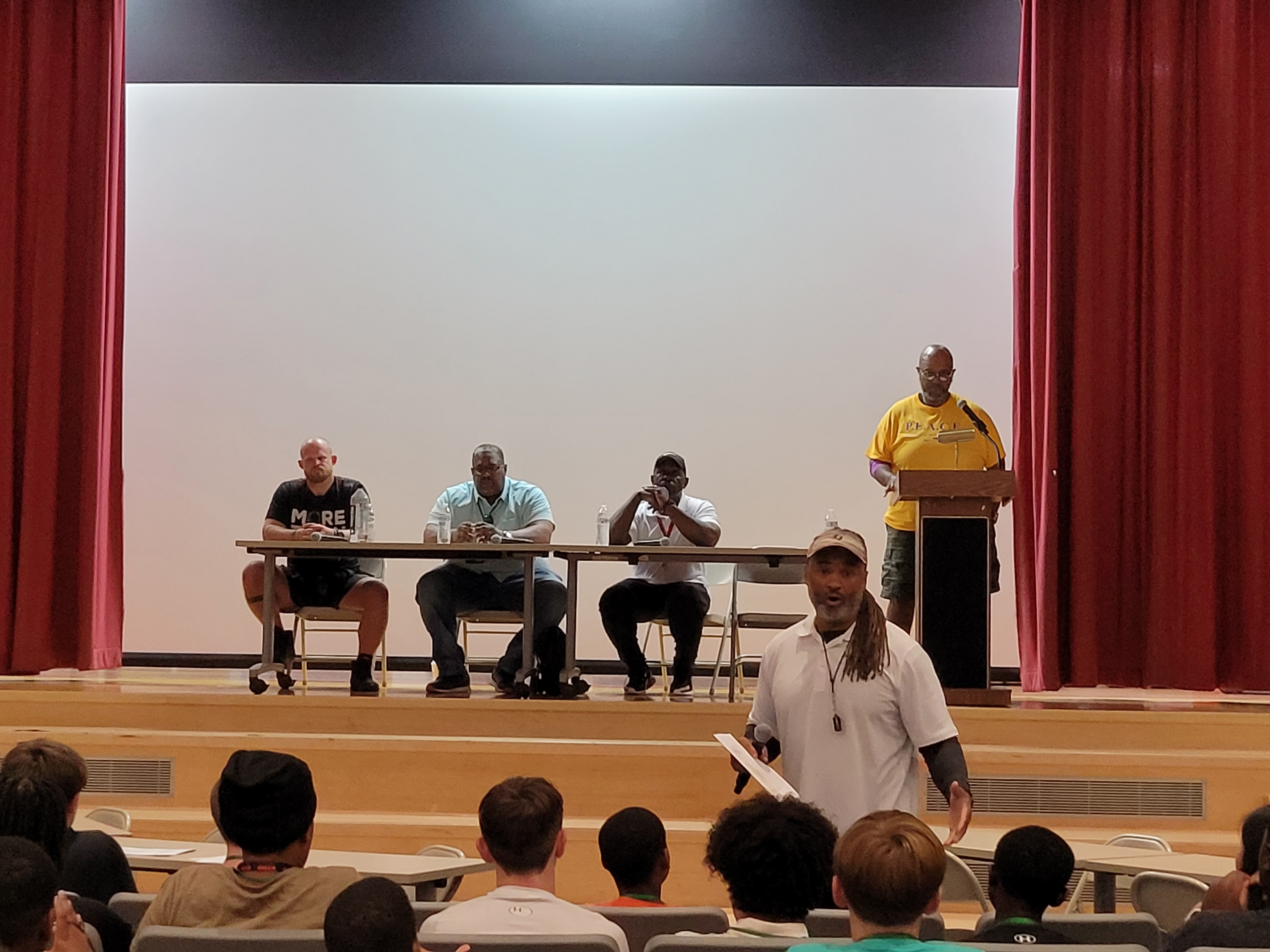
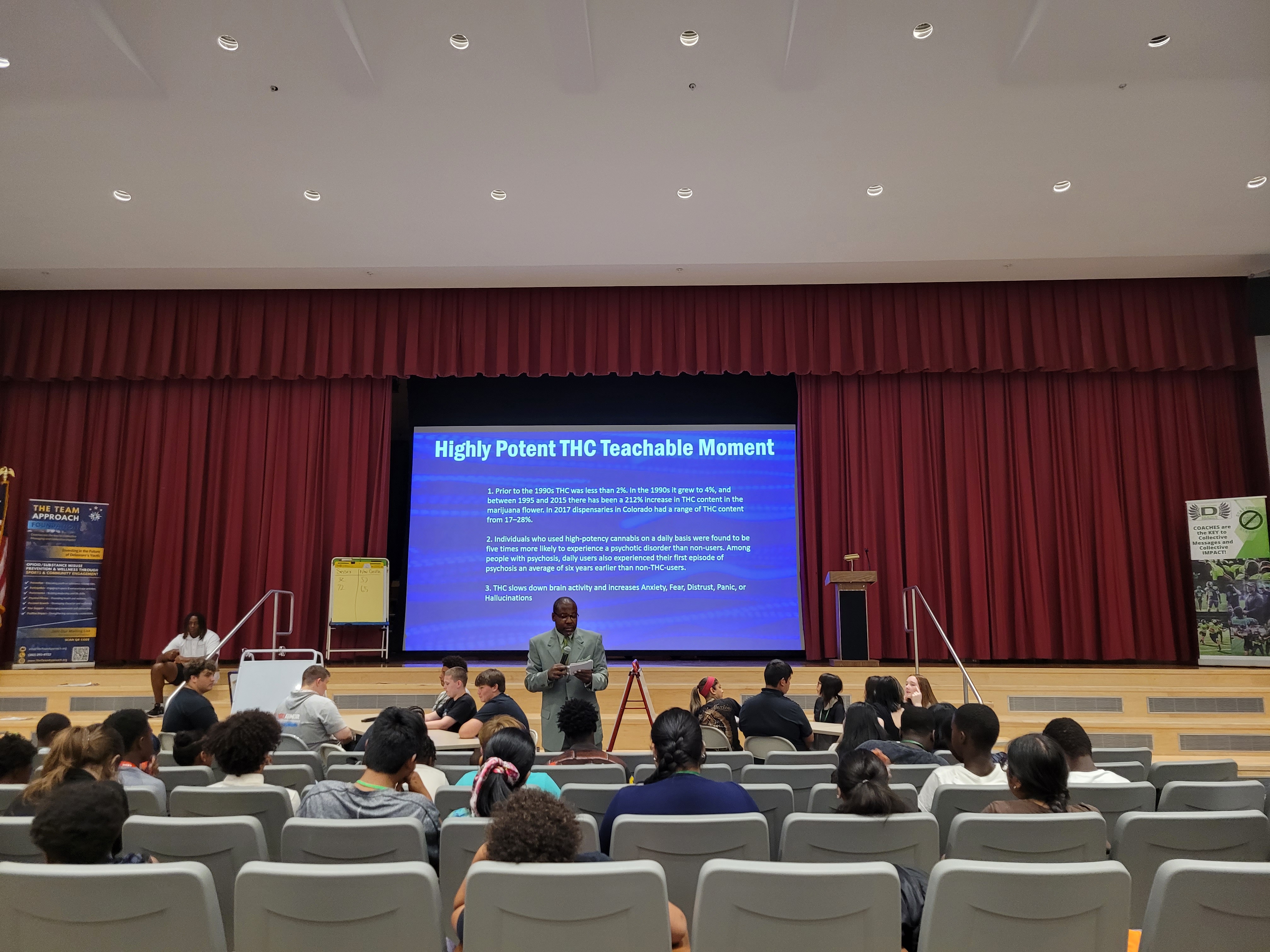
Seventeen students from Sussex County representing the Youth for School Libraries group and Upward Bound- Georgetown were invited to attend the 4th Annual Youth Sports Mini Conference & Football Jamboree at Claymont Elementary School, in Claymont Delaware on Saturday, August 9th, 2025. What does that mean? I will be honest, I didn’t know what that meant either but somewhere in my gut I knew it was important to have some of the most positive, talented, and potential-filled students I knew, to be mentors and co-conspirators in an event that would benefit themselves as well as benefit others as well. Before I go further, HUGE kudos to Coach J, Coach Joe, and Carmina Taylor for thinking of people they NEVER met, to bring us into their fold.
This is what I knew. Activities were put together to educate youth AND parents on the pitfalls and dangers of substance abuse and addiction on many levels. One main theme kept coming across from this event – “Coaches Are The Key To Collective Messaging and Collective Impact”. We found out, you do not have to be a coach in the literal sense as well, to motivate someone else, but there are athletic coaches that serve as magnets of positivity, sportsmanship, and doing the right thing and to keep you on the straight and narrow.
I am not built like the typical, physical coach, so my vocal power needs to come in another form, but the coaches represented at Saturday’s event were all business about keeping a VERY lively, young student group in the circle of what they needed to do to survive what can be an often brutal and unforgiving world. We realized how lucky students were to have adult mentors that would take time away from their summer to want to impact their lives in a better way. Some of the best behaved youth I have seen, soaking in aspects of life that could easily derail them, and yet being delivered through their mode of interest- sports and social media, occurred around us.
I have to say, the challenge was very real for our seventeen students that represented Sussex County. Many of our students had just come off an overnight trip from Upward Bound, others had called their day off work. Even more took time away from family, events on a Saturday to devote even more time to children from other families, to stand among them during an all-day event that demanded their physical, mental, and social presence. This all amid the goals to discuss topics that are usually presented to them in the halls, streets, and hidden away areas of their immediate communities. From substance abuse, dabbing, the impact of alcohol, drug use, subtance abuse, peer pressure, loss, to anything that can take the focus of their lives, let alone their literal lives, was touched upon.
It would be easy to keep patting these seventeen students on the back but it was said, “The cost of a thing is the amount of what I will call life which is required to be exchanged for it, immediately or in the long run.” (Henry David Thoreau), In calling your attention to these Sussex County students who found themselves surrounded by younger students running, hyped up and excited beyond their own wildest dreams, surrounded by louder sounds than they normally would ever experience, saw alot of reinforcement and younger children struggling with attention, being redirected to focus their attention from the physical activities they were so good at to the mental attention needed to take in the message from adults they never knew and some they did know, and as Ms, Carmina Taylor put it, it is a different world. It being a different world applied to all present in many ways – ages activity, energy- Sussex County delving into the experiences of a camp in New Castle County, across county borders, age difference of high school versus elementary and middle school, single parent families and grandparents, aunts, and uncles as well as parents compared to two parent families, individuals confronted with decisions about substance use versus not being tempted by these distractions and so many more, it is much to take in. ALL in ONE day.
Was there chair kicking, some acting out behaviors, and shock at seeing a loud voice, an athletic/military, strong voice repeated and necessary to draw attention to youth and delving into the physical world of exercise and pushups to reinforce better habits.? I would say on a shock level of our students’ experience, seeing this was high in their surprise and reactions. Yet, not having been exposed to the reality of younger children’s lives on a daily and high number basis (for most) is indeed a shock, but more importantly, being AWARE of these children’s needs and knowing the value of having our representative student body, being a part of New Castle and Kent’s representative body for a day, even if younger and older students struggled with aspects of the day, was better than the alternative of not. Turning a blind eye to any of these youth, from any age, youngest to oldest, would be the most defining mistake as many have done already due to substance abuse.
I am VERY impressed with the young athletes and children that Sussex County students met and interacted with – something that would never normally happen without an invite from New Castle County mentors and coaches. It helped show that despite the inherent tendency to be pitted against each other based on county, the needs of youth from the STATE can be tackled and addressed only if we put the stereotypes, preconceptions, and feelings of privileges aside and work together as children, students, athletes, parents, teachers, leaders, coaches, and administrators tied to education.
From our BUS DRIVER Tamari who met our STUDENTS at 7:00 AM at Del Tech, Georgetown traveling to New Castle County, traveling through traffic about 2 1/2 hours to the mini conference, to the COACHES and PARENTS we met and who welcomed us at the doors of their Claymont Elementary School, and then put us in the mix of STUDENTS from all ages, backgrounds, varied levels of discipline, behavior, attention, and ability, to the PARENTS of these attending students from New Castle County to Sussex County, alot happened and alot was present to take in. Alot. There were aspects of the day that were struggles for everyone to work through, from the stories of parents who lost children to abuse or aunts and uncles that were parents because parents of those children succumbed to abuse, to student’s testimonies of losing a parent to abuse, to the onset of exhaustion from the directors of this conference to push through and get important messages to the youth, to the exhaustion of students to take in so much energy, cues of behavior, as well as direct their abilities to participating and being a mentor to someone next to them- that is just a small picture of the dynamics of what students and adults had to take in, during one day.
Yet, and let me say YET, everyone present did something that so many others not present did not. ALL sacrificed their time to each other to reinforce make an effort to be present in what might be uncomfortable topics, situations, behaviors and scenarios to support each other. When all could have been at the playground, the athletic field of choice, on a shopping day, a beach day, a sleep day, a play day, a rest day., wow. It is often easier to pick the latter, but whether the youth and adults realized it, the time they sacrificed for each other, when many would not, lends itself to the needs of so many of our youth that are in need of support that face our communities, and those willing to provide it. Not cities, not different counties, and not just as a state, but as a COMMUNITY, which knows no county, city, or municipality borders.
I cannot say enough about how proud I am of the young children that are athletes and students, the middle and high schools students who also willingly gave up a summer day so close to school for each other, and of course the parents of ALL the attendees, parents of the youth attending, as well as the coaches and mentors that willingly give up more than a WEEK (at least) to make this happen. This involves getting transportation to bring students from other counties to attend, as well as providing food, space, resources, athletic equipment and MORE to make one day occur. Not to mention the special speakers to ask to do the same, and organizational leaders to be present, to make this all happen.
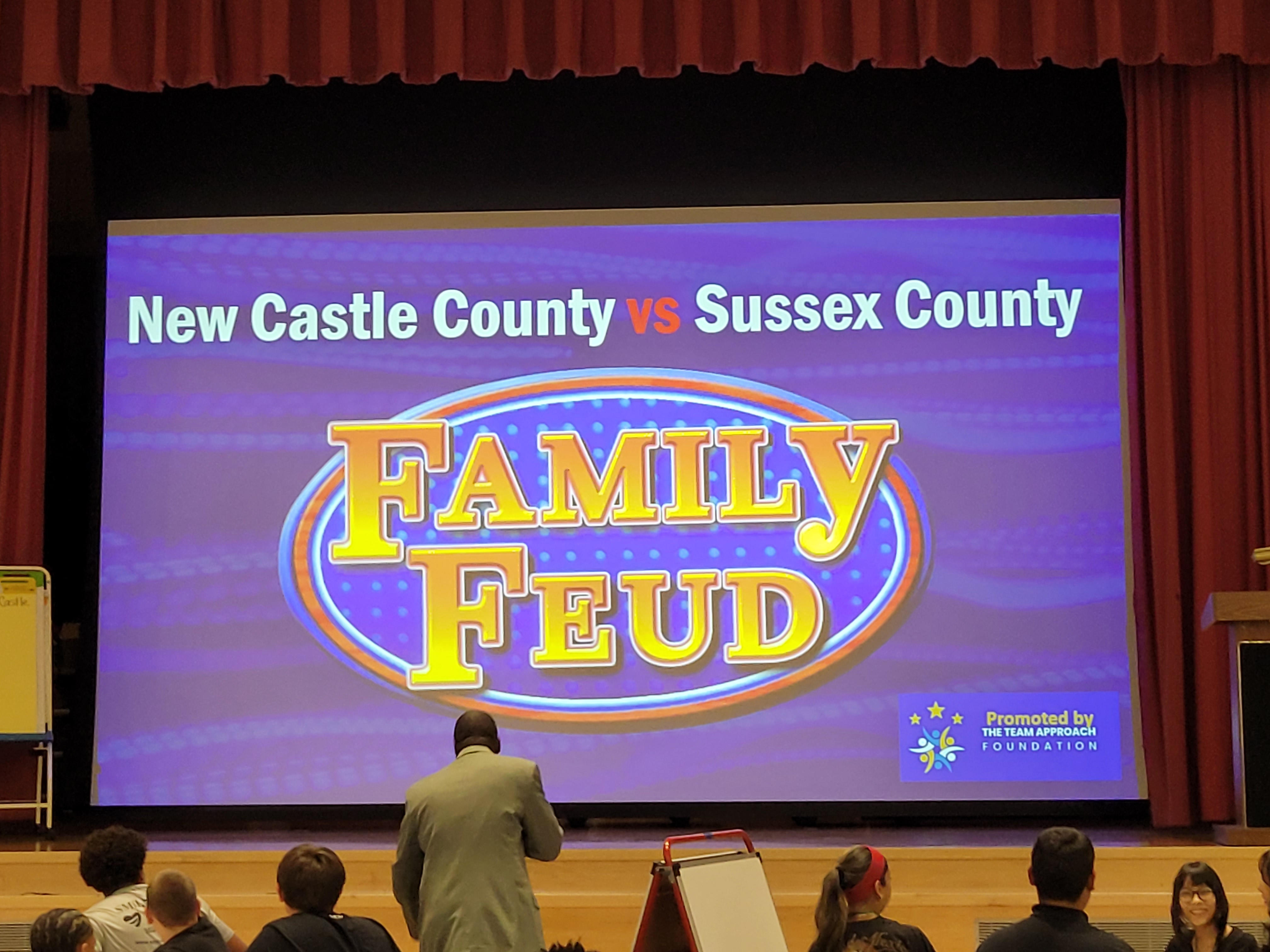
Sometimes it has been said actions speak louder than words. That can go both ways as you know, causing positive and negative responses to actions all see around them. Our students from Sussex County put themselves into an unknown situation of people they never met from another county, and New Castle and Kent County did the same, and many served as key speakers, presenters, and participants in a Family Feud game among a myriad of other activities- all of those combined is alot to willingly expose yourself to on a summer day.
Let’s take a look at what youth from Kent and New County also had to do – they ALSO had to give up their summer day to listen to many older adults than them talk about topics and situations they often DID come into contact with, that are more than not positive topics they deal with every day. Often, their over-the-top-energy and need to be moving constantly might be their best way to deal with uncomfortable situations that they feel and do not know how to verbalize, so to deal with these situations they act out, speak out, or sometimes shut down due to the anxiety, fear, nervousness or sadness they are experiencing. I felt inside it was 100% important for all to experience these feelings to begin to understand each other, instead of judging each other. And that is where a fresh start can occur where as a state, we can meet each other and provide moments of support where we can support each other.
One of the students we brought from Sussex County, Mariela, told me a younger student came up to her and told her she did a GREAT job! It took her by surprise as a high school student, having a student half her age tell her that. Another moment was when she expressed frustration at a younger student was kicking her chair, talking and whispering crazy comments about his classroom experiences and distracting her during some of the testimonies of experiences from the presenting adults. I realized, and so did all the students there, to learn and to push through hard situations often does not involve lashing out at something/ or even the urge to pull away from a situation that causes you uncomfortability, anger, disappointment, or a sense of loss, but to find motivation to push through and find an inner strength to work through it, will not have its benefits until later, for yourself as an individual as well as all those that surround us, a community. To do this, defies the misstep of the impacts of stereotyping, acting as someone of privilege around others, dealing with acts of harassment, sexism, racism, bigotry, being overwhelmed and seduced by social media, and more. Life is too short to be caught up in these pitfalls as we sadly find out later and lose the ability to impacts someone else’s life positively.
Yet, in one day, so many individuals decided to not be counted as individuals and power through many challenges to work as a community. With or without being involved in a sport, that is the true definition of sportsmanship. Kudos to everyone, from 6 years old to 70 years old that were part of this day. It certainly changes the landscape of what our futures can be.
When I heard these words from an inspirational student at the beginning of the Lead and Learn DSEA conference, I knew that we were off to the right start.
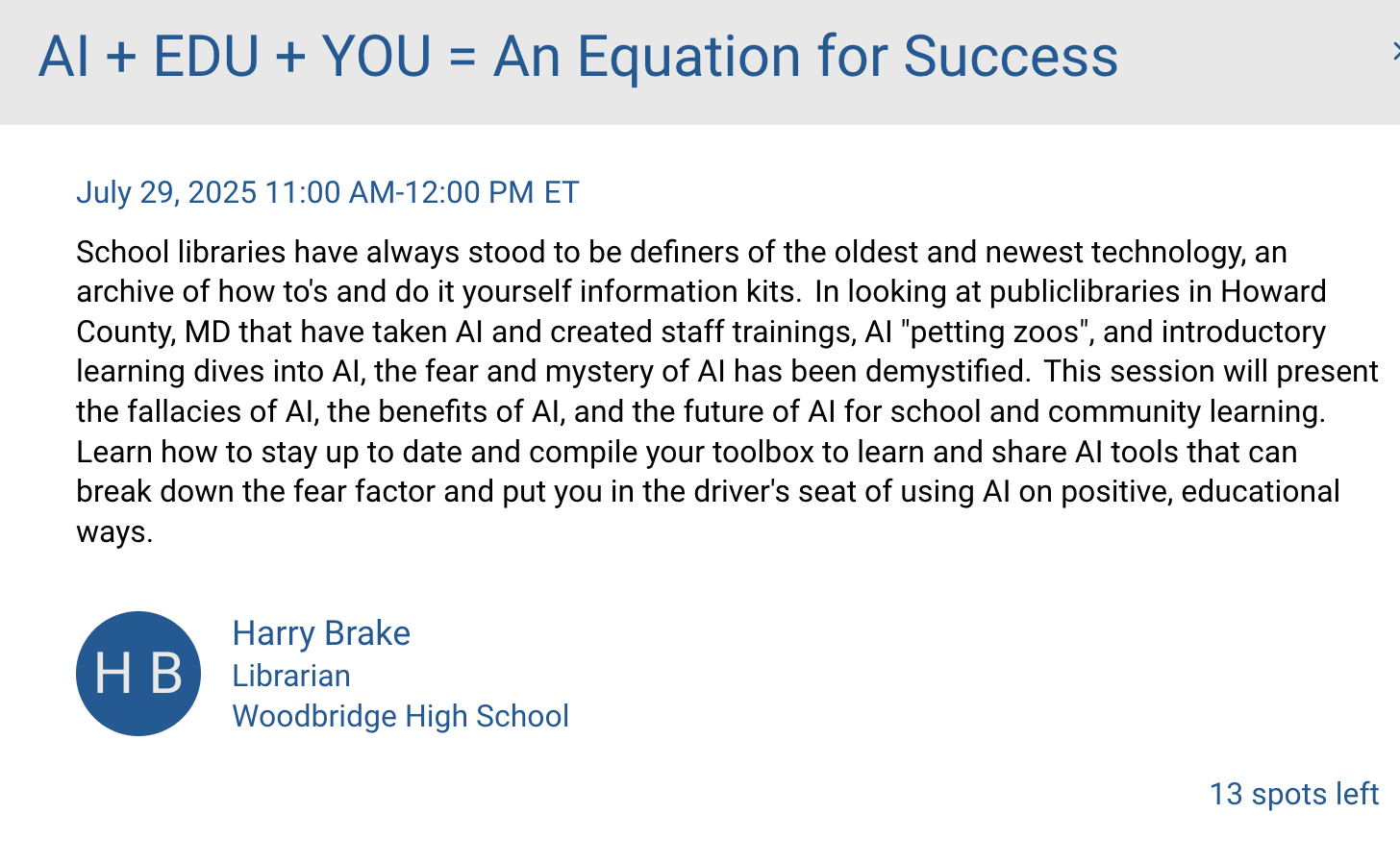
In May, Kathy Dulis, asked, “DSEA is holding a two-day conference in July (July 29th and 30th) on the campus of the University of Delaware. Do you have any interest in facilitating a session on AI and the impact it has on academics?” I thought hmmm, I haven’t dabbled into AI details for a while, why not?
As I made my way of the morning of the 29th, up to the John M. Clayton Hall, (a great venue!), I wondered, what about AI could I, would I, be able to present that would not have to change minds about AI, but just open minds? I mused about how AI has swooped onto the scene in buzz, yet how it has been with us for quite awhile and how we, as educators, learners, ourselves, and mentors, as well as students, would grapple with the questions and fears many had.
(Josh, the IT Specialist on hand, by the way, was AWESOME. All that anyone needed for the conference, he was lightning! Thanks Josh!)
It might sound insignificant, but having a formal land dedication was the reminder of how so often, key people have been forgotten and need to be part of our Delaware story.
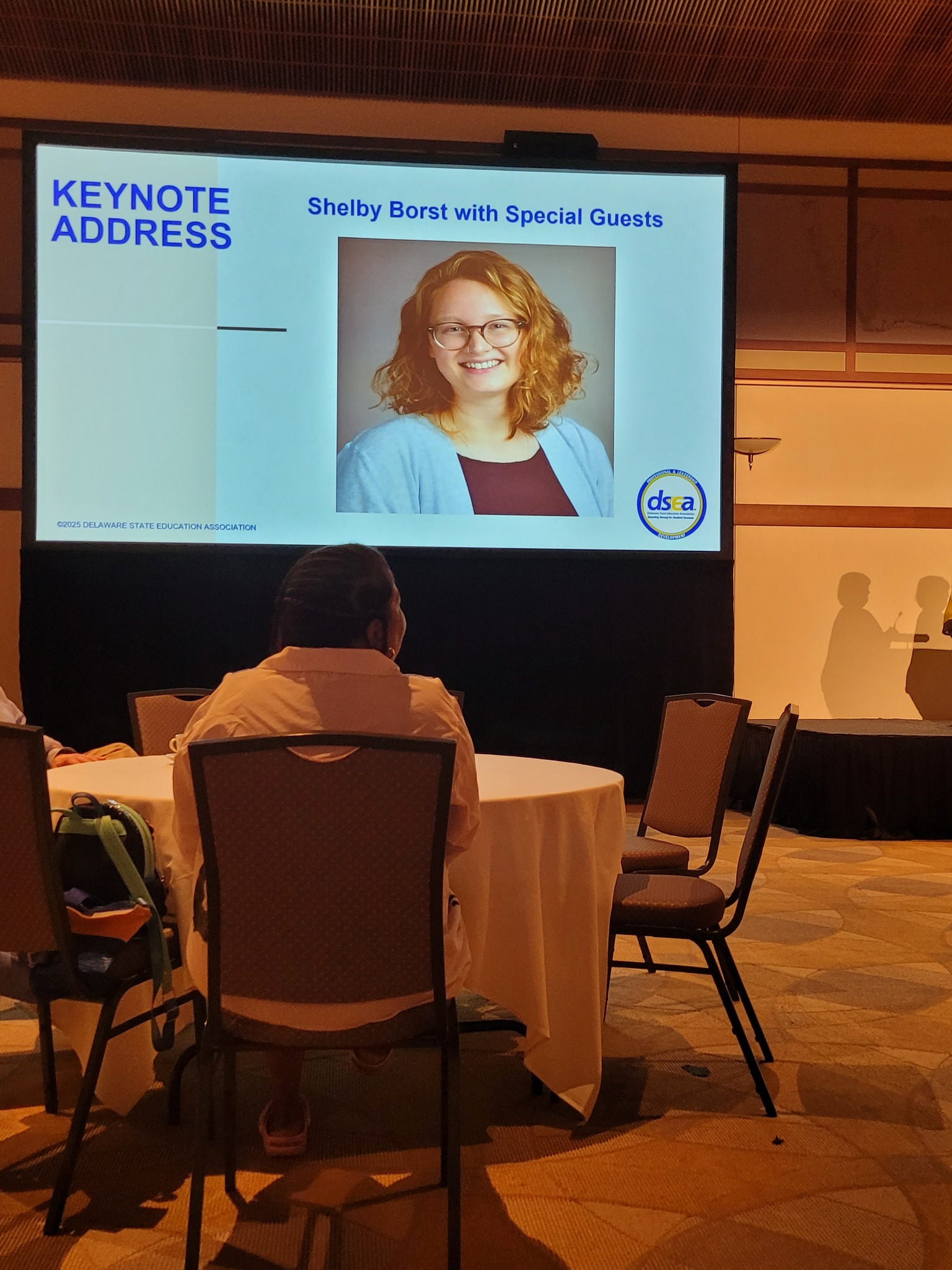
Hearing President Stephanie Ingram reinforce the need for us to grow stronger, better, and have more foresight as educators fell in line with what we all felt we were feeling with the tumultuous path we are setting on in the present day. I felt very at ease and no nervousness as I made it in the nick of time to snag breakfast, and settled down to friendly conversation with attending members. When the Delaware State teacher of the Year, Shelby Borst came to the stage. I liked her stories of collaboration and teamwork with her experience at NASA Space Camp and then, she shared the stage to have two of her students also be part of the key note. I LOVED THIS!
I always hoped to see more students be actively involved in conferences, legislation, advocacy, and more, and always have wanted to see this occur on a higher level. When Jael Avwomakpa and Drew Crute shared their heartfelt desires to be heard, to learn, to be taught in a way that inspired them, it inspired each of us. The attendees were hanging on their every word and I knew we were among the right group, these were our people. There are moments when students in leadership positions are nervous and sometimes it just feels like words. Other times, the words fly to your heart and make you realize the need and agreements that need to occur between educator and student, and this might not always be the way WE were taught. This was such a moment and set the tone for the day ten-fold.
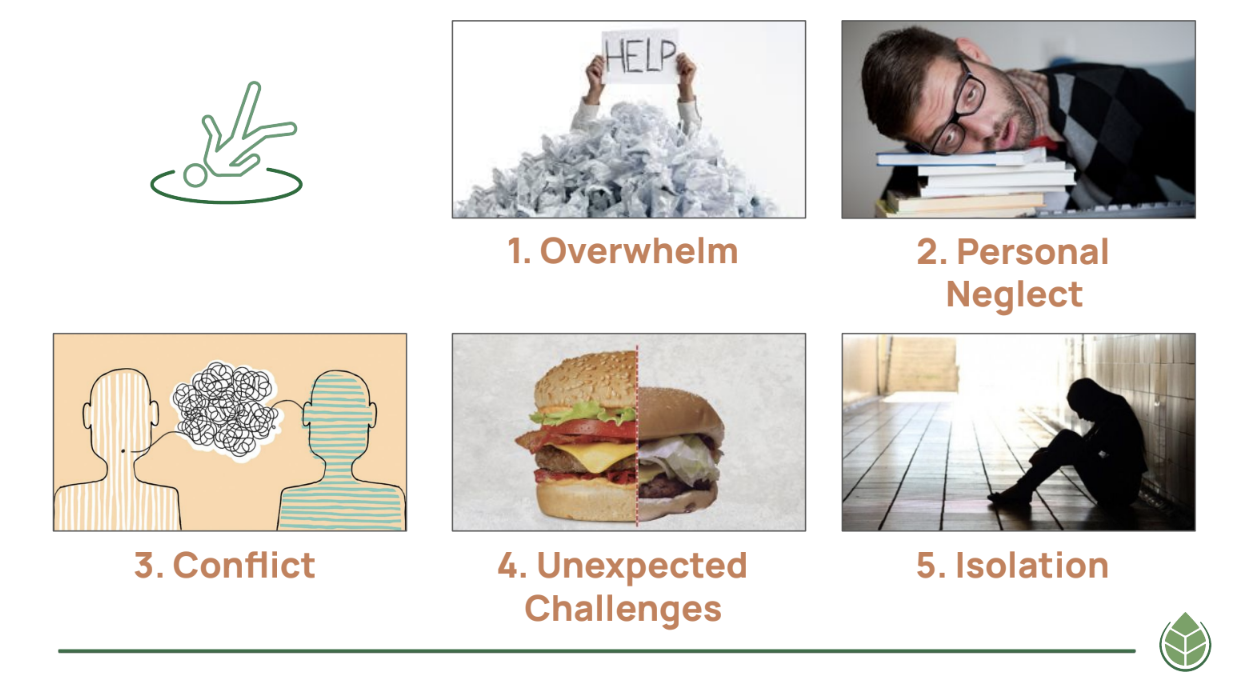
In attending the first session, The Five Pitfalls, so much resonated and put the attendees into a space of ease. Tyler Hester, Co-founder and CEO of Educators Thriving,
presented an array of resources, strategies and tools that hit directly at the need for taking care of ourselves as educators, taking care of others, and implementing strategies that bring everyone together in the learning circle, but in a safe and comfortable space where there is so much chaos that surrounds educators and learners every day. The workshops that provide instant comfort, resonate with our experiences, provide tools that can be immediate and impactful AND improve out passions in and out of the classroom? They are ones that stay with us way past the conference itself. This was such a session.
In working through routine areas that can shorten our lifespans as educators,
(and learners) while finding the positive spins that impact us and can launch our day in a better direction, we grew tightly together as a workshop audience in a short amount of time. We listened to each other, we provided feedback to each other, and on top of that, learned how to build resilience in ourselves as well as those that surround us. This is what many needed, need, and desire as part of their career experience.
Heading to my session on AI, a twinge of nervousness occurred, but evaporated quickly with the conversations of curiosity that occurred before the session.
What I found through all the sessions I presented (and attended) was astounding. The stories of wanting to utilize AI for was to reach students, and other teachers, on a personal level seems like an oxymoron. Yet, the sharing and desires of all of us, being passed backed and forth, helping and suggesting each other through the process, enhanced the content I wanted to share. Making sure to let others see how students have interpreted the information, experiences, and provide insight into most of the information I had been obtaining was a cornerstone of what I had learned over the last three months. When students are the cornerstone of all learning, and part of the planning, implementation, and evaluating process of learning, amazing things begin to happen.
After my third presentation session, I had met some amazing educators, learned much more than I thought I knew coming into the session, and also had gathered alot of inquiries to follow us as a librarian. It seemed fitting as this what I strive to do and show what Library Media Specialists do on a diverse and intricate level. I was able to do this among some of the most interesting educators in Delaware!
Returning back to the closing of the day (HOW WAS THIS OVER ALREADY?) student Drew Crute’s poem reminded us there is a very thin separation between students and educators when it comes to the roles we can play in each other’s lives every day, especially when it becomes the style and format of educating each other. Obviously things need to change to support both educators and students for the long term, and today was an amazing microcosm of how this can occur, with students beside educators each step of the way.
If you have ever doubted the extensions that could exist beyond the immediate lessons of the Upward Bound program, look further!
Just today, the information that we have received regarding the population rise in Germany following the Holocaust, the changes occurring iat a higher level with the Naval Academy, as well as continued information/research that exists on Harriet Tubman, are a few news worthy followups to severa research-based excursions on the part of Upward Bound. What extensions of information will exist from today’s visit to the visit to the University of Pennsylvania today?
German Citizenship rising following Anti-Semitism Fears – When I first heard this article, I thought about the irony of this happening.
A focus on a new Superintendent at the Naval Academy as well as the Naval Academy’s Library has been interesting to see changes occurring due to a new administration.
“Defense Secretary Pete Hegseth’s recent focus on the U.S. Naval Academy has largely been limited to the institution’s on-campus library, and his desire to remove hundreds of books that the administration considers politically unacceptable.”
You may or may not have heard of Upward Bound aka the TRIO Program. When I lived in Mexico, I was a staunch supporter of Outward Bound, close in words but relying on the outdoor experience to ground you in the life we live from day to day. This was my absolute favorite approach to experiencing life around us. I learned so many deep seeded aspects of life I took for granted.
In Upward Bound, the same occurs but in many facets. It is one thing to provide experiences and stepping stones to students who may not ever have the opportunity to go to college, visit colleges or institutions post high school, offer classes all year long and in the summer to bolster their academic preparedness, teach peer social interaction communication, and leadership skills, as well as help grow the qualities of cultural awareness due to field trips and licensed experts in various fields.
YET, above and beyond all of the above that the TRIO program provides- what you do to extend and incorporate the knowledge gained from the above opportunities, how you make these experiences substantial and internal, makes a difference after they occur.
One specific example is when students attended the Holocaust Museum. I have been in over 6 professional summer and off summer institutes, seminars, training, and professional development sessions for over 20 + years, and I found even now, walking through the Holocaust Museum, I still am at a loss of words, but much I learn and my emotions STILL run over with every subsequent visit.
In choosing the graphic novel adaptation of Anne Frank for this year’s Math & Science focus- was part and partial in trying to connect the importance of the overall theme and connect to the original diary, as well as the events that bring out the value in this study.
Students designed parchment paper to mount the best photo they came away with that connects the theme of the Diary of Anne Frank to the Holocaust in their mind, compared the Diary of Anne Frank to sections of the graphic novel, pulled vocabulary and discussed examples of that vocabulary in the graphic novel, listened to memoirs of survivors and highlighted key points that aligned with what they knew about the Holocaust, and that was just the beginning, all in six weeks.
FIRST, on the way to the Holocaust Museum, students were given a series of questions that were created by a colleague, Ms. Fisher years ago. That these questions were still relevant today is important. These can be found HERE– and take into consideration, not all the answers you will see reflect a complete knowledge of the Holocaust on purpose. ALL answers were recorded and listed, and many occurred before and during the visit to the museum. It was important to know and preserve the questions in their original state, and seeing so many of the same, some not exactly correct and just rereading the answers given, created a feeling I cannot explain about this experience.
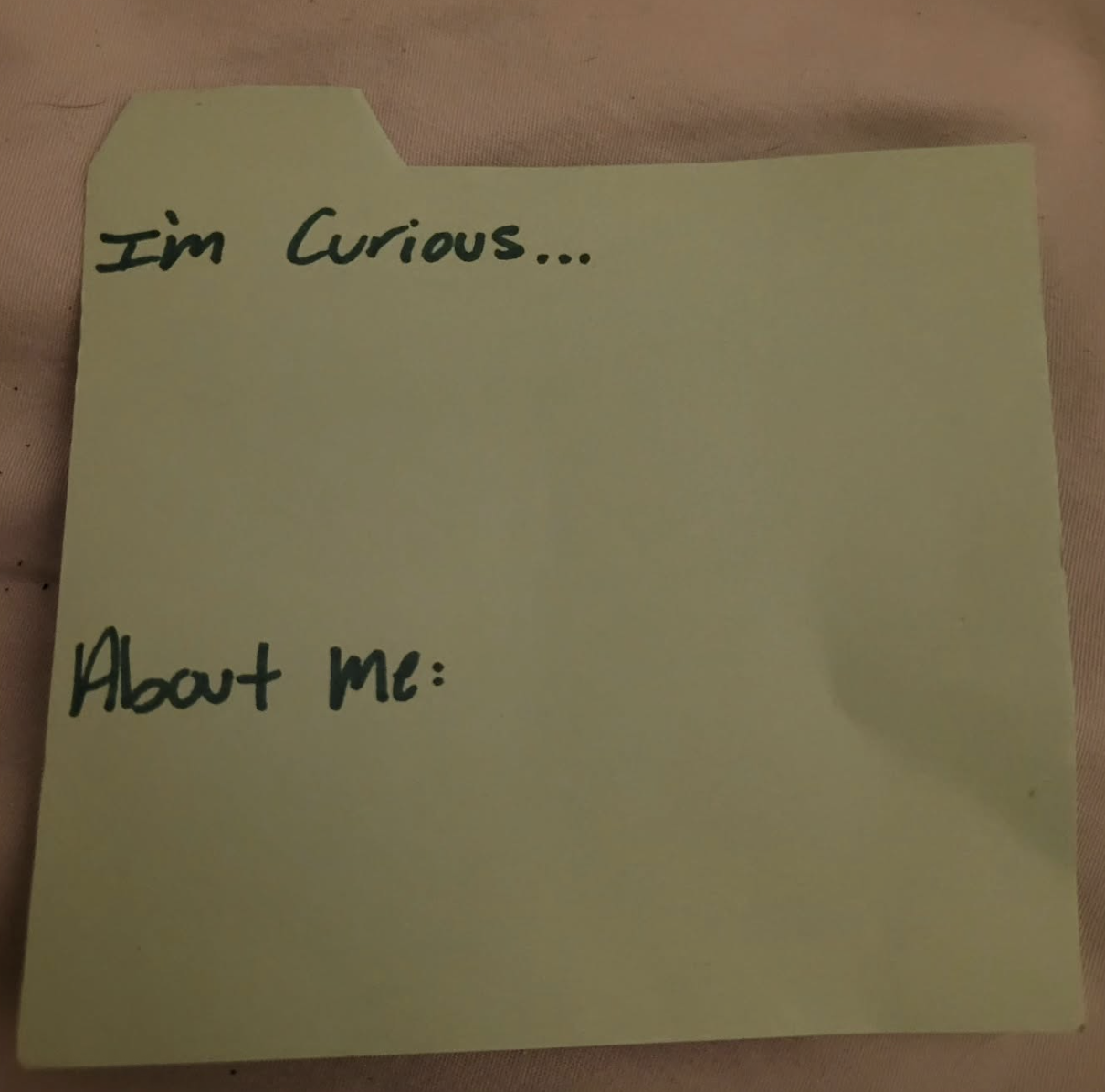
Second, again before the Holocaust Museum visit, students were given smal file cards that said,
“I’m Curious” and also “About Me”. I asked students, that had been in my Diary of Anne Frank graphic novel English class and those that had not as well, to fill these out based on what they were curious about in the Holocaust and then from THEIR perspective, (for the About Me part), list why they thought the Holocaust was a relevant topic for today.
The idea from these smaller index cards was an idea I saw at the Dr. Martin Luther King Jr. Memorial Library in D.C., where when you walked in, you see these cards left behind from visitors and you can read through them, just like a former card catalog, and get a gauge of the visitor’s perspectives on various topics in the museum. Those cards and the student’s inquiries followed up with answers and links to valuable resources than enhance their questions, can be found HERE.
In a time where Upward Bound is being considered to be defunded,
I hope this glimpse into one small aspect of how experiences are brought to the forefront, helps show you how connected and vital this program is for so many people, and is connected to so many aspects of our community like the Humanities. The Upward Bound Program when implemented, enriches both adults and students alike in ways that escape words and is worthy of the existence it provides for so many.
I. Questions listed below that were given before and during Holocaust trip
The planned killing of a group because of their identity.
The mass destruction of ethnic groups (Answer repeated twice).
To destroy racial groups.
Mass destruction of an ethnic group.
People killing a whole group.
Genocide is when a certain group of people are mass murdered.
Genocide is the killing of a. certain race.
Genocide is when a group of people is purposely harmed, attacked, or even wiped out because of their race, religion, ethnicity, or nationality. It’s not just random violence, it’s planned and targeted, with the goal of destroying that minority group of people completely.
The mass extermination of a specific race.
A person killing a group of people.
Genocide is the systematic killing of a group of people.
Killings of people – race, religion.
Genocide (to wipe out) destroy and kill deliberately an entire group based off their religion, ethnicity, and nationality.
Killing of a large group of people.
To destroy religious groups.
When we refer to the “holocaust”, what time period are we talking about?
1933- 1945.
Usually around 1933-1945.
Mid 1900’s.
1935-1945.
1941-1945.
When we refer to the holocaust, we are usually talking about the time period from 1941 to 1945, during WWII, when Nazi Germany under Adolf Hitler, carried out the systematic genocide of German Jews, along with millions of others- including Gypsies, disabled individuals, Poles, prisoners of war and other groups. Some historians also consider the broader period from 1933 to 1945 starting when Hitler came in power when anti Jewish Laws, discrimination, and persecution began. But most killings were from 1941 to 1945.
What levels of German society were most drawn to Hitler and the Nazi Party?
The unemployed and middle class were most drawn to Hitler and the Nazi’s.
Mostly middle and lower class.
Lower and middle classes (Also unemployed people).
Middle Class, WW vets, unemployed, business men, and rural laborers.
Middle class, unemployed, war vets, etc..
The level most drawn to Hitler and their Nazi party, was middle Class, unemployed workers, rural populations, youth and uni students, industrialists, and Business.
People in need of financial stuff and power.
Medium class- kids, working people.
The Nazi Party gained the most support from lower/middle class, rural farms, and struggling workers who were hit hard by economic instability and feared communism. Many young people and nationalists were drawn to Hitler’s promise of restoring German pride, order, and jobs.
What was Hitler’s term for the “master race”? Describe this type of person.
Aryan
Blonde and blue-eyed.
Aryan race- light skin, blonde, blue eyes, hard working Superior, German, or Nordic.
An Aryan was pure blooded.
Hitler caled the so-called master race the “Arynad Race” which he believed included people of pure German or Northern Eurpean descent. He described them as tall, strong, with blonde hair and blue eyes to all races.
The term in “Aryan master race”. Blond hair, blue eyes, tall stature.
Blonde
Blond hair, non Jewish, not gypsy.
White, blonde, blue eyes.
Aryan, light skin, blonde hair, blue eyes, hard working.
Blonde hair, blue eyes.
Blonde hair and blue eyes.
Northern European.
Aryan race, light skin, blonde, blue eyes, hard working.
What types of German citizens were victims of the Nazi Party?
Included Jews, Roma, disabled people, and others labeled “undesirable.”
Jews, Romani, Black, homosexuals, disabled, political opponents.
Jewish people, gypsies, disabled people and those deemed undesirable.
Anyone who doesn’t match the description of the “ideal German: (Roma, Jews, anyone of color).
Victims of the Nazi Party included Jewish people (Gypsies), Roma, disabled individuals, homosexuals, political opponents, and anyone who didn’t fit their idea of the “Aryan Race.” Many were prosecuted, imprisoned, or killed simply for who they were of what they believed.
People who were victims of the Nazi party were Jewish people, people with disabilities, Roma (Gypsies), Gay men, Black people and Jehovah Witnesses.
Jews were considered their #1 enemy.
People who were old and helped the Jews.
Jews, disabled.
Jews, gays, disabled.
Homosexuals, disabled, political, dissidents.
Included Jews, Roma, homosexuals, people with disabilities.
Anti seimitism is hostility prejudice or discrimination against Jewish people simply because they’re Jewish.
Hostility to or prejudice against Jewish people.
The hatred and racism against Jews and basically anyone who was Semitic.
Hatred/hostility towards Jews.
Hating Jews.
Bad treatment of Jews (Stated twice).
A perception of Jews.
Discrimination against Jews.
Hostility against Jews.
When did it begin?
Ancient times.
19th century
1800’s – 1900’s
Originating in the late 19th Century
19th Century but it also began a long time before.
Antisemitism always existed, but became worse after WWI.
5th-15th Century
Antisemitism began centuries before the Holocaust, dating back to ancient times, but it became especially widespread in medieval Europe and grew most in. the 19th and 120th Century.
1930
1800-1900’s
1930
Middle Ages
During Nazi Era
1800-1900’s
Late 1930’s, early 1940’s.
What other nations treated Jews as scapegoats (blamed them for some trouble)?
Russia, France, and other European countries blamed Jews
European counties like Russia, Poland, etc..
Russia, Poland, and most of Europe.
Europe, mostly France, Poland, Italy, Spain, Portugal, etc. (Axis Nations).
The Roman Empire, Spain, Russia, France, England and the world.
Poland, France, Russia.
Through the Holocaust, besides Germany, some allied occupied nations segregated, scapegoated, and prosecuted Jews such as Hungary, Romania, Ukraine, where local authorities often supported or carried out anti – Jewish actions. In some off these countries, they blamed Jews for social and economic troubles and collaborated with Nazi policies.
Nazi Germany, Russia. (repeated twice).
Russia, Poland, France.
Spain, France, and Russia.
Various nations have scapegoated Jews throughout history.
According to the Nuremberg Laws of 1935, how did the German government decide if someone was Jewish?
How many grandparents they had.
The N.L defined Jews by having Jewish grandparents.
Ancestry (repeated twice).
If they weren’t blonde with blue eyes, race not religion.
Regardless of religion, if you had Jew” blood
If they had Jewish ancestry.
According to the Nuremberg laws, the Nazi Government decided if someone was Jewish based on their country, not their religion, and personal beliefs. Ex: 2-3 Jewish grandparents, part married to someone of a Jewish community.
Exclusion from public life.
If they had at least one Jewish relative.
How many grandparents they had (repeated twice).
A person with three or more Jewish grandparents = full Jew. 2- Jewish Grand parent- first degree mischlinge- mixed blood. 1 Jewish grandparent- second degree, mischlinge.
By looking into their eyes.
Jewish ancestry.
Based on their ancestry and Jewish affiliation.
According to the Nuremburg laws, the Nazi Government decided if someone was Jewish based on their ancestry, not their religion/personal beliefs.
Ancestry
Regardless of religion, if you had “Jew” blood.
What did the German government require of Jews in German society?
Wear the Star of David, loss of citizenship, banned from, many public places.
Banned from many public places.
Had to register, carry ID, and wear the Star of David.
Were banned from many jobs/places and losing their rights.
To wear armbands with the Star of David.
Grandparents had to register, carry ID, and wear the Yellow Star of David.
Can’t marry Non Jews.
Stripping them of citizenship.
Curfew.
Stripping citizenship, prohibition of marriage and relationships, economic restrictions.
Forced labor, identity requirements, no marriage, stripped of citizenship.
Yellow star.
Follow the rules that were set (repeated twice).
The Yellow star.
To wear ID badges.
To register, wear identifying marks, and excluded from many aspects of society.
The German government required Jews to wear identifying badges, follow strict segregation laws, and give up their rights as citizens. They were banned from many jobs, schools, and public places, and their property was often taken away.
Wear a yellow star of David, were banned from many jobs/places, and losing their rights.
Stripped of citizenship, no marriage, identity requirements, forced labor.
11. What happened on November 9, 1938? What caused the violence?
On November 9, 1938, The Night of the Broken Glass happened because Polish shot a German diplomat.
On November 9, 1938, Kristallnacht / The Night of the Broken Glass / took place when Nazis attacked Jewish homes, businesses, and synagogues across Germany. The violence sparked by the assassination if a German diplomat by a Jewish teenager in Paris, France.
Nazis attacked Jewish homes, businesses and synagogues. (Kristallnacht).
Nazis attacked Jewish places (e.g. homes, businesses etc.). due to a Jewish teen shooting a German diplomat (twice).
Destroyed Jewish homes, shops, etc..
Kristallnacht – a response to assassination of German diplomat.
Jews homes and shops got destroyed.
The assassination of a German diplomat by a Jewish person.
Kristallnacht was a response to the assassination of a German diplomat.
Kristallnach occurred, the violence was incited by Nazi officials.
Kristallnacht/ Night of the Broken Glass, Antisemitism caused destruction.
The night of the Broken Glass was when a bunch of Nazis destroyed Jewish businesses and synagogues. It was a coordinated Nazi attack.
12. Many Jews escaped Germany during this time. What countries accepted the most Jewish refugees?
The United States, Switzerland, Great Britain, and Palestine were countries who accepted most Jewish refugees.
During this time, the countries that accepted the most Jewish refugees were the U.S., Britain, and Palestine (British). Some also fled to France, the Soviet Union, and Latin America- Argentina and Brazil.
Most Jewish refugees were accepted by the U.S., U.K., and Palestine.
The U.S., Britain & Palestine (thrice).
USA, France, and Palestine.
Palestine/United States.
The U.S., U.K., and France.
The U.S and Soviet Union.
Palestine, West Europe, Switzerland, Britain, Central/South America, The U.S.A.
13. Why did the US not allow entrance to more refugees before WWII?
The US did not allow entrance before WWII because of economic anxieties, antisemitism, public opinion, and isolationism.
The U.S did not allow more Jewish refugees before WW2 mainly due to strict immigration laws, widespread antisemitism, and fears of economic burden during the Great Depression. Many Americans also worried that refugees could be Nazi spies.
The U.S. limited refugees due to strict quotas and antisemitism.
They feared economic problems could arise, so they refused entry of Jews.
They feared economic problems, antisemitism, and national security threats.
Had too many people/ Great Depression.
Economic and antisemitism.
Because of the Great Depression.
Strict immigration quotas and the Great Depression.
Economic anxieties / anti-semitism.
Economic anxieties.
Economic anxieties, (the Great Depression), prejudice, security, immigration laws.
15. How many ghettos existed in German occupied territories?
About 1000 ghettos.
Over 1000 ghettos established.
Over 1000 ghettos were established in German-occupied territories during the holocaust.
Over 1000 ghettos
Over 1000
1000+
Over 1k
Just about 1000.
11o0
1000
Hundred existed and varied in size.
16. Describe the largest ghetto.
Warsaw Ghetto severe overcrowding, starvation, and diseases.
The largest ghetto in was in the Warsaw Ghetto in Poland, which held over 400 k Jews packed in small, overcrowded areas. Conditions were horrific, with extreme hunger, disease, and brutal Nazi control.
Warsaw was the center of Jewish life in Poland. When German conquered it, Jews were forced to wear armbands. Life conditions went down, 575,000 Jews.
Warsaw Ghetto
Warsaw Ghetto, Poland. It held 400,000 Jews in extremely poor conditions. (twice)
Very crowded, poor.
Warsaw, Poland. Very crowded and a lot of rules. (twice).
They did heavy physical labor, digging tunnels, carrying stone.
Most workers in forced labor camps, forced brutal conditions, including long hours, starvation, disease, and physical abuse. Many were worked to death and died from the harsh environmental mistreatment.
Most forced laborers died from harsh conditions.
Starved, beaten, and worked to death.
They were starved, beaten, and walked to death.
Treated badly, starved.
They had to do a lot of forced work and alot died from it.
To punish the Jews.
Starving.
Starvation, exhaustion, and execution.
They had to do a lot of forced work and that’s a reason many people died.
Were either worked to death or murdered.
They did work until they died.
Those subjected to labor were worked to death, dehumanized, or killed right away.
21. Why were people forced to go on “death marches”?
To prevent allied forces from liberating prisoners. They wanted to destroy evidence of their war crimes and to prevent survivors from sharing their stories to the world.
People were forced on death marches to move prisoners away from the advancing allied forces, often under brutal conditions meant to cause death or exhaustion.
They moved prisoners to hide Nazi crimes.
Prisoners were forced to leave camp and march so that they Nazis could hide evidence and prevent their liberation, whenever the Allied forces were closing in.
To hide evidence and prevent liberation.
So they wouldn’t be freed by allies.
To prevent them from having freedom and to torture them. (twice)
So they couldn’t run away.
To prevent liberation by advancing allied forces and to eliminate evidence.
Prevent liberation by allied forces as the Nazi regime collapsed.
To prevent getting caught by allied forces. I remember when I read Night they left the camps and ran in the snow as like a stampede because the Allies started closing in on them. – Rachel.
22. When the Soviet soldiers liberated Auschwitz Death Camp, how many shoes did they find? Why is this a significant fact?
In January 27, 1945 the Soviet Soldiers found about 43000 pairs of shoes. This was a significant fact because it shows the scale of extermination.
More than 40,000 pairs of shoes. This is a significant fact because it highlights the mass murder of innocent people.
It represented the life of the person who was killed not long after their arrival of the death camp.
When Soviet soldiers liberated Auschwitz in 1945, they found tons of thousands left behind by victims. This is significant because the huge # shows the massive scale of the loves lost and the horrible reality of the Holocaust.
44,000 pairs of shoes showing the brutality of these camps.
They found over 40,000 pairs of shoes. This shows the huge number of victims, and the scale of destruction the Holocaust caused.
Over 40,000 shoes found showing the number of victims.
Over 40, 000 pairs of shows were found; it sheds light on the amount of gruesome deaths that occurred.
40k due to killings.
About 5 tons of shoes. It is a significant fact because it shows how many people actually got killed. (twice).
40, 000
700,000 This marks human loss and serves as a reminder of the suffering victims.
Thousands (a lot). It shows how many people were tortured and killed. The laborers in these camps were dehumanized and subjected to the worst things possible and the allies were horrified when they saw it.
Importance of teaching about the Holocaust
23. If you were going to teach others about the importance of studying the Holocaust, what would you include?
I would include how we are leaving now compared to how they were leaving back then.
Teaching someone the Holocaust is complicated. There were lives taken, families were torn apart, and most of all, the loves of people were impacted. I would mostly include a video of a survivor as they experienced the suffering. I would also include images and artifacts for the people to see.
That Jews were treated as outcasts only because the wrong person has too much power
I would include the gas chambers.
If I were to teach someone about the Holocaust I would include how different it was for them to stay alive because they had hard labor and sometimes were starved. These families were torn apart. I would include some of the things that were said by the people in the camps.
Everything in the above questions.
I would tell them about how the Holocaust is one of the best examples of what happens when hatred, racism, injustice, and silence is allowed to grow. And also, how this is a great example of how too much power and trust for one person can ruin lives of people. It’s important to learn about the cruelty that those victims were going through and how the world responded to this. It shows how cruel the human mind can be. The Holocaust serves a reminder to make sure that something like that should never happen again. Its also important to see the signs of a genocide and to help fight against the signs. It also shows how a group of people, and their opinions can influence a whole population. (MAGA).
I would include how the Nazi party was successful in their indoctrination and propaganda. It’s important to be educate; learning about history is incredibly important so that we are not doomed to repeat it. Being silent and ignorant is just as bad as killing and oppressing an ethnic group; because, by acting ignorant, you’re letting the cycle of oppression continue. Basic human rights are an inherent right we should all possess – we cannot allow anyone to take them away.
Warns against hatred and prejudice
Highlights the importance of human rights
Shows the dangers of propaganda
Reminds us to think critically
Honor victims and survivors
Helps prevent future injustices
The fact that anyone who wasn’t the “The Ideal German” or “superior” would be subjected to the large-scale violence that happened during the Holocaust.
The Holocaust is something that has happened, therefore, anything that happened, can happen again.
I would make a point to prevent this from happening again. We need to learn about it so humanity doesn’t go down that path again.
If I were to teach others about the importance of studying the Holocaust, I would include how it shows the dangers of hatred, racism, and intolerance. The consequences of
_______, government power, and the need to protect human rights to prevent such atrocities from happening again.
Sop that it never happens again. (However, many Muslim and Brown people are going through it with no help. Ex: Palestine, Kashmir, Sudan, Yemen, Uyghurs, etc..)
II. Answers provided to the I’m Curious and the About Me: mini file cards given to students:
“I’m Curious” And “About me”
I’m curious about what this generation of Jews feel about the Holocaust.
What can the Holocaust teach someone from a minority about the dangers of silence and the importance of speaking out? Against prejudice? Against racism, etc.?
Did Anne’s parents know she was documenting everything or was is secret? Why was her diary named Kitty? Is it true that it was named kitty?
““I knew that Anne wrote a diary,” he said in a later interview. “But I must say I was very much surprised about the deep thoughts Anne had. It was quite a different Anne than I had known as my daughter. My conclusion is… that most parents don’t know, really, their children.”
“Although Kitty is best known for Anne’s diaries, Anne did not invent the character herself. Originally, Kitty was a character in the popular Joop ter Heul series, written by Cissy van Marxveldt.
These books for girls revolved around the adventures of Joop ter Heul and her friends. Kitty Francken – Anne wrote Franken (!) – was one of those friends. She was cheerful and humorous, as well as naughty and cheeky. There was this time when Cissy van Marxveldt’s Kitty smuggled a children’s piano into the classroom and played on it during class. She was expelled for a week.
Anne had started reading the Joop ter Heul books before going into hiding and finished the whole series in the Secret Annex. Some of the books were written in the form of letters, which may have inspired Anne to use the same format for her diary.”
About me (What I feel is the value of learning about the Holocaust today).
To see how it still effects them.
To know the importance of history.
To make sure the Holocaust doesn’t happen again in the world.
Understanding the Holocaust will help us better understand the Jews.
I was raised by two hard working immigrant parents who left their homes to give me a better future. So Trump doing all this is personal to me.
I have two immigrant parents and with everything happening today- many people compare today to back then.
That you know what happened and who it happened to.
Interested in feelings and thoughts of Anne and those affected.
It is important to learn so we can learn from their mistake. And to show how bad they treated the Jews.
So events don’t repeat themselves and people are aware of why it was so impactful.
I think it is important to continue to review the Holocaust as it was a terrible event that should not be forgotten. We need to learn from the past and grow- we can’t do that if we ignore mistakes made. Also, the Holocaust continued to effect people today.
Today, the Holocaust should be a topic that can still be talked about because somethings are still happening today and feel like people should know about it.
As someone who comes from a minority group, Hispanic, immigrant parents, and Asian student, I think it matters to ask this question because prejudice/racism and hate crimes still exist in this time and we should be aware of when it comes to a certain point, where minority comments can speak up and revolt.
This is still very relevant to today because its important to learn about the past and see how far we’ve come and appreciate others more.
This event can be related with what is happening in the world right now.
I think the Holocaust should be talked about today to remember the lives lost and what they went through.
I feel sad because seeing families being separated and being killed.
I am mad that someone had to be killed for their religion.