
You may or may not have heard of Upward Bound aka the TRIO Program. When I lived in Mexico, I was a staunch supporter of Outward Bound, close in words but relying on the outdoor experience to ground you in the life we live from day to day. This was my absolute favorite approach to experiencing life around us. I learned so many deep seeded aspects of life I took for granted.
In Upward Bound, the same occurs but in many facets. It is one thing to provide experiences and stepping stones to students who may not ever have the opportunity to go to college, visit colleges or institutions post high school, offer classes all year long and in the summer to bolster their academic preparedness, teach peer social interaction communication, and leadership skills, as well as help grow the qualities of cultural awareness due to field trips and licensed experts in various fields.
YET, above and beyond all of the above that the TRIO program provides- what you do to extend and incorporate the knowledge gained from the above opportunities, how you make these experiences substantial and internal, makes a difference after they occur.
One specific example is when students attended the Holocaust Museum. I have been in over 6 professional summer and off summer institutes, seminars, training, and professional development sessions for over 20 + years, and I found even now, walking through the Holocaust Museum, I still am at a loss of words, but much I learn and my emotions STILL run over with every subsequent visit.
In choosing the graphic novel adaptation of Anne Frank for this year’s Math & Science focus- was part and partial in trying to connect the importance of the overall theme and connect to the original diary, as well as the events that bring out the value in this study.
Students designed parchment paper to mount the best photo they came away with that connects the theme of the Diary of Anne Frank to the Holocaust in their mind, compared the Diary of Anne Frank to sections of the graphic novel, pulled vocabulary and discussed examples of that vocabulary in the graphic novel, listened to memoirs of survivors and highlighted key points that aligned with what they knew about the Holocaust, and that was just the beginning, all in six weeks.
FIRST, on the way to the Holocaust Museum, students were given a series of questions that were created by a colleague, Ms. Fisher years ago. That these questions were still relevant today is important. These can be found HERE– and take into consideration, not all the answers you will see reflect a complete knowledge of the Holocaust on purpose. ALL answers were recorded and listed, and many occurred before and during the visit to the museum. It was important to know and preserve the questions in their original state, and seeing so many of the same, some not exactly correct and just rereading the answers given, created a feeling I cannot explain about this experience.
Second, again before the Holocaust Museum visit, students were given smal file cards that said,
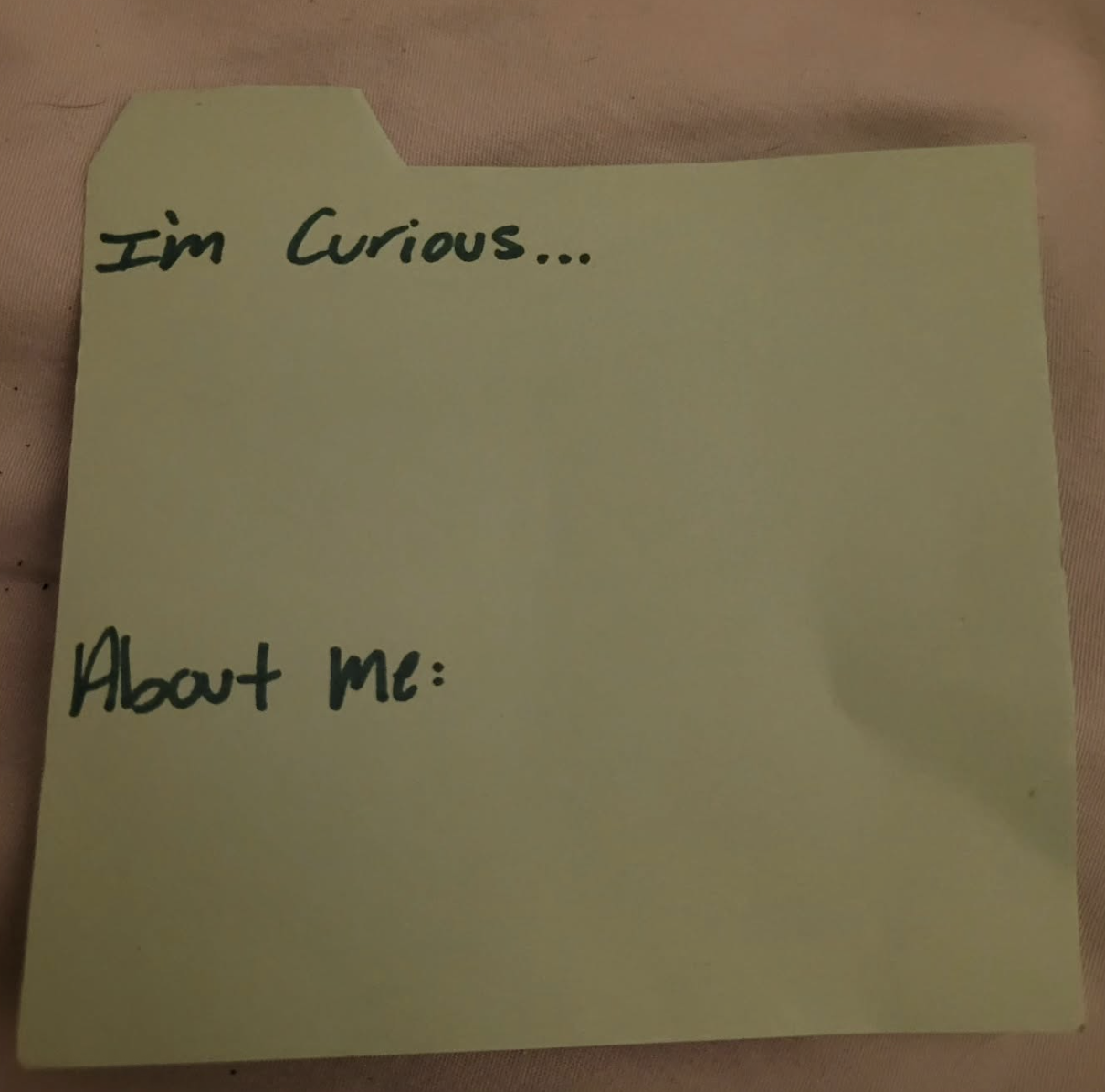
“I’m Curious” and also “About Me”. I asked students, that had been in my Diary of Anne Frank graphic novel English class and those that had not as well, to fill these out based on what they were curious about in the Holocaust and then from THEIR perspective, (for the About Me part), list why they thought the Holocaust was a relevant topic for today.
The idea from these smaller index cards was an idea I saw at the Dr. Martin Luther King Jr. Memorial Library in D.C., where when you walked in, you see these cards left behind from visitors and you can read through them, just like a former card catalog, and get a gauge of the visitor’s perspectives on various topics in the museum. Those cards and the student’s inquiries followed up with answers and links to valuable resources than enhance their questions, can be found HERE.
In a time where Upward Bound is being considered to be defunded,
I hope this glimpse into one small aspect of how experiences are brought to the forefront, helps show you how connected and vital this program is for so many people, and is connected to so many aspects of our community like the Humanities. The Upward Bound Program when implemented, enriches both adults and students alike in ways that escape words and is worthy of the existence it provides for so many.
I. Questions listed below that were given before and during Holocaust trip
- Define “genocide” in your own words.
The planned killing of a group because of their identity.
The mass destruction of ethnic groups (Answer repeated twice).
To destroy racial groups.
Mass destruction of an ethnic group.
People killing a whole group.
Genocide is when a certain group of people are mass murdered.
Genocide is the killing of a. certain race.
Genocide is when a group of people is purposely harmed, attacked, or even wiped out because of their race, religion, ethnicity, or nationality. It’s not just random violence, it’s planned and targeted, with the goal of destroying that minority group of people completely.
The mass extermination of a specific race.
A person killing a group of people.
Genocide is the systematic killing of a group of people.
Killings of people – race, religion.
Genocide (to wipe out) destroy and kill deliberately an entire group based off their religion, ethnicity, and nationality.
Killing of a large group of people.
To destroy religious groups.
- When we refer to the “holocaust”, what time period are we talking about?
1933- 1945.
Usually around 1933-1945.
Mid 1900’s.
1935-1945.
1941-1945.
When we refer to the holocaust, we are usually talking about the time period from 1941 to 1945, during WWII, when Nazi Germany under Adolf Hitler, carried out the systematic genocide of German Jews, along with millions of others- including Gypsies, disabled individuals, Poles, prisoners of war and other groups. Some historians also consider the broader period from 1933 to 1945 starting when Hitler came in power when anti Jewish Laws, discrimination, and persecution began. But most killings were from 1941 to 1945.
1945.
1941-1945.
From 1941-1943.
- What levels of German society were most drawn to Hitler and the Nazi Party?
The unemployed and middle class were most drawn to Hitler and the Nazi’s.
Mostly middle and lower class.
Lower and middle classes (Also unemployed people).
Middle Class, WW vets, unemployed, business men, and rural laborers.
Middle class, unemployed, war vets, etc..
The level most drawn to Hitler and their Nazi party, was middle Class, unemployed workers, rural populations, youth and uni students, industrialists, and Business.
People in need of financial stuff and power.
Medium class- kids, working people.
The Nazi Party gained the most support from lower/middle class, rural farms, and struggling workers who were hit hard by economic instability and feared communism. Many young people and nationalists were drawn to Hitler’s promise of restoring German pride, order, and jobs.
High society.
Poor and middle.
Kids, working people.
Poor.
Lower Class Germans.
From various parts of German society.
Medium class, kids, working people.
- What was Hitler’s term for the “master race”? Describe this type of person.
Aryan
Blonde and blue-eyed.
Aryan race- light skin, blonde, blue eyes, hard working
Superior, German, or Nordic.
An Aryan was pure blooded.
Hitler caled the so-called master race the “Arynad Race” which he believed included people of pure German or Northern Eurpean descent. He described them as tall, strong, with blonde hair and blue eyes to all races.
The term in “Aryan master race”. Blond hair, blue eyes, tall stature.
Blonde
Blond hair, non Jewish, not gypsy.
White, blonde, blue eyes.
Aryan, light skin, blonde hair, blue eyes, hard working.
Blonde hair, blue eyes.
Blonde hair and blue eyes.
Northern European.
Aryan race, light skin, blonde, blue eyes, hard working.
- What types of German citizens were victims of the Nazi Party?
Included Jews, Roma, disabled people, and others labeled “undesirable.”
Jews, Romani, Black, homosexuals, disabled, political opponents.
Jewish people, gypsies, disabled people and those deemed undesirable.
Anyone who doesn’t match the description of the “ideal German: (Roma, Jews, anyone of color).
Victims of the Nazi Party included Jewish people (Gypsies), Roma, disabled individuals, homosexuals, political opponents, and anyone who didn’t fit their idea of the “Aryan Race.” Many were prosecuted, imprisoned, or killed simply for who they were of what they believed.
People who were victims of the Nazi party were Jewish people, people with disabilities, Roma (Gypsies), Gay men, Black people and Jehovah Witnesses.
Jews were considered their #1 enemy.
People who were old and helped the Jews.
Jews, disabled.
Jews, gays, disabled.
Homosexuals, disabled, political, dissidents.
Included Jews, Roma, homosexuals, people with disabilities.
Jews, gays, disabled.
- Define anti-semitism.
Hatred or prejudice against Jews.
Discrimination and hatred against Jews.
Discrimination and hatred against Jewish people.
Bad treatment to Jews.
Anti seimitism is hostility prejudice or discrimination against Jewish people simply because they’re Jewish.
Hostility to or prejudice against Jewish people.
The hatred and racism against Jews and basically anyone who was Semitic.
Hatred/hostility towards Jews.
Hating Jews.
Bad treatment of Jews (Stated twice).
A perception of Jews.
Discrimination against Jews.
Hostility against Jews.
- When did it begin?
Ancient times.
19th century
1800’s – 1900’s
Originating in the late 19th Century
19th Century but it also began a long time before.
Antisemitism always existed, but became worse after WWI.
5th-15th Century
Antisemitism began centuries before the Holocaust, dating back to ancient times, but it became especially widespread in medieval Europe and grew most in. the 19th and 120th Century.
1930
1800-1900’s
1930
Middle Ages
During Nazi Era
1800-1900’s
Late 1930’s, early 1940’s.
- What other nations treated Jews as scapegoats (blamed them for some trouble)?
Russia, France, and other European countries blamed Jews
European counties like Russia, Poland, etc..
Russia, Poland, and most of Europe.
Europe, mostly France, Poland, Italy, Spain, Portugal, etc. (Axis Nations).
Hungary, Romania, Slovakia, Croatia, Bulgaria, Italy.
Italy and Japan.
The Roman Empire, Spain, Russia, France, England and the world.
Poland, France, Russia.
Through the Holocaust, besides Germany, some allied occupied nations segregated, scapegoated, and prosecuted Jews such as Hungary, Romania, Ukraine, where local authorities often supported or carried out anti – Jewish actions. In some off these countries, they blamed Jews for social and economic troubles and collaborated with Nazi policies.
Nazi Germany, Russia. (repeated twice).
Russia, Poland, France.
Spain, France, and Russia.
Various nations have scapegoated Jews throughout history.
- According to the Nuremberg Laws of 1935, how did the German government decide if someone was Jewish?
How many grandparents they had.
The N.L defined Jews by having Jewish grandparents.
Ancestry (repeated twice).
If they weren’t blonde with blue eyes, race not religion.
Regardless of religion, if you had Jew” blood
If they had Jewish ancestry.
According to the Nuremberg laws, the Nazi Government decided if someone was Jewish based on their country, not their religion, and personal beliefs. Ex: 2-3 Jewish grandparents, part married to someone of a Jewish community.
Exclusion from public life.
If they had at least one Jewish relative.
How many grandparents they had (repeated twice).
A person with three or more Jewish grandparents = full Jew. 2- Jewish Grand parent- first degree mischlinge- mixed blood. 1 Jewish grandparent- second degree, mischlinge.
By looking into their eyes.
Jewish ancestry.
Based on their ancestry and Jewish affiliation.
According to the Nuremburg laws, the Nazi Government decided if someone was Jewish based on their ancestry, not their religion/personal beliefs.
Ancestry
Regardless of religion, if you had “Jew” blood.
- What did the German government require of Jews in German society?
Wear the Star of David, loss of citizenship, banned from, many public places.
Banned from many public places.
Had to register, carry ID, and wear the Star of David.
Were banned from many jobs/places and losing their rights.
To wear armbands with the Star of David.
Grandparents had to register, carry ID, and wear the Yellow Star of David.
Can’t marry Non Jews.
Stripping them of citizenship.
Curfew.
Stripping citizenship, prohibition of marriage and relationships, economic restrictions.
Forced labor, identity requirements, no marriage, stripped of citizenship.
Yellow star.
Follow the rules that were set (repeated twice).
The Yellow star.
To wear ID badges.
To register, wear identifying marks, and excluded from many aspects of society.
The German government required Jews to wear identifying badges, follow strict segregation laws, and give up their rights as citizens. They were banned from many jobs, schools, and public places, and their property was often taken away.
Wear a yellow star of David, were banned from many jobs/places, and losing their rights.
Stripped of citizenship, no marriage, identity requirements, forced labor.
Kristallnacht: The Night of Broken Glass
11. What happened on November 9, 1938? What caused the violence?
On November 9, 1938, The Night of the Broken Glass happened because Polish shot a German diplomat.
On November 9, 1938, Kristallnacht / The Night of the Broken Glass / took place when Nazis attacked Jewish homes, businesses, and synagogues across Germany. The violence sparked by the assassination if a German diplomat by a Jewish teenager in Paris, France.
Nazis attacked Jewish homes, businesses and synagogues. (Kristallnacht).
Nazis attacked Jewish places (e.g. homes, businesses etc.). due to a Jewish teen shooting a German diplomat (twice).
Destroyed Jewish homes, shops, etc..
Kristallnacht – a response to assassination of German diplomat.
Jews homes and shops got destroyed.
The assassination of a German diplomat by a Jewish person.
Kristallnacht was a response to the assassination of a German diplomat.
Kristallnach occurred, the violence was incited by Nazi officials.
Kristallnacht/ Night of the Broken Glass, Antisemitism caused destruction.
The night of the Broken Glass was when a bunch of Nazis destroyed Jewish businesses and synagogues. It was a coordinated Nazi attack.
12. Many Jews escaped Germany during this time. What countries accepted the most Jewish refugees?
The United States, Switzerland, Great Britain, and Palestine were countries who accepted most Jewish refugees.
During this time, the countries that accepted the most Jewish refugees were the U.S., Britain, and Palestine (British). Some also fled to France, the Soviet Union, and Latin America- Argentina and Brazil.
Most Jewish refugees were accepted by the U.S., U.K., and Palestine.
The U.S., Britain & Palestine (thrice).
USA, France, and Palestine.
Palestine/United States.
The U.S., U.K., and France.
The U.S and Soviet Union.
Palestine, West Europe, Switzerland, Britain, Central/South America, The U.S.A.
13. Why did the US not allow entrance to more refugees before WWII?
The US did not allow entrance before WWII because of economic anxieties, antisemitism, public opinion, and isolationism.
The U.S did not allow more Jewish refugees before WW2 mainly due to strict immigration laws, widespread antisemitism, and fears of economic burden during the Great Depression. Many Americans also worried that refugees could be Nazi spies.
The U.S. limited refugees due to strict quotas and antisemitism.
They feared economic problems could arise, so they refused entry of Jews.
They feared economic problems, antisemitism, and national security threats.
Had too many people/ Great Depression.
Economic and antisemitism.
Because of the Great Depression.
Strict immigration quotas and the Great Depression.
Economic anxieties / anti-semitism.
Economic anxieties.
Economic anxieties, (the Great Depression), prejudice, security, immigration laws.
14. What was the goal of the “Final Solution?”
The “Final Solution” was to murder all of the European Jews.
The goal of the “Final Solution: was to systematically exterminate all Jews in Europe through mass murder.
The final solution aimed to kill all Jews in Europe.
Exterminate all Jews in Europe through mass murder.
To kill all the Jews in Europe through mass murder.
To kill all Jews in Europe.
To eliminate Europe’s Jewish population.
To kill every single Jew.
Exterminate the Jews population in Europe.
The final solution as the Nazi plan to eliminate Europe’s Jewish population.
Nazi plan to murder all Jewish people.
Make Jews extinct (and other minorities).
The goal was to eliminate anyone who wasn’t the “ideal” German.
15. How many ghettos existed in German occupied territories?
About 1000 ghettos.
Over 1000 ghettos established.
Over 1000 ghettos were established in German-occupied territories during the holocaust.
Over 1000 ghettos
Over 1000
1000+
Over 1k
Just about 1000.
11o0
1000
Hundred existed and varied in size.
16. Describe the largest ghetto.
Warsaw Ghetto severe overcrowding, starvation, and diseases.
The largest ghetto in was in the Warsaw Ghetto in Poland, which held over 400 k Jews packed in small, overcrowded areas. Conditions were horrific, with extreme hunger, disease, and brutal Nazi control.
Warsaw was the center of Jewish life in Poland. When German conquered it, Jews were forced to wear armbands. Life conditions went down, 575,000 Jews.
Warsaw Ghetto
Warsaw Ghetto, Poland. It held 400,000 Jews in extremely poor conditions. (twice)
Very crowded, poor.
Warsaw, Poland. Very crowded and a lot of rules. (twice).
Very poor.
Over 400,000 Jews lived.
Warsaw Ghetto. Housed 400, 000 Jews, 13 square miles.
Warsaw.
17. What were the first Nazi concentration camps?
Was established in 1933 …
The first Nazi Concentration Camp was Dachau (1933) near Munich and Buchenwald (1937).
Dachau, Buchenwold, and Sachsenhansen (Three).
Dachau, Buchenwald (thrice)
Established in 1933.
Dachau.
Dachau, Auschwitz, Buchenwald, And Manhausen.
18. What was the primary purpose of these camps?
…and its purpose was to imprison communists, political opponents, trade unionists, Jews, homosexuals.
These camps were initially used to imprison political opponents and other enemies of the state.
Imprisoned, forced labor, and killing.
Imprison political enemies, Jews, Roma, Black homosexual, and others they deemed “inferior.”
To Imprison Jews, Gypsies, political enemies, and others considered undesirable.
Punish/control Jews.
Reeducate, kill enemies. (twice).
To punish the Jews.
To detain political opponents and other dissidents.
Incarcerate and intimidate political opponents.
Imprison and intimidate.
To eliminate anyone who wasn’t German.
19. Describe what happens to most “workers”.
They did heavy physical labor, digging tunnels, carrying stone.
Most workers in forced labor camps, forced brutal conditions, including long hours, starvation, disease, and physical abuse. Many were worked to death and died from the harsh environmental mistreatment.
Most forced laborers died from harsh conditions.
Starved, beaten, and worked to death.
They were starved, beaten, and walked to death.
Treated badly, starved.
They had to do a lot of forced work and alot died from it.
To punish the Jews.
Starving.
Starvation, exhaustion, and execution.
They had to do a lot of forced work and that’s a reason many people died.
Were either worked to death or murdered.
They did work until they died.
Those subjected to labor were worked to death, dehumanized, or killed right away.
They died by gas, starvation, and exhaustion.
20. What happened at most of these camps?
In death camps there were mass murder, forced labor, dehumanization, medical experiments, disposal of bodies. The murder of millions.
Death camps used mass murders, mainly gas chambers.
Most forced labor camps subjected prisoners to brutal work, starvation, and violence causing many to die or be killed.
Mass executions, most commonly by using a gas chamber.
Mass executions, mainly gas chambers. Bodies were burned and most were forced to dig their own graves (literally).
Killed in gas chambers or sickness.
It was very unsanitary so they got sick. They got diseases and forced labor.
Jews got killed in gas chambers.
Death marches.
It was unsanitary and the reason people got sick.
Mass extermination of Jews.
They died/were gassed, or were abused and starved.
Victims were beaten, gassed burned, etc..
They focused on the extermination of Jews/anyone in the camps.
They would go into showers and poisonous gas would kill them, mostly children died.
21. Why were people forced to go on “death marches”?
To prevent allied forces from liberating prisoners. They wanted to destroy evidence of their war crimes and to prevent survivors from sharing their stories to the world.
People were forced on death marches to move prisoners away from the advancing allied forces, often under brutal conditions meant to cause death or exhaustion.
They moved prisoners to hide Nazi crimes.
Prisoners were forced to leave camp and march so that they Nazis could hide evidence and prevent their liberation, whenever the Allied forces were closing in.
To hide evidence and prevent liberation.
So they wouldn’t be freed by allies.
To prevent them from having freedom and to torture them. (twice)
So they couldn’t run away.
To prevent liberation by advancing allied forces and to eliminate evidence.
Prevent liberation by allied forces as the Nazi regime collapsed.
Forced labor, preventing testimonies, evacuation and concealment, bargaining chips, forced relocation.
To prevent getting caught by allied forces. I remember when I read Night they left the camps and ran in the snow as like a stampede because the Allies started closing in on them. – Rachel.
22. When the Soviet soldiers liberated Auschwitz Death Camp, how many shoes did they find? Why is this a significant fact?
In January 27, 1945 the Soviet Soldiers found about 43000 pairs of shoes. This was a significant fact because it shows the scale of extermination.
More than 40,000 pairs of shoes. This is a significant fact because it highlights the mass murder of innocent people.
It represented the life of the person who was killed not long after their arrival of the death camp.
When Soviet soldiers liberated Auschwitz in 1945, they found tons of thousands left behind by victims. This is significant because the huge # shows the massive scale of the loves lost and the horrible reality of the Holocaust.
44,000 pairs of shoes showing the brutality of these camps.
They found over 40,000 pairs of shoes. This shows the huge number of victims, and the scale of destruction the Holocaust caused.
Over 40,000 shoes found showing the number of victims.
Over 40, 000 pairs of shows were found; it sheds light on the amount of gruesome deaths that occurred.
40k due to killings.
About 5 tons of shoes. It is a significant fact because it shows how many people actually got killed. (twice).
40, 000
700,000 This marks human loss and serves as a reminder of the suffering victims.
Thousands (a lot). It shows how many people were tortured and killed. The laborers in these camps were dehumanized and subjected to the worst things possible and the allies were horrified when they saw it.
Importance of teaching about the Holocaust
23. If you were going to teach others about the importance of studying the Holocaust, what would you include?
I would include how we are leaving now compared to how they were leaving back then.
Teaching someone the Holocaust is complicated. There were lives taken, families were torn apart, and most of all, the loves of people were impacted. I would mostly include a video of a survivor as they experienced the suffering. I would also include images and artifacts for the people to see.
That Jews were treated as outcasts only because the wrong person has too much power
I would include the gas chambers.
If I were to teach someone about the Holocaust I would include how different it was for them to stay alive because they had hard labor and sometimes were starved. These families were torn apart. I would include some of the things that were said by the people in the camps.
Everything in the above questions.
I would tell them about how the Holocaust is one of the best examples of what happens when hatred, racism, injustice, and silence is allowed to grow. And also, how this is a great example of how too much power and trust for one person can ruin lives of people. It’s important to learn about the cruelty that those victims were going through and how the world responded to this. It shows how cruel the human mind can be. The Holocaust serves a reminder to make sure that something like that should never happen again. Its also important to see the signs of a genocide and to help fight against the signs. It also shows how a group of people, and their opinions can influence a whole population. (MAGA).
I would include how the Nazi party was successful in their indoctrination and propaganda. It’s important to be educate; learning about history is incredibly important so that we are not doomed to repeat it. Being silent and ignorant is just as bad as killing and oppressing an ethnic group; because, by acting ignorant, you’re letting the cycle of oppression continue. Basic human rights are an inherent right we should all possess – we cannot allow anyone to take them away.
Warns against hatred and prejudice
Highlights the importance of human rights
Shows the dangers of propaganda
Reminds us to think critically
Honor victims and survivors
Helps prevent future injustices
The fact that anyone who wasn’t the “The Ideal German” or “superior” would be subjected to the large-scale violence that happened during the Holocaust.
The Holocaust is something that has happened, therefore, anything that happened, can happen again.
I would make a point to prevent this from happening again. We need to learn about it so humanity doesn’t go down that path again.
If I were to teach others about the importance of studying the Holocaust, I would include how it shows the dangers of hatred, racism, and intolerance. The consequences of
_______, government power, and the need to protect human rights to prevent such atrocities from happening again.
Sop that it never happens again. (However, many Muslim and Brown people are going through it with no help. Ex: Palestine, Kashmir, Sudan, Yemen, Uyghurs, etc..)
II. Answers provided to the I’m Curious and the About Me: mini file cards given to students:
“I’m Curious” And “About me”
I’m curious about what this generation of Jews feel about the Holocaust.
Why the Germans didn’t care at all for what they were doing to the Jews. And how did they manage to overcome all the hard things they had to do.
https://www.ushmm.org/teach/fundamentals/holocaust-questions
The conditions set on Germany from the Treaty of Versailles
What were the experiences of the survivors after being freed?
https://encyclopedia.ushmm.org/content/en/article/the-aftermath-of-the-holocaust
How did they feel when they first found out that this was happening?
Why were the Jews so discriminated against?
https://www.ushmm.org/antisemitism/what-is-antisemitism/why-the-jews-history-of-antisemitism
What can the Holocaust teach someone from a minority about the dangers of silence and the importance of speaking out? Against prejudice? Against racism, etc.?
https://www.unesco.org/en/articles/importance-teaching-and-learning-about-holocaust
When someone had a family member that was Jewish, did they kill them too or what happened?
The family unit and the Holocaust
https://www.yadvashem.org/articles/general/family-gave-them-strength.html
Family and the holocaust
https://jwa.org/encyclopedia/article/family-during-holocaust
Family Support and the Holocaust
Why did they all sort of turn on each other (be mean) in such an essential time to be family?
https://www.oxfordbibliographies.com/display/document/obo-9780199840731/obo-9780199840731-0252.xml
Did Anne’s parents know she was documenting everything or was is secret? Why was her diary named Kitty? Is it true that it was named kitty?
““I knew that Anne wrote a diary,” he said in a later interview. “But I must say I was very much surprised about the deep thoughts Anne had. It was quite a different Anne than I had known as my daughter. My conclusion is… that most parents don’t know, really, their children.”
Kitty – https://www.annefrank.org/en/anne-frank/diary/so-who-is-dear-kitty/
From https://www.annefrank.org/en/anne-frank/diary/so-who-is-dear-kitty/ : See below:
“Although Kitty is best known for Anne’s diaries, Anne did not invent the character herself. Originally, Kitty was a character in the popular Joop ter Heul series, written by Cissy van Marxveldt.
These books for girls revolved around the adventures of Joop ter Heul and her friends. Kitty Francken – Anne wrote Franken (!) – was one of those friends. She was cheerful and humorous, as well as naughty and cheeky. There was this time when Cissy van Marxveldt’s Kitty smuggled a children’s piano into the classroom and played on it during class. She was expelled for a week.
Anne had started reading the Joop ter Heul books before going into hiding and finished the whole series in the Secret Annex. Some of the books were written in the form of letters, which may have inspired Anne to use the same format for her diary.”
https://exhibitions.ushmm.org/americans-and-the-holocaust/personal-story/otto-frank
What happened to the people who stayed at Anne’s home?
https://www.annefrank.org/en/anne-frank/go-in-depth/reconstruction-arrest-people-hiding/
How can Anne Frank’s feelings implemented in the book change the plot?
https://www.annefrank.ch/en/diary
https://www.annefrank.org/en/anne-frank/diary/complete-works-anne-frank/
Why was Hitler serious about taking over? Why did he hate the Jewish so bad? Why did
Hitler send soldiers to a specific spot and do it fast and not plan instead?
https://www.saturdayeveningpost.com/2021/07/how-did-hitler-succeed-and-why-wasnt-he-stopped
https://www.ushmm.org/learn/holocaust/consequences-nazi-ideology-film
Why the Nazi’s would have done that.
How did the deportations happen when the Holocaust started?
https://encyclopedia.ushmm.org/content/en/article/deportations
Why did Hitler hate the Jews so much? Does Trump sound like Hitler? Are we going
Back to the Holocaust because of the Alligator Alcatraz?
https://news.artnet.com/art-world-archives/holocaust-museum-statement-trumps-remarks-839534
https://www.jns.org/the-lefts-vile-hitler-trump-analogies-dishonor-the-shoah/
https://www.annefrank.org/en/anne-frank/go-in-depth/why-did-hitler-hate-jews/
https://aboutholocaust.org/en/facts/why-were-jews-targeted-for-persecution-and-annihilation
https://www.latimes.com/politics/la-fi-hiltzik-trump-holocaust-20190715-story.html
How many survived?
https://encyclopedia.ushmm.org/content/en/article/the-survivors
https://www.holocaustmuseumla.org/
What were the Nazi’s primary motivations?
https://www.bbc.co.uk/bitesize/guides/z3bp82p/revision/6
What was the role of concentrations camps in the Holocaust and how did they function?
https://encyclopedia.ushmm.org/content/en/article/concentration-camps-1933-39
https://guides.libraries.wright.edu/dhrc/camps
How did the Holocaust influence/impact the Jewish community to this day?
https://encyclopedia.ushmm.org/content/en/article/the-aftermath-of-the-holocaust
https://hmh.org/education/why-holocaust-still-matters-today
How many people died?
https://www.nationalww2museum.org/war/articles/holocaust
https://www.jewishgen.org/forgottencamps/general/victimsengl.html
Museum of Memory and Tolerance in Mexico City
https://artsandculture.google.com/partner/museo-de-la-memoria-y-tolerancia
———-
About me (What I feel is the value of learning about the Holocaust today).
To see how it still effects them.
To know the importance of history.
To make sure the Holocaust doesn’t happen again in the world.
Understanding the Holocaust will help us better understand the Jews.
I was raised by two hard working immigrant parents who left their homes to give me a better future. So Trump doing all this is personal to me.
I have two immigrant parents and with everything happening today- many people compare today to back then.
That you know what happened and who it happened to.
Interested in feelings and thoughts of Anne and those affected.
It is important to learn so we can learn from their mistake. And to show how bad they treated the Jews.
So events don’t repeat themselves and people are aware of why it was so impactful.
I think it is important to continue to review the Holocaust as it was a terrible event that should not be forgotten. We need to learn from the past and grow- we can’t do that if we ignore mistakes made. Also, the Holocaust continued to effect people today.
Today, the Holocaust should be a topic that can still be talked about because somethings are still happening today and feel like people should know about it.
As someone who comes from a minority group, Hispanic, immigrant parents, and Asian student, I think it matters to ask this question because prejudice/racism and hate crimes still exist in this time and we should be aware of when it comes to a certain point, where minority comments can speak up and revolt.
This is still very relevant to today because its important to learn about the past and see how far we’ve come and appreciate others more.
This event can be related with what is happening in the world right now.
I think the Holocaust should be talked about today to remember the lives lost and what they went through.
I feel sad because seeing families being separated and being killed.
I am mad that someone had to be killed for their religion.


 PAVEing a Blog